

Facom Screw Extractors

 Loading...
End of content
Error - No more pages to load
Facom Screw Extractors at Tooled-Up.com
When a fixing breaks or a screw head strips mid-job, the frustration can bring work to a grinding halt. Facom Screw Extractors are engineered specifically to solve this common workshop challenge with precision and reliability. As part of the renowned French manufacturer's hand tool portfolio, these extractors combine over a century of engineering excellence with innovative design features that make removing damaged, seized, or broken fasteners significantly easier and more reliable than improvised methods.
Tooled-Up.com stocks a comprehensive selection of Facom Screw Extractors designed to tackle everything from delicate electrical work to heavy-duty automotive and industrial applications. Manufactured from premium-grade tool steel with specialised heat treatment processes, Facom's extractors deliver exceptional grip and torsional strength whilst minimising the risk of extractor breakage—a critical consideration when dealing with already compromised fixings. The range encompasses various extraction methods including spiral flute extractors, straight flute designs, and multi-spline options, ensuring tradespeople have the right tool for every scenario.
Whether you're dealing with corroded bolts in outdoor installations, over-torqued machine screws in precision equipment, or sheared studs in engine blocks, the Facom screw extractor range available from Tooled-Up provides professional-grade solutions that justify their place in any serious toolkit. The brand's commitment to dimensional accuracy ensures these extractors work effectively across metric and imperial fastener sizes, whilst their distinctive design features reduce the likelihood of further damage to surrounding components or threaded holes.
Why Choose Facom Screw Extractors?
Facom has earned its reputation as a premium tool manufacturer through consistent innovation and uncompromising quality standards. Their screw extractors benefit from decades of research into material science, heat treatment processes, and extraction geometry. Unlike budget alternatives that can snap inside already damaged fixings—compounding the problem exponentially—Facom extractors are manufactured from specially selected tool steels that undergo rigorous quality control testing to ensure they can withstand the extreme torsional forces involved in extraction work.
The brand's reverse-spiral flute design on many models creates an aggressive bite that increases grip as rotational force is applied, effectively turning the problem of a stripped head into an advantage. Facom's attention to the critical taper angles and cutting edges means these extractors engage more quickly and hold more securely than generic alternatives. This precision engineering significantly reduces the risk of extractor slippage, which can round off what's left of a damaged fastener and make removal nearly impossible.
Professional tradespeople consistently choose Facom for applications where failure isn't an option. The brand's extractors maintain their hardness and edge retention even after repeated use in demanding conditions, representing a genuine long-term investment rather than a disposable consumable. This durability, combined with Facom's comprehensive sizing options, ensures you'll have a reliable extraction solution ready when equipment downtime or project delays would prove costly.
Who Uses Facom Screw Extractors?
- Motor mechanics and automotive technicians dealing with corroded exhaust manifold studs, sheared wheel bolts, and seized engine components
- Plant maintenance engineers working on industrial machinery where broken fixings in critical equipment require immediate, reliable removal
- Agricultural engineers frequently encountering weather-damaged and corroded fasteners on farming equipment and machinery
- Marine engineers and boat builders removing seized fixings affected by saltwater corrosion
- HGV and commercial vehicle technicians working with heavy-duty fasteners that have failed under high stress
- General engineering workshops requiring dependable extraction tools for varied applications across different materials and fastener types
- Maintenance departments in manufacturing facilities where minimising equipment downtime is critical
- Construction professionals dealing with damaged fixings in structural steelwork and plant equipment
- Tool hire businesses seeking durable extraction tools that can withstand varied use by different operators
Key Features of Facom Screw Extractors
Facom Screw Extractors incorporate several distinctive features that set them apart from standard extraction tools. The reverse-spiral flute design creates an increasingly aggressive grip as torque is applied, effectively using the rotational force to bite deeper into the damaged fastener rather than simply twisting against it. This fundamental design principle significantly improves extraction success rates, particularly with severely damaged or corroded fixings.
The brand utilises specially formulated tool steels with optimised carbon content and alloying elements, followed by precision heat treatment processes that achieve the ideal balance between hardness and toughness. This metallurgical approach ensures the extractors are hard enough to bite into damaged fasteners whilst retaining sufficient toughness to resist the brittle fracture that plagues inferior extraction tools.
Dimensional accuracy is another hallmark of Facom extractors. Precise sizing ensures optimal engagement with pilot holes, whilst carefully controlled taper angles provide progressive grip that increases extraction force without suddenly overloading the extractor. Many Facom extractors feature clearly marked sizing information, allowing quick selection of the correct tool for the fastener size being removed. The square drive ends are manufactured to exacting tolerances, ensuring secure engagement with tap wrenches, adjustable wrenches, or extractor sockets without the slippage that can occur with poorly finished alternatives.
Surface treatments on selected Facom extractors provide corrosion resistance and reduce friction during the extraction process, whilst the brand's attention to edge geometry ensures the cutting flutes engage quickly and maintain their bite even when working with hardened fasteners. This combination of features makes Facom extractors particularly effective in the challenging conditions faced by professional tradespeople working with aged, corroded, or over-torqued fixings.
Popular Facom Screw Extractors
The Facom range at Tooled-Up includes various extractor configurations to address different removal challenges. Spiral flute extractors remain the most versatile option, suitable for removing broken bolts, studs, and screws across a wide size range. These tools work by drilling a pilot hole into the damaged fastener before inserting the tapered extractor, which bites into the softer inner material and allows reverse rotation to remove the broken fixing.
Straight flute extractors offer advantages in specific applications, particularly where access is restricted or where the broken fastener sits flush with or below the surface. Multi-spline extractors provide an alternative approach, using a socket-like interface with multiple gripping surfaces that can sometimes achieve purchase on rounded or damaged hex heads without requiring drilling.
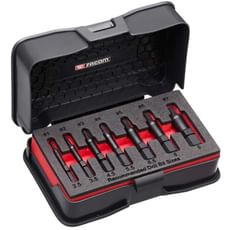
Facom also produces extractor sets that combine various sizes in organised cases, providing comprehensive coverage for different fastener dimensions. These sets typically include the most commonly required sizes for automotive, industrial, or general engineering applications, ensuring technicians have appropriate extraction tools readily available when problems arise. Individual extractors are also available, allowing professionals to replace worn sizes or expand their extraction capabilities for specialist applications.
Safety and Compliance
Using screw extractors involves inherent risks that require appropriate safety precautions. Eye protection is essential when drilling pilot holes or applying extraction force, as metal chips and fragments can be ejected at high velocity. The HSE recommends suitable impact-resistant eye protection that meets BS EN 166 standards for any work involving metal cutting or fastener removal operations.
Proper tool selection is critical for safe extraction work. Using an undersized extractor risks tool breakage, whilst oversized extractors may not achieve adequate grip or could damage the threaded hole. Always match the extractor size to the manufacturer's recommendations for the fastener being removed. When drilling pilot holes, ensure the drill bit is sharp, correctly sized, and suitable for the material being penetrated. Dull bits require excessive force and generate heat that can work-harden the material, making extraction more difficult.
Apply cutting fluid or penetrating oil when working with corroded or seized fasteners to reduce friction and heat generation. Avoid excessive force—if an extractor isn't achieving progress, reassess the approach rather than risking tool breakage. If an extractor does break inside a fastener, removal becomes exponentially more difficult due to the hardness of the tool steel. Work methodically and patiently, allowing penetrating fluids time to work and using appropriate extraction force rather than attempting to rush the process.
Ensure workpieces are securely clamped or supported before applying extraction force. The sudden release when a stubborn fastener finally moves can cause injury if the workpiece shifts unexpectedly. When using power tools to drive extractors, use appropriate speed settings—excessive RPM generates heat without improving extraction success and increases the risk of tool breakage.
Frequently Asked Questions
What size pilot hole should I drill for Facom screw extractors?
Pilot hole size is critical for extraction success and varies depending on the extractor size and fastener diameter. Facom provides specific drilling recommendations for each extractor size, typically requiring a pilot hole slightly smaller than the minor diameter of the damaged thread. Drilling too large a hole leaves insufficient material for the extractor to grip, whilst too small a hole prevents proper insertion. Always consult the sizing chart provided with Facom extractor sets or refer to the manufacturer's specifications. As a general principle, the pilot hole should be approximately 75-80% of the fastener's core diameter, but precise recommendations ensure optimal results.
Why do screw extractors sometimes break, and how can I prevent this with Facom tools?
Extractor breakage typically results from excessive torque, improper sizing, or attempting to extract work-hardened fasteners without adequate preparation. Facom extractors are manufactured from premium tool steel with optimised hardness to resist breakage, but no extractor is indestructible. Prevent breakage by ensuring correct size selection, drilling accurate pilot holes to the recommended depth, using penetrating fluid on corroded fasteners, and applying steady, controlled force rather than sudden impacts. If resistance is excessive, apply more penetrating fluid, use heat if appropriate for the application, or drill the pilot hole slightly deeper before continuing. Facom's superior material quality and heat treatment provide better breakage resistance than budget alternatives, but proper technique remains essential.
Can Facom screw extractors remove both metric and imperial fasteners?
Yes, Facom screw extractors work with both metric and imperial fasteners. The extraction principle relies on gripping the inner material of a broken or damaged fastener rather than engaging with external hex flats or threads, so the fastener's measurement system is largely irrelevant. What matters is selecting an extractor size appropriate for the fastener's diameter. Facom extractor sets typically include a size range that covers commonly encountered fastener diameters in both measurement systems. The key is matching the extractor to the drilled pilot hole size and the remaining fastener diameter, regardless of whether the original fixing was metric or imperial specification.
How do I remove a Facom extractor if it becomes stuck in a fastener?
If an extractor becomes stuck without breaking, it's usually because insufficient penetrating fluid was used or the fastener is severely corroded. Apply more penetrating oil around the extractor and allow extended soaking time—hours or even overnight for severely seized fixings. Gentle tapping with a small hammer can help the fluid penetrate whilst providing vibration that may break corrosion bonds. Apply heat if the surrounding material and application permit, as thermal expansion can break corrosion locks. Alternate between clockwise and anticlockwise rotation in small increments to work the extractor free. If the extractor has broken, removal becomes significantly more challenging and may require electrical discharge machining (EDM) or drilling out with carbide bits—situations best avoided through proper technique and the use of quality extractors like those manufactured by Facom.
Are Facom screw extractors suitable for removing security screws and tamper-proof fasteners?
Facom screw extractors can sometimes remove security screws, but this depends on the security fastener type and whether you're authorised to remove it. Extractors work by gripping the inner material of a fastener, so they can potentially remove security screws with unusual drive types (star with centre pin, tri-wing, clutch head, etc.) if you drill a pilot hole and use the appropriate extractor size. However, this destroys the screw head and the security feature. For hardened security bolts with breakaway heads, extraction becomes more challenging as the hardened material resists both drilling and extractor bite. Always ensure you have legal authority to remove security fasteners, as they're often fitted to prevent unauthorised access to equipment, utilities, or safety-critical systems.