

Priory Number Punches
 Loading...
End of content
Error - No more pages to load
Priory Number Punches at Tooled-Up.com
Priory has established itself as a trusted name in hand striking tools, and their number punches exemplify the precision engineering and robust construction that tradespeople have relied upon for generations. Manufacturing high-quality marking and stamping tools in the UK, Priory brings decades of expertise to every number punch set they produce. Whether you're marking steel components in a fabrication workshop, identifying parts in automotive repair, or stamping serial numbers for quality control, Priory number punches deliver consistent, legible impressions time after time.
The Priory number punch range at Tooled-Up features hardened and tempered steel construction designed to withstand repeated striking without mushrooming or deforming. Each punch is precision-machined to ensure clean, uniform character impressions across various metal surfaces including mild steel, aluminium, brass, and copper. Available in multiple sizes to suit different applications, these punches are essential tools for engineers, fabricators, and maintenance professionals who require permanent, professional marking solutions.
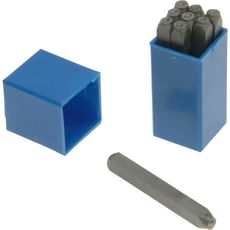
Tooled-Up stocks Priory number punches in various configurations, from individual pieces to complete sets housed in durable storage cases. The range typically includes punches from 3mm to 12mm character heights, allowing tradespeople to select the appropriate size for their specific marking requirements. Each punch features a knurled grip section for secure handling and accurate positioning, whilst the striking end is designed to provide a comfortable surface for hammer blows.
Why Choose Priory Number Punches?
Priory's reputation for producing dependable hand tools is built on consistent quality and attention to detail. Their number punches are manufactured from specially selected high-carbon steel that's been heat-treated to achieve optimal hardness levels – hard enough to mark tough metals effectively, yet tough enough to resist brittleness and breakage under repeated use. This careful metallurgical balance ensures extended tool life even in demanding workshop environments.
The precision grinding process used on Priory number punches creates characters with sharp, well-defined edges that produce clear impressions requiring minimal striking force. This precision reduces the risk of double-striking or unclear marks that can occur with inferior punches. The uniformity across each set means that multi-digit numbers maintain consistent appearance and readability – crucial for serial numbers, part identification, and quality control applications.
British manufacturing heritage gives Priory number punches an edge in quality assurance. Each punch undergoes rigorous inspection to ensure character accuracy, proper hardness, and surface finish consistency. This attention to quality control means tradespeople can rely on Priory tools to perform consistently across entire sets, avoiding the frustration of mismatched or poorly-formed characters.
Who Uses Priory Number Punches?
- General Engineers – marking components, assemblies, and tooling with identification numbers
- Fabricators and Welders – stamping job numbers and part identifiers on steelwork
- Automotive Mechanics – marking engine components and chassis numbers during restoration work
- Maintenance Fitters – identifying equipment, machinery parts, and asset tagging
- Sheet Metal Workers – stamping batch numbers and specifications on formed parts
- Tool and Die Makers – marking precision tooling and jigs with reference numbers
- Quality Control Inspectors – stamping inspection marks and traceability codes
- Aerospace and Defence Contractors – applying permanent identification to critical components
- Marine Engineers – marking fittings and components in shipbuilding and repair
- Agricultural Engineers – identifying farm machinery parts and implements
Key Features of Priory Number Punches
Priory number punches incorporate several design features that distinguish them from budget alternatives. The hardened steel construction typically achieves a Rockwell hardness of 58-62 HRC, providing the perfect balance between marking capability and durability. This hardness specification ensures the punch face retains its sharp definition through thousands of impressions without wearing or deforming.
The character design itself reflects careful attention to legibility. Each number features appropriate depth and relief angles that create clean impressions without requiring excessive striking force. The characters are precisely centred on the punch face, ensuring accurate alignment when marking and reducing the likelihood of off-centre or tilted impressions that compromise readability.
The shank design incorporates a knurled section that provides secure grip and precise control during positioning. This texturing prevents the punch from rotating in the hand during striking, which is essential for maintaining character orientation. The striking head features a properly chamfered edge that resists mushrooming – a common failure mode in poorly manufactured punches that creates safety hazards and reduces tool life.
Many Priory number punch sets include letter punches as well, providing complete alphanumeric marking capability. The sets typically come in protective cases with individual compartments that keep each punch organised and readily accessible, whilst protecting the precision-ground faces from damage during storage and transport.
Popular Priory Number Punches
The most commonly specified Priory number punches are the 4mm and 6mm character height sets, which provide versatile marking capability suitable for general engineering and fabrication work. These sizes produce impressions that are clearly readable without requiring excessive depth of mark, making them ideal for components where material removal must be minimised.
For heavier fabrication and structural steelwork, the 8mm and 10mm character sets are popular choices. These larger punches create bold, highly visible marks that remain legible even on rough or scaled surfaces. They're particularly valued in site work environments where marked components may be exposed to weather, paint, or galvanising processes that could obscure smaller stampings.
Complete sets spanning multiple sizes – typically 3mm, 4mm, 6mm, 8mm, and 10mm – are favoured by workshops and maintenance departments that handle diverse marking requirements. These comprehensive sets ensure the appropriate punch size is always available, eliminating the need to compromise with unsuitable character heights.
Safety and Compliance
When using Priory number punches, appropriate personal protective equipment should always be worn. Safety glasses or face shields are essential to protect against metal fragments that may dislodge during striking. Gloves should be considered carefully – whilst they provide hand protection, they can reduce tactile feedback and grip security, so many experienced tradespeople prefer bare hands for better control.
The punches should be struck with an appropriate ball-pein hammer or soft-face mallet. Using the correct striking tool prevents damage to both the punch and the workpiece. The workpiece must be properly supported on a solid, flat surface – preferably a steel anvil or substantial backing plate – to ensure clean impressions and prevent workpiece distortion.
Regular inspection of punch faces and striking heads is important for maintaining both safety and performance. Any signs of mushrooming on the striking end should be addressed by carefully grinding the head flat and re-chamfering the edge. Worn or damaged character faces should be retired from service as they produce unclear marks and may require excessive striking force.
Priory number punches should be stored in their protective cases when not in use, keeping them clean and dry to prevent corrosion. A light coating of oil on the punch faces helps maintain sharpness and prevents rust formation, particularly in damp workshop environments.
Frequently Asked Questions
What materials can I mark with Priory number punches?
Priory number punches are designed to mark mild steel, stainless steel, aluminium, brass, copper, and most other metals commonly encountered in engineering and fabrication work. They're not suitable for hardened tool steels or case-hardened surfaces, which may damage the punch face. For softer materials like aluminium, lighter striking force is required to avoid excessively deep impressions.
How do I achieve clean, legible impressions with number punches?
Proper technique is essential for quality results. Ensure the workpiece is firmly supported on a solid surface, position the punch perpendicular to the work surface, and strike with a single firm blow from an appropriate hammer. Multiple light taps often produce unclear or doubled impressions. Practice on scrap material first to gauge the correct striking force for your specific application.
What's the difference between different character height sizes?
Character height determines the size and visibility of the impression. Smaller sizes (3-4mm) are used where space is limited or minimal material removal is important. Medium sizes (6mm) offer versatile general-purpose marking. Larger sizes (8-12mm) create bold, highly visible marks ideal for identification that must remain legible under harsh conditions or from a distance.
Can Priory number punches be resharpened or reconditioned?
The striking head can be maintained by grinding away any mushrooming and re-chamfering the edge, which is normal maintenance for hand striking tools. However, the character face should not be resharpened, as this would alter the character depth and definition. If the punch face becomes worn or damaged, the punch should be replaced to ensure continued marking quality.
Are Priory number punch sets available with both numbers and letters?
Yes, many Priory punch sets include complete alphanumeric capability with both 0-9 numbers and A-Z letters. This provides comprehensive marking capability for part numbers, serial codes, and identification marks that require both letters and numerals. Individual number-only sets are also available for applications requiring only numeric marking.