

Trend Pronged Tee Nuts
 Loading...
End of content
Error - No more pages to load
Trend Pronged Tee Nuts at Tooled-Up.com
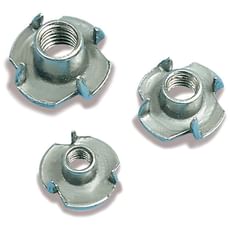
Trend has established itself as a trusted name in woodworking fasteners and fixing solutions, and their pronged tee nuts exemplify the brand's commitment to quality and innovation. These essential hardware components provide robust threaded inserts for wood, board materials, and composite surfaces, making them indispensable for furniture makers, joiners, and workshop professionals who demand reliable, long-lasting fixings.
Pronged tee nuts from Trend feature precision-engineered prongs that bite securely into timber and board materials, creating a permanent threaded anchor point that won't pull out under stress. The Tooled-Up range of Trend pronged tee nuts caters to various applications, from furniture assembly and jig building to workshop fixture construction and specialist joinery projects. Manufactured to exacting standards, these tee nuts deliver consistent performance across demanding professional environments.
Whether you're constructing bespoke furniture, building workshop jigs, or creating knock-down fittings for commercial installations, Trend pronged tee nuts provide the mechanical strength and thread integrity that professional tradespeople rely upon. Available in multiple thread sizes and prong configurations, these fasteners accommodate diverse material thicknesses and load requirements.
Why Choose Trend Pronged Tee Nuts?
Trend's reputation in the woodworking industry is built on decades of innovation and quality manufacturing. Their pronged tee nuts benefit from the same rigorous quality control processes that have made Trend routing cutters and accessories industry standards. Each tee nut features hardened steel construction with precision-rolled threads that resist stripping and cross-threading, ensuring dependable performance throughout the life of your assembly.
The prong design is particularly critical to performance, and Trend engineers these components with sharp, evenly-spaced prongs that distribute load effectively whilst preventing rotation under torque. The zinc-plated finish provides corrosion resistance for workshop environments, whilst the barrel design ensures flush seating in pre-drilled holes. Professional joiners and furniture makers choose Trend pronged tee nuts because they understand that hidden fasteners must perform flawlessly – there's no room for failure in structural fixings.
Trend's commitment to consistency means that every tee nut meets precise dimensional tolerances, allowing for efficient installation and reliable thread engagement. This attention to detail translates to faster assembly times, reduced fitting failures, and professional results that stand the test of time.
Who Uses Trend Pronged Tee Nuts?
- Furniture Makers – Creating knock-down furniture with secure, repeatable assembly points
- Joiners and Carpenters – Installing adjustable legs, levelling feet, and mounting hardware
- Cabinet Makers – Fitting hinges, handles, and adjustable shelf systems
- Workshop Engineers – Building jigs, fixtures, and custom tooling with adjustable components
- Theatrical Set Builders – Assembling modular staging and scenery with reliable fixings
- Exhibition Stand Fitters – Creating reusable display systems with concealed fasteners
- Shopfitters – Installing retail fixtures and fittings requiring adjustability
- Educational Workshops – Equipping woodwork classrooms with professional-grade fixings
Key Features of Trend Pronged Tee Nuts
Trend pronged tee nuts incorporate several design features that distinguish them from budget alternatives. The precisely formed prongs feature sharpened tips that penetrate wood fibres cleanly without requiring excessive installation force, whilst their angular design prevents backing out under vibration or repeated assembly cycles. The barrel diameter is carefully calculated to provide maximum material contact whilst accommodating standard drill bit sizes for consistent installation depths.
Thread quality represents another area where Trend excels – rolled rather than cut threads create stronger, more durable internal threads that resist wear from repeated bolt insertion and removal. The thread profile follows ISO standards, ensuring compatibility with standard metric bolts and machine screws. Zinc plating provides environmental protection whilst maintaining thread clarity and ease of engagement.
The flat bearing surface of Trend tee nuts sits flush with material surfaces, preventing proud edges that could interfere with adjacent components or finishing operations. This attention to dimensional accuracy ensures that fixings remain concealed whilst providing the mechanical advantage of through-thickness anchoring.
Popular Trend Pronged Tee Nuts
Trend offers pronged tee nuts in the most commonly specified metric thread sizes, with M6 and M8 variants proving particularly popular for furniture and joinery applications. The M6 format suits lighter-duty applications such as adjustable feet, handle fixings, and decorative hardware, whilst M8 tee nuts handle more demanding structural connections including leg mounting brackets and heavy-duty adjustment mechanisms.
Four-prong configurations deliver balanced load distribution and excellent resistance to rotation, making them the preferred choice for applications where bolts will be repeatedly tightened and loosened. The compact footprint of Trend's tee nut design allows installation in relatively thin materials – typically from 12mm upwards – without compromising holding strength or thread engagement depth.
Safety and Compliance
When installing Trend pronged tee nuts, always pre-drill holes to the manufacturer's specified diameter to ensure proper prong engagement without splitting the material. Use a hammer or soft-faced mallet to drive the tee nut flush with the surface, checking that all prongs have fully penetrated the material and that the barrel sits level. Never over-torque bolts, as this can pull the tee nut through thin materials or strip the internal threads.
For structural applications, consider material thickness and load requirements carefully – pronged tee nuts work best in solid timber, plywood, and MDF of adequate thickness. In critical load-bearing applications, consult HSE guidelines regarding mechanical fixings and ensure appropriate safety factors. Always wear safety glasses when hammering tee nuts to protect against metal fragments or splinters.
Frequently Asked Questions
What material thickness do I need for Trend pronged tee nuts?
Minimum material thickness varies by tee nut size, but generally 12mm represents the practical minimum for M6 variants, with 15-18mm preferred for M8 sizes. Thicker materials provide better prong engagement and improved pull-out resistance, particularly important for load-bearing applications.
Can Trend pronged tee nuts be removed and reinstalled?
Pronged tee nuts are designed as permanent fixings – the prongs create a one-way anchor that resists removal. Attempting to extract an installed tee nut typically damages the surrounding material. For temporary or repositionable applications, consider alternative fixing methods.
Do Trend tee nuts work in MDF and chipboard?
Yes, Trend pronged tee nuts perform well in MDF, chipboard, and plywood, though holding strength varies with material density. High-density MDF provides excellent performance, whilst lower-grade chipboard may require thicker sections or additional reinforcement for demanding applications.
What's the correct installation method for pronged tee nuts?
Drill a hole matching the barrel diameter (typically 10mm for M6, 12mm for M8), position the tee nut with prongs facing into the material, and drive flush using a hammer. Strike squarely to ensure even prong penetration. The flat surface should sit flush or slightly below the material surface.
Are Trend pronged tee nuts suitable for outdoor furniture?
The zinc-plated finish provides moderate corrosion resistance suitable for indoor use and occasional outdoor exposure. For permanent outdoor installations, consider stainless steel alternatives or apply additional protective treatments to prevent rust, particularly in coastal or high-humidity environments.