

Dial Indicators
Pay in 3 interest-free payments on purchases from £30-2000 with  . Learn more.
 Loading...
End of content
Error - No more pages to load
About Dial Indicators
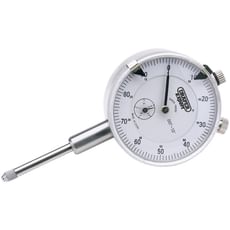
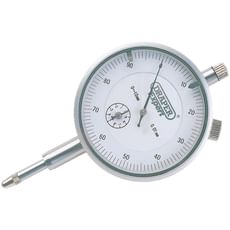
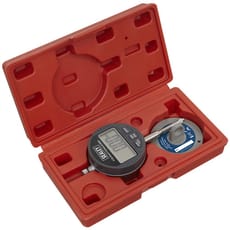
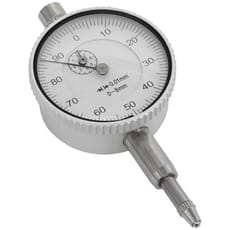
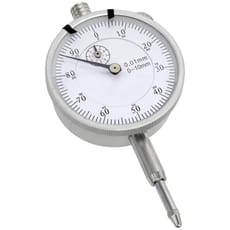
Dial indicators are precision measuring instruments fundamental to engineering, machining, and quality control applications where dimensional accuracy is paramount. These mechanical or digital gauges detect and measure minute linear variations with exceptional precision, typically displaying measurements in increments of 0.01mm or 0.001" for high-precision models. Operating through a spring-loaded contact point connected to a rack-and-pinion or electronic mechanism, dial indicators convert small linear displacements into readable measurements on either a traditional calibrated dial face or a digital display, enabling tradespeople to verify tolerances, detect surface irregularities, measure runout, and check concentricity on manufactured components.
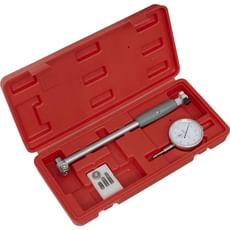
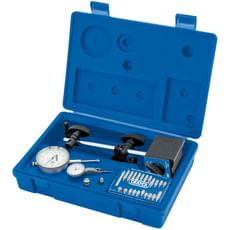
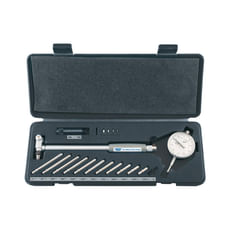
The selection at Tooled-Up.com encompasses metric and imperial dial indicators, dial test indicator (DTI) kits with interchangeable measuring points, bore gauge sets for internal diameter measurement, and complete packages featuring magnetic bases and adjustable arms for versatile positioning. Whether you're inspecting component tolerances on a lathe, measuring bearing clearances in automotive work, setting up CNC machinery, performing quality assurance checks on manufactured parts, or verifying shaft alignment during maintenance operations, these instruments deliver the repeatable accuracy essential for professional engineering and precision manufacturing.
Available from established brands including Draper Expert, Sealey, and Facom, these dial indicators meet the exacting standards required by British manufacturing and precision engineering sectors. Modern digital dial gauges offer additional functionality such as switchable metric/imperial displays, data output connections for statistical process control, zeroing functions at any position, and enhanced readability in poorly-lit workshop environments. Traditional analogue dial indicators remain widely favoured for their mechanical reliability, independence from batteries, instantaneous response, and the tactile feedback that experienced machinists prefer when making critical adjustments.
Jargon Buster
- Resolution: The smallest measurement increment the indicator can display, typically 0.01mm (10 microns) for standard engineering dial indicators or 0.001mm (1 micron) for metrology-grade precision models. This specification determines how finely you can detect and measure dimensional variations in components.
- Plunger Travel: The total linear distance the contact point can move inward and outward from its rest position, commonly ranging from 10mm to 50mm depending on the model design. Greater travel range provides measurement versatility without repositioning, whilst shorter travel offers improved rigidity and accuracy for small tolerance checks.
- Contact Point (Anvil): The replaceable probe tip that physically touches the workpiece being measured. Available in various configurations including spherical (for general purpose), flat (for surface measurement), pointed (for accessing confined spaces), and extended reach designs for specific measuring applications and workpiece geometries.
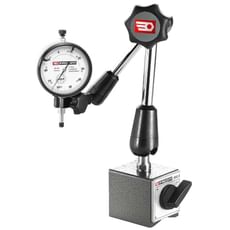
- Magnetic Base: An adjustable mounting system featuring a powerful switchable electromagnet or permanent magnet that securely attaches the dial indicator to ferrous surfaces such as machine beds, surface plates, or steel workpieces, enabling hands-free measurement with infinite positioning possibilities through articulating arms.
- Bore Gauge: A specialised dial indicator configuration designed specifically for accurately measuring internal diameters of holes, cylinders, and bores. Features interchangeable measuring heads or extension rods to accommodate different size ranges, with centering mechanisms to ensure accurate diameter readings.
- Runout (Total Indicator Reading): The measurement of how much a rotating surface deviates from being perfectly circular or concentric as it revolves. Dial indicators excel at detecting runout on shafts, spindles, chucks, and rotating components, critical for machine tool setup and quality control.
Who Uses Dial Indicators?
Dial indicators serve as essential precision measuring tools across numerous trades and technical applications:
- Machinists and CNC Operators: Setting up workpieces accurately, checking machined component tolerances, verifying machine accuracy, and aligning fixtures on lathes, milling machines, and CNC machining centres
- Mechanical Engineers: Dimensional verification, quality control inspections, prototype testing, and tolerance validation in manufacturing and production environments
- Automotive Technicians: Measuring crankshaft runout, checking brake disc flatness and thickness variation, verifying engine component tolerances, clutch plate inspection, and diagnostic measurement work
- Toolmakers and Die Makers: Precision tool setup, mould alignment verification, punch and die clearance checking, and quality inspection of manufactured tooling and press tools
- Metrology and Inspection Technicians: Professional measurement and dimensional verification in quality assurance laboratories, receiving inspection departments, and calibration facilities
- Maintenance Engineers: Checking bearing clearances, verifying shaft alignment, measuring machine wear, and performing calibration checks during preventative maintenance programmes
- Fabricators and Welders: Verifying flatness and dimensional accuracy of fabricated assemblies, checking alignment before welding, and measuring distortion after heat processes
- Model Engineers and Precision Hobbyists: Home workshop machining projects, model engineering requiring accurate measurements, restoration of vintage machinery, and precision DIY applications
How to Choose the Right Dial Indicators
Analogue versus Digital Technology: Traditional mechanical dial indicators offer robust simplicity with no battery dependency, excellent tactile feedback for experienced users, and proven reliability in dusty workshop environments. Digital models from brands like Sealey provide easier reading with larger displays, switchable metric/imperial units without conversion calculations, zeroing at any position, data output capabilities for quality records, and superior visibility in poor lighting conditions typical of production environments.
Resolution and Accuracy Requirements: Standard dial indicators offering 0.01mm resolution suit most general machining, automotive, and engineering applications where tolerances typically range from ±0.05mm to ±0.1mm. High-precision models with 0.001mm resolution become necessary for metrology work, gauge inspection, and applications involving extremely tight tolerances below ±0.02mm. Consider what accuracy your work genuinely demands—higher precision instruments cost considerably more and may prove unnecessarily sensitive for routine workshop tasks.
Measurement Range (Plunger Travel): Select travel distance based on typical application requirements. Shorter travel ranges (10mm) provide superior rigidity, less deflection, and greater accuracy when measuring small variations and tight tolerances. Longer travel indicators (25-50mm) offer versatility for checking larger dimensional variations without repositioning the gauge, useful for surface flatness checks and general inspection work.
Mounting Configuration: Complete kits including magnetic bases with adjustable articulating arms provide maximum positioning versatility and represent excellent value for workshops establishing measurement capabilities. Stand-alone indicators suit users with existing mounting equipment or those requiring compact storage for mobile work. Bore gauge sets available from Tooled-Up include specialised mounting arrangements and interchangeable heads specifically for internal measurement applications.
Metric versus Imperial Scales: UK engineering predominantly operates in metric dimensions, making metric dial indicators the primary choice for most applications. However, certain industries (particularly automotive restoration and aerospace maintenance) and older British machinery require imperial measurements. Digital models with switchable display units eliminate manual conversion calculations and associated errors, whilst analogue users should match the scale to their predominant work requirements to avoid constant conversion.
Brand Quality and Calibration: Draper Expert and Facom represent professional-grade accuracy and build quality suitable for critical engineering applications and production environments. Sealey instruments offer excellent value and reliability for general workshop, automotive, and fabrication use. For metrology, inspection work, and applications requiring certified accuracy with traceability to national standards, consider instruments supplied with calibration certificates conforming to UKAS or equivalent accreditation.
Popular Accessories
- Magnetic Bases with Adjustable Arms: Essential for hands-free operation, these versatile mounting systems feature powerful switchable magnets that secure to machine tables, surface plates, or any ferrous surface. Multi-jointed articulating arms with fine adjustment knobs enable precise positioning at virtually any angle or orientation.
- Interchangeable Contact Points: Expand measurement versatility with different anvil configurations including spherical tips for general purpose work, flat contacts for surface measurement, pointed probes for confined access, extended reach designs, and specialist profiles for particular workpiece geometries.
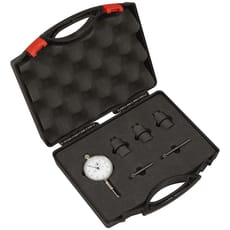
- Protective Storage Cases: Prevent damage to precision instruments during transport and storage with purpose-designed carrying cases featuring foam inserts that securely hold complete kits with dedicated compartments for each component and accessory.
- Extension Rods and Spacers: Increase measuring reach for deep bores and difficult-to-access locations. Bore gauge kits typically include multiple extension rods and spacing rings to accommodate various diameter ranges without requiring separate instruments.
- Mounting Brackets and Clamps: Precision dovetail brackets, threaded posts, and universal clamps for installing indicators on machine tool carriages, inspection fixtures, and custom measurement setups where magnetic mounting proves unsuitable.
- Calibration Standards and Setting Masters: Gauge blocks, setting rings, and precision references for verifying indicator accuracy, maintaining measurement traceability, and performing regular accuracy checks to quality management system requirements.
Safety Information
Whilst dial indicators themselves present minimal direct safety hazards, observe these important precautions during measurement operations:
- Always ensure machinery is properly stopped and workpieces are securely held before taking measurements to prevent unexpected movement that could damage the precision instrument or cause personal injury
- Exercise caution when positioning magnetic bases near rotating machinery—ensure the base cannot be dislodged by swarf, coolant spray, vibration, or accidental contact, which could cause the indicator to strike moving parts
- Wear appropriate PPE including safety glasses when working around machining operations, even during measurement tasks, as you remain exposed to flying debris and coolant
- Ensure indicators are properly mounted with stable support before applying contact pressure to workpieces, avoiding sudden slipping that could damage the sensitive mechanism or cause the gauge to drop
- Never force the plunger beyond its specified travel limits as this can permanently damage the internal rack-and-pinion mechanism, bend the contact stem, or compromise calibration accuracy
- Store precision instruments away from extreme temperatures, excessive moisture, strong magnetic fields, and vibration that could affect calibration and mechanical accuracy
- Follow HSE manual handling guidelines when positioning heavy magnetic bases and mounting equipment, particularly when working in confined spaces or awkward positions around machinery
- Keep measuring instruments away from grinding operations where abrasive dust can contaminate and damage sensitive mechanisms
Frequently Asked Questions
What's the difference between a dial indicator and a dial test indicator?
A standard dial indicator (sometimes called a plunger gauge) measures linear movement along a single axis with the contact point moving perpendicular to the dial face, ideal for measuring heights, depths, and perpendicular surfaces. A dial test indicator (DTI) features a lever arm with the contact point positioned at right angles to the dial, making it superior for measuring surface runout, positioning work on machine tools, and detecting variations parallel to the mounting surface. Both serve different but complementary measurement purposes in most engineering workshops.
How often should dial indicators be calibrated?
For professional metrology, quality control, and production environments requiring measurement traceability to ISO 9001 or aerospace standards, annual calibration against certified reference standards is typically mandatory. In general workshop use without formal quality system requirements, verify accuracy periodically using gauge blocks or precision references, particularly after suspected damage, heavy use, or if measurements seem inconsistent. Maintain calibration records including dates, results, and any adjustments made, especially if supplying components to customers with quality assurance requirements.
Can I use metric dial indicators for imperial measurements or vice versa?
Whilst mathematically possible using conversion factors (25.4mm per inch), this approach introduces calculation errors, slows workflow, and defeats the precision purpose of dial indicators where you're often working to tolerances smaller than rounding errors. For regular work in both measurement systems, invest in dedicated imperial and metric gauges, or choose a digital model with switchable metric/imperial displays that provides instant unit conversion without accuracy loss or calculation mistakes.
Why does my dial indicator reading drift or change when I remove contact pressure?
This typically indicates insufficient preload (the indicator should be set with the plunger compressed approximately 1-2mm from its rest position to maintain spring tension), movement in the magnetic base or mounting arrangement, flex in the measuring setup, or the workpiece shifting in its fixture. Ensure rigid mounting with the magnetic base firmly engaged, apply proper preload, verify workpieces are securely clamped, and check that machine slideways are locked. Thermal expansion from handling or machinery warmth can also cause readings to drift on precision measurements—allow components to stabilize to ambient temperature.
What maintenance do dial indicators require for accurate long-term performance?
Keep the plunger stem and contact point clean and lightly lubricated with precision instrument oil—avoid heavy greases that attract dust and swarf. Prevent coolant, cutting fluid, and abrasive dust from entering the mechanism by storing gauges away from active machining when not in use. Never disassemble the internal mechanism as this requires specialist tools, knowledge, and will void any calibration. If dropped, impacted, or showing erratic readings, have the instrument professionally inspected and recalibrated before relying on measurements for critical work. Store in protective cases within stable temperature environments away from strong magnetic fields that could affect mechanical components.