

Die Stocks
Pay in 3 interest-free payments on purchases from £30-2000 with  . Learn more.

 Loading...
End of content
Error - No more pages to load
About Die Stocks
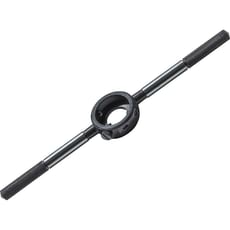
Die stocks, also known as die holders or diestocks, are precision hand tools designed to hold circular threading dies securely whilst cutting external threads onto rods, bolts, pipes, and other cylindrical metal workpieces. These essential threading tools feature a frame with handles that allow you to apply controlled rotational force, guiding the cutting die to create accurate, consistent threads. Whether you're a plumber threading steel pipes for gas installations, a machinist creating custom fasteners, or a maintenance engineer repairing damaged threads on machinery, a quality die stock provides the stability and control needed for professional threading work.
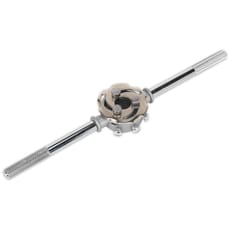
Modern die stocks are available in several configurations to suit different threading applications and working environments. Standard fixed-size die holders offer robust construction for dedicated applications, whilst adjustable models accommodate multiple die sizes for greater versatility. Ratchet die holders have become increasingly popular amongst tradespeople working in confined spaces, as they allow threads to be cut using partial back-and-forth movements rather than requiring full rotations. Professional-grade models typically incorporate three-screw alignment mechanisms that ensure the die remains perfectly perpendicular to the workpiece, preventing cross-threading and costly damage to components.
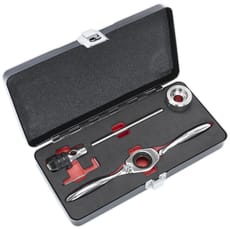
The selection available from Tooled-Up.com includes die stocks from trusted brands such as Sealey, Draper, and Faithfull. These range from straightforward single-die holders suitable for occasional workshop use through to comprehensive tap and die holder sets with ratchet mechanisms, ideal for engineers and plumbers who undertake regular threading work as part of their daily operations. Quality construction with hardened steel components and precisely machined guide plates ensures reliable performance and accurate thread cutting across demanding professional applications.
Jargon Buster
- Die Stock: The hand tool frame that holds and turns a circular threading die to cut external threads onto rods, bolts, or pipes through manual rotation.
- Threading Die: A circular cutting tool with hardened internal teeth that removes material to form external threads. Dies are held securely within the die stock during operation.
- Three-Screw Alignment Mechanism: A precision adjustment system using three screws positioned around the die to ensure it sits perfectly square to the workpiece, preventing cross-threading and ensuring accurate thread formation.
- Ratchet Die Holder: A die stock featuring a ratcheting mechanism that allows threading with partial back-and-forth movements rather than full rotations, invaluable when working in confined spaces or on installed pipework.
- Guide Plate: The central component where the die sits, often featuring alignment markings to help position the die correctly and ensure perpendicular contact with the workpiece.
- Thread Pitch: The distance between thread crests, measured in millimetres for metric threads or threads per inch (TPI) for imperial threads. Matching the correct pitch is essential for compatibility.
Who Uses Die Stocks?
Die stocks are valuable tools across numerous trades and applications:
- Plumbers and Heating Engineers: Threading steel pipes for gas and water installations, particularly on site where pre-threaded sections aren't available
- General Engineers and Machinists: Creating custom threaded components, repairing damaged threads, and fabricating specialised fasteners in workshop environments
- Maintenance Technicians: Restoring or creating threads on damaged equipment during repair and refurbishment work
- Agricultural Engineers: Fabricating and repairing farm machinery where replacement threaded components may not be readily available
- Marine Engineers: Threading rods and creating custom fittings for boat maintenance, repairs, and modifications
- Automotive Mechanics: Repairing stripped threads on exhaust systems, suspension components, and undertaking custom fabrication work
- Site Workers and Fabricators: Creating temporary or permanent threaded fixings during construction and metalwork projects
- DIY Enthusiasts: Home metalworking projects, restoring vintage machinery, and general workshop applications
How to Choose the Right Die Stocks
Selecting the appropriate die stock depends on several key factors that affect both performance and suitability for your specific threading requirements:
Die Size Compatibility: Ensure the die stock accepts the die sizes you regularly work with. Adjustable models from brands like Sealey offer greater versatility if you thread different diameter rods, whilst fixed-size holders such as the Faithfull diestock holder provide robust construction for dedicated applications with specific die sizes.
Build Quality and Materials: Professional-grade die stocks feature hardened steel construction and precisely machined components that maintain alignment under pressure. The quality of manufacturing directly affects thread accuracy - cheaper versions may flex or misalign during use, resulting in poor quality threads and potentially damaged workpieces.
Handle Design and Length: Longer handles provide better leverage for cutting threads in harder materials or larger diameters. Consider whether fixed or removable handles suit your storage constraints and working environment better. Knurled or rubberised handles improve grip, particularly when using cutting fluid.
Ratchet Mechanism: If you frequently work in confined spaces, on installed pipework, or at awkward angles where full rotations aren't possible, a ratchet die holder becomes invaluable. The Tooled-Up range includes ratchet models that allow you to cut threads with partial back-and-forth movements whilst maintaining consistent pressure.
Alignment Features: Three-screw alignment mechanisms allow precise centring of the die, crucial for starting threads accurately and preventing costly workpiece damage. This feature is particularly important for professional applications where precision matters and material costs are significant.
Complete Sets vs Individual Holders: Consider whether a comprehensive tap and die holder set offers better value, especially if you also undertake internal threading work. Complete sets provide everything needed for threading operations and often include storage cases for organised tool management.
Popular Accessories
To get the most from your die stocks and ensure quality threading results, consider these complementary products:
- Threading Dies: Metric and imperial dies in various sizes and pitches to match your threading requirements
- Cutting Fluid and Tapping Compound: Reduces friction, prevents overheating, extends die life, and significantly improves thread quality
- Thread Gauges: Verify thread pitch and diameter to ensure accuracy before and after threading operations
- Engineers' Squares: Check that your die stock starts perpendicular to the workpiece for accurate thread alignment
- Bench Vices: Securely hold workpieces during threading operations, essential for safe working practice
- Wire Brushes: Clean threads and remove metal swarf after cutting operations
- Thread Files: Clean up and repair damaged threads without requiring complete re-cutting
- Engineers' Files: Prepare rod ends and chamfer edges before threading to help the die engage properly
- Safety Glasses and Work Gloves: Protect against metal swarf and sharp edges during threading work
- Tool Storage Cases: Keep dies and holders organised, protected, and easily transportable between jobs
Safety Information
Threading operations with die stocks involve sharp cutting edges and metal workpieces that require proper safety precautions:
Personal Protective Equipment: Always wear safety glasses or goggles to protect against metal swarf and debris. Work gloves should be considered carefully - whilst they protect against sharp edges, loose gloves can catch on rotating tools. Close-fitting rigger gloves or mechanics' gloves offer a good compromise between protection and dexterity.
Workpiece Security: Always secure the workpiece firmly in a vice or appropriate clamping device before threading. Never hold work by hand whilst cutting threads, as the rotational force can cause the stock to bind suddenly, potentially causing hand injuries or dropping the workpiece.
Sharp Edges and Thread Quality: Freshly cut threads have extremely sharp edges that can cause nasty cuts. Handle threaded components carefully and consider chamfering or deburring thread ends immediately after cutting. Use appropriate handling techniques when checking thread quality.
Proper Technique: Apply steady, even pressure and avoid forcing the die. If resistance becomes excessive, back off and clear swarf rather than forcing the cut, which can break the die or damage threads. Follow HSE guidance on manual handling to avoid strain injuries from repetitive threading work, particularly when using longer die stocks that require more physical effort.
Metal Swarf Management: The metal chips produced during threading are sharp and can cause cuts. Use a brush to clear swarf rather than your hands, and dispose of waste appropriately to prevent injuries to yourself and others. Keep your work area clear of accumulated swarf to maintain safe footing.
Frequently Asked Questions
What's the difference between a die stock and a tap wrench?
A die stock holds circular dies for cutting external threads on the outside of rods and pipes, whilst a tap wrench holds taps for cutting internal threads inside holes. Though they perform related operations, they're distinct tools with different holding mechanisms. Some professional sets available at Tooled-Up include both for complete threading capability across internal and external applications.
Can I use one die stock for both metric and imperial dies?
This depends on the specific model and die sizes involved. Many adjustable die stocks can accommodate various die sizes within a range, which may include both metric and imperial dies of similar outside diameter. However, always check the manufacturer's specifications, as some holders are designed specifically for either metric or imperial standards. The three-screw alignment mechanism on quality models helps accommodate slight variations.
Why won't my die start cutting the thread properly?
Common causes include: the die not being perfectly square to the workpiece (check your starting alignment with an engineer's square), insufficient cutting fluid causing binding and overheating, the rod diameter being incorrect for the die size, or a dull die that needs replacing. Always chamfer the rod end slightly before starting to help the die engage properly, and ensure you're rotating in the correct direction.
Do I need a ratchet die holder or is a standard one sufficient?
For workshop use with free access around the workpiece, a standard die stock is perfectly adequate and often more robust for heavy-duty applications. However, if you regularly thread installed pipework, work in confined spaces, or deal with awkward angles on site work, a ratchet die holder becomes invaluable as it allows threading with partial movements rather than requiring full rotations - essential for plumbers and maintenance engineers.
How do I maintain my die stocks and keep them in good working order?
Keep die stocks clean and free from swarf after each use with a wire brush. Occasionally apply a light machine oil to moving parts, threads on ratchet models, and adjustment screws. Check that adjustment screws turn smoothly and handles remain secure with no play. Store in a dry location or tool case to prevent rust, and inspect regularly for wear or damage that might affect thread quality. Replace worn guide plates or damaged alignment screws promptly to maintain accuracy.