

Dividers

Pay in 3 interest-free payments on purchases from £20-£3000 with  . Learn more.
 Loading...
End of content
Error - No more pages to load
About Dividers
Dividers and calipers are precision measuring and marking tools essential for metalworking, engineering, woodworking, and technical drawing applications. These instruments enable tradespeople and engineers to transfer measurements accurately, scribe circles and arcs, and compare dimensions with exceptional precision. The range at Tooled-Up.com includes various configurations such as spring dividers, wing dividers, jenny calipers, and firm joint designs—tools that have been fundamental to accurate craftsmanship for centuries and remain indispensable in modern workshops across the UK.
Quality dividers feature hardened steel points that maintain sharpness over extended use, with adjustment mechanisms ranging from simple friction joints to sophisticated spring-loaded designs with fine-tuning screws. Spring dividers offer quick, one-handed adjustment and consistent tension, making them ideal for repetitive marking tasks. Firm joint calipers, including inside and outside variants, provide reliable measurements in engineering and metalworking applications where precise diameter checks are critical. Jenny calipers, with their distinctive curved legs, excel at measuring turned work and checking internal recesses.
Tooled-Up stocks dividers from leading manufacturers including Moore and Wright, Faithfull, Sealey, and Draper—brands that manufacture these tools to exacting standards, with many models conforming to BS and EN specifications. Whether you're marking out metalwork on the shop floor, transferring dimensions in technical drawing, or checking component tolerances in precision engineering, the right dividers ensure accuracy and repeatability in your work.
Jargon Buster
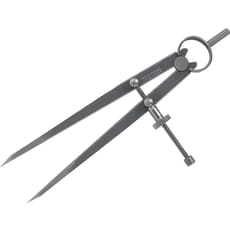
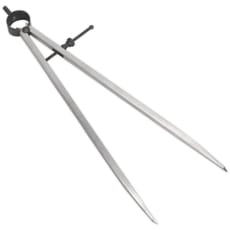
- Spring Divider: A type of divider with a spring mechanism and adjustment screw that maintains constant tension between the legs, allowing precise, repeatable settings and one-handed operation ideal for scribing circles and transferring measurements.
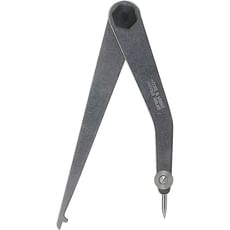
- Jenny Caliper (Hermaphrodite Caliper): A measuring tool with one straight leg and one curved, inward-turning leg, designed for finding centres, scribing lines parallel to edges, and measuring depths or distances from a reference surface.
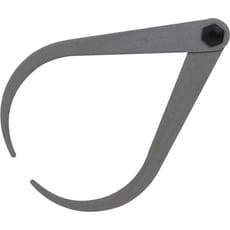
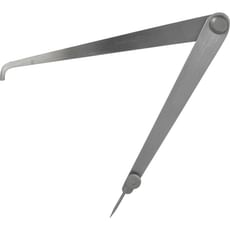
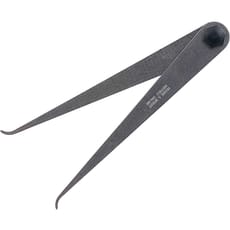
- Firm Joint Caliper: A caliper with a simple pivot joint held by friction, available as inside or outside variants for measuring internal or external dimensions respectively, commonly used in engineering and metalworking for checking diameters and tolerances.
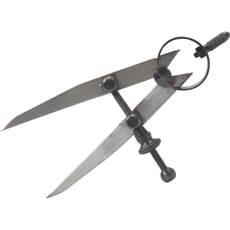
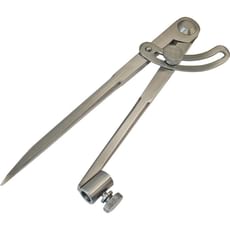
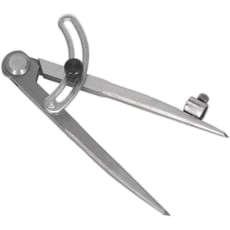
- Wing Divider: A compass-style tool with a central adjustment nut and wing-shaped head, combining the functions of a divider and compass, particularly useful for technical drawing and marking larger circles.
- Scribing: The process of marking or scratching a line onto metal, wood, or other materials using the hardened point of a divider, creating a permanent reference line for cutting, drilling, or assembly.
- Outside/Inside Caliper: Specialist measuring tools designed specifically for checking external diameters (outside) or internal diameters (inside) of cylindrical components, tubes, or holes, essential for precision engineering work.
Who Uses Dividers?
Dividers and calipers are used across numerous trades and professions:
- Metalworkers and Fabricators: For marking out steel, aluminium, and other metals prior to cutting, drilling, or welding
- Engineers and Machinists: Checking tolerances, measuring component dimensions, and quality control in workshops and manufacturing environments
- Sheet Metal Workers: Scribing cutting lines and transferring patterns onto sheet materials
- Woodworkers and Joiners: Marking curves, circles, and transferring measurements in cabinet making and joinery
- Technical Draughtsmen: Creating precise drawings, though increasingly supplemented by CAD software
- Pattern Makers: Developing templates and patterns for casting and manufacturing
- Automotive Technicians: Measuring brake discs, bearings, and various component dimensions
- Model Makers and Craft Workers: Precision work on small-scale projects and detailed craftsmanship
- DIY Enthusiasts: Home metalworking, engineering projects, and precision woodworking tasks
How to Choose the Right Dividers
Type and Function: Spring dividers are the most versatile choice for general marking and circle scribing, offering quick adjustment and consistent tension. If you primarily measure cylindrical components, dedicated inside or outside calipers provide superior accuracy. Jenny calipers are invaluable for centre-finding and surface-parallel marking, whilst wing dividers suit technical drawing and larger radius work.
Size and Capacity: Dividers typically range from 100mm to 300mm in length, with the maximum opening determining the largest circle or measurement you can achieve. Consider your typical workpiece sizes—150mm to 200mm models suit most general engineering and metalworking applications, whilst larger 250mm to 300mm versions are necessary for bigger fabrication work.
Build Quality and Materials: Professional-grade dividers from manufacturers like Moore and Wright feature hardened, ground steel points that resist wear and maintain sharpness. Quality construction ensures joints remain tight without excessive play, critical for measurement accuracy. Look for smooth adjustment mechanisms and comfortable handle finishes for extended use.
Adjustment Mechanism: Spring dividers with fine-adjustment screws offer the greatest precision and ease of use, particularly for repetitive tasks. Firm joint models are simpler and more robust but require two hands to adjust. Consider whether you need quick resetting or maximum rigidity for your applications.
Application-Specific Features: For workshop environments, choose dividers with corrosion-resistant finishes. If working with delicate materials, ensure points aren't excessively sharp. Some models include replaceable points or interchangeable pencil attachments for non-permanent marking.
Popular Accessories
- Engineer's Scriber: Complements dividers for straight-line marking and detailed layout work on metal surfaces
- Centre Punch: Works alongside dividers to mark hole centres accurately before drilling
- Steel Rules and Straight Edges: Essential for transferring measurements to dividers and checking straightness
- Vernier Calipers and Micrometers: Provide digital or analogue measurement readings that can be transferred using dividers
- Marking Blue or Layout Fluid: Applied to metal surfaces to make scribed lines more visible
- Sharpening Stones: Maintain divider point sharpness for clean, accurate scribing
- Compass Point Protectors: Safeguard sharp points during storage and transportation
Safety Information
Whilst dividers are relatively simple tools, their sharp points require careful handling:
- Always store dividers with points closed or protected to prevent accidental injury when reaching into toolboxes
- Carry dividers with points facing downward and away from your body
- Ensure workpieces are securely clamped when scribing to prevent slipping that could cause the point to skid and potentially cause injury
- Wear appropriate eye protection when working with metal, as scribing can occasionally produce small particles
- Keep points sharp—dull points require excessive pressure and are more likely to slip
- When adjusting spring dividers, keep fingers clear of the points as tension release can cause sudden movement
- Store tools in a dry environment to prevent corrosion, which can affect accuracy and create rough edges
Frequently Asked Questions
What's the difference between dividers and compasses?
Whilst similar in appearance, dividers have two metal points for scribing and transferring measurements, whereas compasses have one point and one pencil holder for drawing. Wing dividers can function as both by accepting pencil attachments. Dividers are primarily workshop measuring tools, whilst compasses are drawing instruments.
How do I maintain accuracy with spring dividers?
Regularly check that both points meet precisely when closed—any misalignment affects accuracy. Keep adjustment screws clean and lightly oiled, and ensure the spring mechanism operates smoothly without binding. Store dividers properly to prevent the points from damage, and periodically sharpen points on a fine stone to maintain clean scribing lines.
Can I use dividers on soft materials like wood or plastic?
Yes, though dividers are primarily designed for metalworking, they work effectively on wood, plastic, and other materials. The sharp points may leave more pronounced marks on softer materials, so test on scrap first. For very soft or finished surfaces where permanent marking isn't desired, consider using a compass with pencil attachment instead.
What size dividers do I need for general engineering work?
A 150mm or 200mm spring divider covers most general engineering, metalworking, and fabrication tasks, providing sufficient capacity for typical component sizes whilst remaining manageable and precise. This size range offers a good balance between versatility and control, suitable for everything from small precision work to larger layout tasks.
Why choose firm joint calipers over spring dividers?
Firm joint calipers excel at measuring existing dimensions—you set them to match a component's diameter, then transfer that measurement to a rule or gauge. Their simple friction joint holds settings securely without springs that might shift under pressure. They're particularly valued in traditional engineering and quality control applications where you're checking rather than marking dimensions.