

Engineers Squares
Pay in 3 interest-free payments on purchases from £30-2000 with  . Learn more.
 Loading...
End of content
Error - No more pages to load
About Engineers Squares
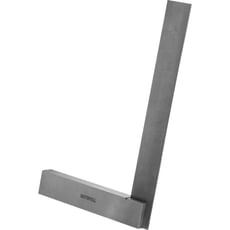
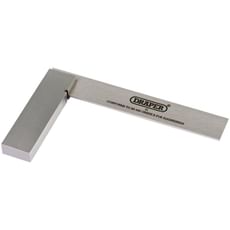
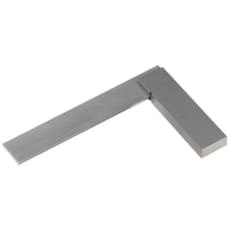
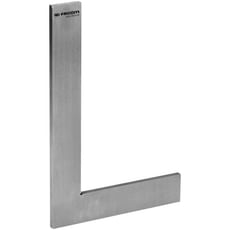
Engineers squares, also known as precision squares or machinist squares, are essential measuring and marking tools designed to provide perfectly accurate 90-degree angles for precision engineering, metalwork, and woodworking tasks. These indispensable tools feature an L-shaped design with a stock (or beam) and a blade set at an exact right angle, allowing tradespeople to check the squareness of workpieces, mark perpendicular lines, and verify the accuracy of machine setups with confidence. Unlike standard try squares used in carpentry, engineers squares are manufactured to exacting tolerances, typically within 0.016-0.02mm per 100mm, making them suitable for applications where dimensional precision is critical.
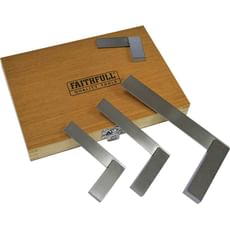
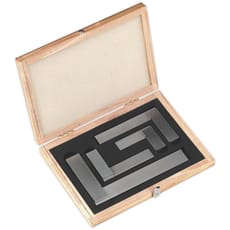
Available in various sizes ranging from compact 50mm models for detailed work to larger 300mm versions for sizeable projects, engineers squares are manufactured using hardened stainless steel or precision-ground carbon steel. The finest examples conform to British Standard BS 939 or DIN 875 specifications, ensuring consistent accuracy across different grades and manufacturers. Whether supplied individually or as part of a comprehensive four-piece set, these tools represent a fundamental component of any professional engineer's, machinist's, or fabricator's toolkit, enabling accurate setup work, quality control inspections, and precise marking operations.
The selection at Tooled-Up.com features trusted brands including Draper, Facom, Faithfull, and Sealey, offering both individual squares and multi-piece sets to suit various precision requirements and budgets. From workshop calibration tasks to on-site fabrication work, a quality engineers square ensures measurements remain true and work meets the exacting standards demanded by modern engineering and manufacturing environments.
Jargon Buster
- BS 939 Workshop Grade: The British Standard specification for engineers squares, defining tolerances and accuracy grades. Grade A offers the highest precision, whilst Grade B (typically ±0.016mm) suits general workshop applications.
- DIN 875 Standard: The European standard specification for engineers squares, defining tolerances across three grades. Grade 0 provides laboratory precision, Grade 1 suits toolmaking, and Grade 2 serves general engineering work.
- Squareness Tolerance: The permissible deviation from a perfect 90-degree angle, usually expressed as millimetres per length (e.g., 0.02mm per 100mm), with lower values indicating greater precision and accuracy.
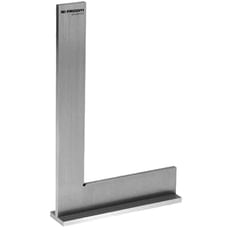
- Flanged Base: A wider, reinforced base on some precision squares that provides additional stability when checking workpieces and prevents rocking on uneven surfaces, particularly useful for vertical surface verification.
- Ground Edges: Precision-machined edges that have been surface-ground to achieve exceptional flatness and straightness, essential for accurate scribing and measurement verification in critical applications.
- Hardened and Tempered Blade: Heat-treated steel that has been hardened to resist wear and deformation, then tempered to reduce brittleness, ensuring the square maintains its accuracy over prolonged use in demanding workshop environments.
Who Uses Engineers Squares?
Engineers squares are indispensable tools across numerous trades and applications:
- Mechanical Engineers – checking component squareness, verifying machine tool setups, and ensuring dimensional accuracy in manufactured parts
- Toolmakers and Die Makers – precision work requiring absolute accuracy when creating moulds, dies, and tooling components
- Machinists – setting up lathes, milling machines, and grinders, plus verifying workpiece orientation and alignment
- Fabricators and Welders – ensuring steel structures, frames, and assemblies are perfectly square before welding operations
- Maintenance Fitters – diagnosing machinery problems, checking equipment alignment, and conducting quality control inspections
- Precision Woodworkers – marking accurate cuts, checking joinery, and setting up machinery for fine furniture making
- Quality Control Inspectors – verifying manufactured components meet dimensional specifications and tolerances
- Apprentices and Students – learning fundamental measurement techniques in engineering and manufacturing education programmes
- Serious DIY Enthusiasts – home workshop projects requiring professional-level accuracy and precision
How to Choose the Right Engineers Squares
Size and Application: Consider the typical dimensions of your workpieces. Smaller 50-100mm squares suit intricate work, model making, and tight spaces, whilst 150-300mm models are better for larger fabrication and general engineering tasks. Multi-piece sets from brands like Faithfull or Sealey offer versatility for varying applications, typically including four popular sizes in one convenient package.
Accuracy Grade: Professional toolmakers and inspectors require DIN 875 Grade 0 or 1 squares with tolerances of 0.01-0.02mm per 100mm. General engineering and fabrication work is well-served by Grade 2 or BS 939 Grade B squares, whilst workshop and DIY applications can use standard accuracy models. The squareness tolerance directly impacts measurement reliability in critical applications.
Material and Construction: Hardened stainless steel offers excellent corrosion resistance and longevity, ideal for environments exposed to coolants and cutting fluids. Carbon steel squares, whilst requiring more care to prevent rust, often provide exceptional rigidity and wear resistance. Look for precision-ground edges and finely polished blades for optimal accuracy and ease of use when scribing lines.
Base Design: Flanged or reinforced bases, such as those found on Facom precision squares, provide superior stability when checking vertical surfaces and are less prone to rocking on slightly uneven workpieces. Standard bases are perfectly adequate for most general applications and drawing work.
Brand Quality: Established manufacturers like Facom, Draper, Sealey, and Faithfull maintain strict quality control and manufacture to recognised British and European standards. Investing in reputable brands ensures long-term accuracy and reliability, with many precision models conforming to BS 939 or DIN 875 specifications.
Set vs Individual: Four-piece precision square sets provide multiple sizes for different tasks and excellent value, whilst individual squares allow you to select specific sizes for specialised requirements. Many tradespeople start with a 150mm square for general use, then add other sizes as specific requirements arise.
Popular Accessories
- Centre Finders and Edge Finders: Complementary precision tools for locating exact centres and edges on workpieces and machine tables
- Engineer's Scribers: Hardened steel marking tools for scribing accurate lines against the square's edge on metal surfaces
- Engineer's Marking Blue: Layout fluid applied to metal surfaces to make scribed lines more visible and permanent during marking operations
- Precision Spirit Levels: For checking both squareness and level simultaneously during setup and installation work
- Combination Squares: Versatile measuring tools from brands like Stanley or Bahco that work alongside engineers squares for marking 45-degree angles
- Inspection Gauge Blocks: Calibrated reference standards for verifying the accuracy of your measuring equipment
- Protective Cases: Padded storage solutions to protect precision squares from impact damage and corrosion during transport
- Workshop Granite Surface Plates: Precision reference surfaces for accurate layout work and measurement verification
- Microfibre Cleaning Cloths: For maintaining clean, debris-free measuring surfaces
- Corrosion Prevention Oil: Light lubricants for protecting carbon steel squares from rust and oxidation
Safety Information
Whilst engineers squares don't present significant safety hazards, proper care ensures both personal safety and tool longevity:
Sharp Edges: Precision-ground edges can be extremely sharp, particularly on new squares. Handle with care to avoid cuts, especially when cleaning or inspecting the tool. Consider wearing work gloves when handling multiple squares simultaneously or during storage organisation.
Secure Storage: Always store engineers squares in protective cases or dedicated tool drawers to prevent damage from being dropped or knocked. A damaged square cannot be reliably repaired and will compromise measurement accuracy, potentially affecting the quality and safety of finished work.
Workshop Hazards: Be aware of your surroundings when using squares near rotating machinery. Ensure the square cannot be drawn into chucks, spindles, or other moving parts, which could cause injury or damage equipment. Remove the square from the work area before starting any powered machinery.
Regular Calibration: For critical precision work, periodically verify your squares against certified reference standards or granite surface plates, particularly if dropped or subjected to impact. HSE guidelines recommend regular calibration of precision measuring equipment in quality-critical manufacturing environments to maintain workplace standards and product quality.
Frequently Asked Questions
What's the difference between an engineers square and a try square?
Engineers squares are manufactured to much tighter tolerances (typically within 0.016-0.02mm per 100mm) using hardened steel construction with precision-ground edges, making them suitable for precision engineering and metalwork. Try squares are woodworking tools with lower accuracy standards, usually featuring wooden or plastic stocks, and aren't appropriate for precision engineering applications requiring dimensional accuracy. Engineers squares also conform to recognised standards like BS 939 or DIN 875.
How do I check if my engineers square is still accurate?
Place the square against a known straight edge (such as a precision granite surface plate or recently surface-ground workpiece) and scribe a line. Flip the square over and align it with the same line from the opposite direction. If the square's edge perfectly matches your original line from both orientations, it's accurate. Any visible gap indicates the square is out of true and should be replaced, as engineers squares cannot be reliably adjusted or repaired once damaged.
Do I need a set of engineers squares or just one size?
This depends on your typical work. If you regularly work with varying component sizes, a 4-piece set from brands like Faithfull or Sealey available at Tooled-Up offers excellent value and versatility, typically including 50mm, 75mm, 100mm, and 150mm sizes. For specialised work with consistent dimensions, a single appropriately-sized square suffices. Many tradespeople start with a 150mm square for general use, then add other sizes as specific requirements arise.
How should I maintain my engineers square?
After each use, wipe the square clean with a lint-free cloth to remove metal filings, coolant, and debris. Apply a light coating of corrosion-preventive oil if the square is carbon steel rather than stainless steel. Store in a protective case or dedicated drawer location where it won't be dropped or knocked against other tools. Never use engineers squares as prying tools, hammers, or for any purpose other than measuring and marking, as this will compromise their accuracy permanently.
What accuracy grade do I need for general fabrication work?
For most fabrication, welding, and general engineering applications, BS 939 Grade B or DIN 875 Grade 2 squares provide more than adequate accuracy. Toolmaking, inspection work, and precision manufacturing require Grade 0 or 1 squares. If you're uncertain, Grade 1 or BS 939 Grade A represents an excellent middle ground offering high precision without the premium cost of laboratory-grade Grade 0 tools, suitable for most professional engineering applications.