

Height Gauges

Pay in 3 interest-free payments on purchases from £20-£3000 with  . Learn more.
Loading...
End of content
Error - No more pages to load
About Height Gauges
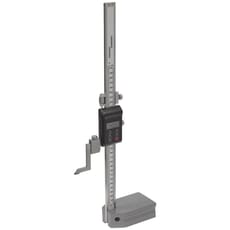
Height gauges are precision measuring instruments used to determine the vertical distance of features on workpieces with exceptional accuracy. These essential metrology tools consist of a graduated vertical beam mounted on a sturdy base, with a measuring head that slides along the beam to record measurements. Height gauges are indispensable in engineering workshops, quality control departments, and metalworking facilities where precise vertical measurements are critical for ensuring components meet exact specifications.
Modern height gauges come in both analogue and digital formats, with digital models offering enhanced readability and data recording capabilities. These tools can measure heights, depths, step differences, and centre distances with repeatability measured in hundredths of a millimetre. Most height gauges are designed to work in conjunction with a surface plate or granite table, which provides the flat reference plane necessary for accurate measurements. Tooled-Up.com stocks professional-grade height gauges including digital models from trusted brands like Sealey, ensuring workshops have access to reliable measurement tools.
Professional-grade height gauges typically feature hardened and ground measuring faces, fine adjustment mechanisms, and robust construction to maintain accuracy even in demanding workshop environments. Digital versions often include useful features such as zero-setting at any position, millimetre-to-inch conversion, data output ports for recording measurements, and large LCD displays for easy reading in various lighting conditions.
Jargon Buster
- Scriber: The pointed attachment that contacts the workpiece and marks or indicates the measurement point. Can be replaced with other measuring attachments depending on the application.
- Surface Plate: A precision-ground flat reference surface, typically made from granite or cast iron, upon which the height gauge sits to ensure accurate vertical measurements.
- Resolution: The smallest increment that can be displayed or read on the gauge, typically 0.01mm or 0.001" on quality digital models, indicating the level of precision achievable.
- Repeatability: The ability of the gauge to produce the same reading when measuring the same dimension multiple times, a critical indicator of measurement reliability.
- Zero-Setting: A digital feature allowing the user to set any position as the zero reference point, making comparative and differential measurements much simpler.
- Data Output: A connection port (often USB or RS232) that allows measurement data to be transferred directly to computers for quality control documentation and statistical analysis.
Who Uses Height Gauges?
Height gauges are essential tools for a wide range of precision engineering and manufacturing professionals:
- Precision Engineers: Use height gauges daily for component inspection and verification during manufacturing processes
- Quality Control Inspectors: Rely on these instruments to verify that finished parts meet dimensional tolerances specified in technical drawings
- Tool and Die Makers: Require height gauges for setting up and measuring tooling components with extreme accuracy
- Machinists: Use them for layout work, setting up workpieces on machine tools, and verifying machined dimensions
- Metrology Technicians: Employ height gauges as part of comprehensive measurement and calibration programmes
- Manufacturing Engineers: Utilise these tools during product development and production setup to ensure dimensional compliance
- Automotive and Aerospace Workshops: Where precision is paramount and components must meet stringent specifications
- Educational Institutions: Technical colleges and apprenticeship programmes teaching precision measurement techniques
How to Choose the Right Height Gauges
Selecting the appropriate height gauge depends on several key factors that match the tool to your specific measurement requirements:
Measuring Range: Consider the maximum height you need to measure. Standard models typically range from 300mm to 600mm, though larger capacity gauges are available for specialist applications. Ensure the range comfortably exceeds your typical workpiece dimensions.
Digital vs Analogue: Digital height gauges offer easier reading, data recording capabilities, and features like zero-setting and unit conversion. Analogue vernier models are more economical and require no batteries, making them reliable for basic applications where data output isn't required.
Accuracy and Resolution: Professional applications typically require resolution of 0.01mm with repeatability of ±0.02mm. For less critical work, slightly lower specifications may suffice. Consider calibration requirements and whether the gauge comes with a certificate of accuracy traceable to national standards.
Construction Quality: Look for hardened steel construction, precision ground measuring faces, and robust column design. The base should be substantial enough to provide stability, and all moving parts should operate smoothly without play or binding.
Additional Features: Data output ports are valuable for quality control documentation, whilst preset functions and memory storage can speed up repetitive measurement tasks. Battery type and life should also be considered for digital models. The Tooled-Up range includes digital height gauges with six-digit LCD displays and both absolute and comparative measurement functions.
Popular Accessories
- Surface Plates: Precision-ground granite or cast iron reference surfaces essential for accurate height gauge operation, available in various grades and sizes
- Scriber Attachments: Alternative measuring points including carbide-tipped scribers for marking, ball-ended scribers for centre finding, and offset scribers for hard-to-reach areas
- Protective Cases: Purpose-designed storage cases protect your height gauge from workshop damage and maintain calibration between uses
- Calibration Equipment: Gauge blocks and setting standards for verifying and maintaining measurement accuracy
- Data Cables: USB or RS232 cables for connecting digital models to computers for automated data collection and quality control documentation
- Replacement Batteries: Spare CR2032 batteries ensure uninterrupted operation of digital height gauges during critical measurement tasks
Safety Information
Whilst height gauges present minimal direct safety hazards, proper handling and usage practices ensure both personal safety and measurement accuracy:
- Handle height gauges carefully to avoid dropping, which can damage precision components and compromise accuracy
- Be mindful of sharp scriber points which can cause injury if mishandled; always store with protective caps fitted
- Ensure workpieces are properly secured before measuring to prevent movement that could cause injury or damage the gauge
- Maintain clean working conditions as swarf, oil, and debris can affect measurement accuracy and create slip hazards around the surface plate
- Use appropriate lifting techniques when moving larger surface plates, as these can be extremely heavy
- Store height gauges in their protective cases when not in use to maintain calibration and prevent workshop accidents
- Regular calibration against known standards ensures measurement reliability, which is critical for quality control and safety-critical components in accordance with HSE guidance
Frequently Asked Questions
Do I need a surface plate to use a height gauge?
Yes, a precision-ground surface plate is essential for accurate height gauge measurements. The surface plate provides the flat reference plane from which all vertical measurements are taken. Without this flat datum, measurements will be inaccurate and unreliable.
What's the difference between digital and vernier height gauges?
Digital height gauges display measurements on an LCD screen, offer features like data output, zero-setting at any position, and unit conversion. Vernier models use a traditional graduated scale that requires manual reading but are more economical, require no batteries, and are perfectly adequate for applications where data recording isn't needed.
How often should height gauges be calibrated?
For quality-critical applications, annual calibration against traceable standards is typically recommended. However, frequency depends on usage intensity and the criticality of measurements. Workshops with ISO 9001 certification or producing safety-critical components may require more frequent calibration, potentially quarterly or even monthly.
Can height gauges measure depth as well as height?
Yes, height gauges can measure depths, step heights, centre distances, and various other vertical dimensions. By zeroing the gauge at different reference points, you can measure the difference between features, making them versatile tools for multiple measurement applications beyond simple height measurement.
What accuracy can I expect from a digital height gauge?
Professional digital height gauges typically offer resolution of 0.01mm with repeatability of ±0.02mm or better. Actual accuracy depends on the quality of the instrument, proper calibration, correct usage technique, and environmental factors such as temperature stability. Always verify specifications match your precision requirements before purchasing.