

Mechanical Timers

Pay in 3 interest-free payments on purchases from £20-£3000 with  . Learn more.
 Loading...
End of content
Error - No more pages to load
About Mechanical Timers
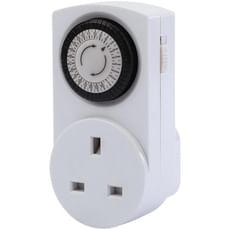
Mechanical timers are simple, reliable devices that enable automatic control of electrical appliances and equipment without the need for digital programming or batteries. Operating on a straightforward clockwork mechanism with adjustable pins or segments, these plug-in timers connect between a standard 13A socket and any 240v appliance, allowing users to schedule when devices switch on and off throughout a 24-hour cycle. Unlike their digital counterparts, mechanical timers offer immediate visual feedback of the programmed schedule and continue operating during power cuts, making them particularly dependable for everyday automation tasks.
The mechanical timers available from Tooled-Up.com typically feature multiple switching segments per day – often up to 48 on/off settings – with minimum time intervals of around 30 minutes. Most models include a manual override switch that allows temporary operation outside the programmed schedule without losing the timer settings. With power ratings commonly around 8A or 2000W, these timers are suitable for controlling a wide range of household and light commercial equipment, from lighting and heating to power tools and battery chargers.
Beyond simple convenience, mechanical timers deliver genuine energy savings by ensuring appliances only operate when needed. They're particularly valuable for controlling heating systems, outdoor lighting, greenhouse equipment, and workshop machinery, helping both tradespeople and homeowners reduce electricity consumption and lower running costs. Their robust, purely mechanical construction means fewer components to fail compared to electronic alternatives, contributing to their reputation for longevity and dependability in demanding environments.
Jargon Buster
- 24-Hour Cycle: The timer completes one full rotation every 24 hours, with the dial representing the complete day. Segments or pins are positioned around this dial to correspond with specific times.
- Switching Segments: The adjustable tabs, pins or blocks around the timer dial that determine when the connected appliance switches on or off. A timer with 48 segments allows switching every 30 minutes.
- Manual Override: A switch that allows you to turn the connected appliance on or off immediately, regardless of the programmed schedule, without losing your timer settings.
- Load Rating: The maximum electrical load the timer can safely handle, typically expressed in amps (A) and watts (W). Common ratings are 8A/2000W or 13A/3000W for 240v UK mains supply.
- Plug-In Timer: A timer that plugs directly into a standard wall socket, with its own socket on the front to accept the appliance plug – no installation or wiring required.
- Minimum Switching Time: The shortest duration you can programme, determined by the physical size of the switching segments. Common minimum times are 15 or 30 minutes.
Who Uses Mechanical Timers?
- Electricians and electrical contractors installing automated lighting and heating control systems for domestic and commercial clients
- Plumbers and heating engineers setting up timed control for immersion heaters, central heating pumps, and hot water systems
- Gardeners and landscapers automating greenhouse heating, grow lights, irrigation pumps, and water features
- Security installers creating occupancy simulation by scheduling lights and radios to operate when properties are vacant
- Workshop owners and tradespeople controlling dust extraction systems, battery chargers, and workshop heating to reduce energy waste
- Retail and hospitality businesses managing window display lighting, signage, and equipment that operates on regular schedules
- Farmers and agricultural workers automating livestock heating lamps, ventilation fans, and feeding equipment
- DIY enthusiasts and homeowners controlling aquarium equipment, outdoor lighting, festive decorations, and home appliances
- Property managers and landlords automating communal lighting, heating timers, and external security lighting in rental properties
How to Choose the Right Mechanical Timers
Power Rating: Always check that the timer's load rating exceeds the power consumption of your intended appliance. Most mechanical timers are rated at 8A/2000W or 13A/3000W for 240v supply. Calculate the wattage of your appliance and ensure adequate capacity – never exceed the timer's maximum rating as this presents a fire risk and will void any warranty.
Switching Frequency: Consider how many on/off cycles you need daily. Timers with 48 segments (30-minute intervals) suit most applications, whilst models with 96 segments (15-minute intervals) offer greater precision for tasks requiring frequent switching. The mechanical timers stocked at Tooled-Up typically provide 48 settings per 24 hours, which meets the vast majority of domestic and light commercial requirements.
Manual Override Function: This feature proves invaluable when you need temporary control outside the programmed schedule. Quality mechanical timers include a three-position switch (On/Timer/Off) allowing manual operation without disturbing your programmed settings – particularly useful for testing equipment or occasional use.
Build Quality and Durability: Examine the casing material and mechanism robustness, especially for workshop or outdoor applications where the timer may face dust, temperature variations, or occasional knocks. Established brands like Draper manufacture timers with reliable clockwork mechanisms that maintain accuracy over years of service.
Plug Configuration: Ensure the timer accepts standard UK 13A plugs and fits your socket location. Some timers feature a compact design that won't block adjacent sockets in double outlets, whilst others may require dedicated socket access.
Visual Clarity: Choose timers with clearly marked dials and easily adjustable segments. You should be able to read the current time and programmed schedule at a glance, which proves particularly important when adjusting settings or troubleshooting.
Popular Accessories
- Extension leads and socket outlets for positioning timers away from wall sockets or controlling multiple appliances from one timer
- RCD adapters and safety plugs providing additional electrical protection when using timers with high-load heating or motor-driven equipment
- Outdoor weatherproof socket covers for mechanical timers controlling external lighting, pond pumps, or garden equipment
- Cable management accessories including cable ties and trunking to keep timer-controlled appliance cables neat and safe
- Multi-gang extension towers allowing several appliances to be controlled simultaneously from a single mechanical timer
- Labelling supplies for marking timer settings and identifying which appliances are connected in multi-timer installations
- Digital timers and programmable alternatives for applications requiring weekly schedules, multiple programmes, or more sophisticated control
- Energy monitoring plugs to measure actual consumption and calculate the savings achieved through timer use
Safety Information
Always verify that the mechanical timer's load rating significantly exceeds your appliance's power consumption. Never daisy-chain multiple timers or extension leads together, as this increases resistance and fire risk. Mechanical timers should only be used with 240v UK mains supply and must not be modified or used with incompatible voltage systems.
Avoid using mechanical timers with appliances that pose safety risks if activated unexpectedly, such as power tools, soldering irons, or heating equipment in unsupervised locations. Check that the timer mechanism operates smoothly and segments click securely into position – worn or stiff mechanisms may fail to switch accurately.
Keep mechanical timers away from moisture, excessive heat, and flammable materials. Whilst generally robust, the clockwork mechanism can be affected by extreme temperatures or direct water ingress. For outdoor applications, house the timer in a weatherproof enclosure or use specifically rated outdoor timer models.
Regularly inspect timers for signs of overheating, such as discolouration, melting, or burning smells, which indicate the connected load may exceed the timer's capacity. If any damage is evident, discontinue use immediately. Always follow the manufacturer's instructions and relevant HSE guidance when using electrical timing devices in commercial or workplace settings.
Frequently Asked Questions
How accurate are mechanical timers compared to digital models?
Mechanical timers typically maintain accuracy within a few minutes per week, which proves perfectly adequate for most applications like lighting, heating, and appliance control. The clockwork mechanism may gradually drift and require occasional adjustment – simply rotate the dial to align the current time marker with the actual time. Digital timers offer greater precision but require battery backup or reprogramming after power cuts, whereas mechanical timers continue operating and maintain their schedule through power interruptions.
Can I use a mechanical timer with heating appliances like fan heaters or oil-filled radiators?
Yes, provided the heater's wattage doesn't exceed the timer's load rating. Most mechanical timers are rated at 8A/2000W or 13A/3000W for 240v supply. A typical 2kW fan heater operates at the limit of an 8A timer, so a 13A model would be safer. Always add a safety margin and never run timers at maximum capacity continuously, as this generates heat and accelerates wear. Ensure adequate ventilation around the timer and check regularly for signs of overheating.
What happens to my timer settings during a power cut?
The mechanical timer's clockwork mechanism continues running during power cuts, maintaining your programmed on/off segments. However, the dial continues rotating, so when power returns, the timer's clock will be ahead of the actual time by the duration of the outage. Simply rotate the dial backwards to realign the current time marker with the actual time – your switching segments remain in position and don't need reprogramming.
How many appliances can I control with a single mechanical timer?
You can control multiple appliances by connecting them via an extension lead or multi-gang adapter plugged into the timer, but the combined power consumption must not exceed the timer's maximum load rating. For example, an 8A/2000W timer could safely control several LED lights totalling 100W, but would be overloaded by two 1500W heaters. Calculate total wattage carefully and include a safety margin – for high-load applications, use individual timers for each appliance.
Do mechanical timers consume electricity even when the connected appliance is switched off?
Yes, but consumption is minimal – typically under 1W to power the clockwork mechanism motor. Over a year, this amounts to just a few pence of electricity. The energy savings from preventing appliances running unnecessarily far outweigh the timer's own consumption. Unlike digital timers with displays and microprocessors, mechanical models use very little standby power, making them genuinely economical for energy management.