
Milling Clamps

Pay in 3 interest-free payments on purchases from £20-£3000 with  . Learn more.

Loading...
End of content
Error - No more pages to load
About Milling Clamps
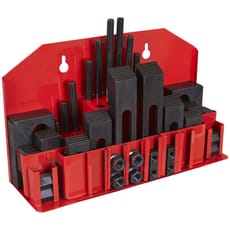
Milling clamps are essential precision workholding accessories designed to secure workpieces firmly to the table of milling machines and drilling machines during metalworking operations. These specialised clamping systems typically consist of T-nuts, step blocks, clamp straps, studs, and hex bolts that work together to create a stable, rigid hold on materials being machined. By fitting into the T-slots machined into milling machine tables, these clamps allow machinists to position and secure workpieces at various angles and locations, ensuring accuracy and safety during cutting, drilling, and milling operations.
Available in comprehensive kits ranging from 42 to 52 pieces, milling clamps at Tooled-Up.com provide everything needed to tackle a wide variety of workholding challenges in machine shops, engineering workshops, and home workshops. These kits are designed to be compatible with popular mini mill and drill-mill combination machines, offering versatility for both professional engineers and serious hobbyists. The clamps are manufactured to exacting standards, with hardened components that can withstand the forces generated during machining operations whilst maintaining dimensional accuracy.
Quality milling clamp sets include various sizes of components to accommodate different workpiece dimensions and machining requirements. The range typically features different lengths of clamp straps, multiple step block heights, and an assortment of T-nuts and fasteners to provide maximum flexibility. Brands such as Sealey and Draper offer comprehensive kits that represent excellent value, eliminating the need to purchase individual clamping components separately and ensuring you have the right tool for virtually any workholding situation.
Jargon Buster
- T-Nuts: Specially shaped nuts designed to fit into the T-shaped slots machined into milling machine tables. They provide the anchor point for clamping studs and can slide along the slot for positioning before being tightened.
- Step Blocks: Precisely machined blocks with multiple stepped surfaces at different heights, used to support the free end of a clamp strap and provide the correct clamping geometry for various workpiece thicknesses.
- Clamp Straps: Metal bars or plates that span across the workpiece and apply downward clamping force when tightened. They typically have slots for adjustment and are available in various lengths.
- T-Slots: The T-shaped channels machined into milling machine tables that accept T-nuts and other holding devices, allowing flexible positioning of clamps anywhere on the work surface.
- Clamping Studs: Threaded rods or bolts that connect the T-nut below the table to the clamp strap above, providing the means to apply clamping pressure by tightening the hex nut.
- Packing Pieces: Small blocks or shims used to raise or level a workpiece, or to provide additional support under clamps to achieve the correct clamping angle and pressure distribution.
Who Uses Milling Clamps?
- Model Engineers: Hobbyists building scale models and precision miniatures who require secure workholding for intricate milling operations
- Tool and Die Makers: Skilled tradespeople creating precision tooling, moulds, and dies in engineering workshops
- General Machinists: Professionals operating milling machines in machine shops and manufacturing facilities
- Prototype Engineers: Specialists creating one-off components and prototypes requiring flexible workholding solutions
- Maintenance Engineers: Technicians in industrial settings who need to machine replacement parts and repair components
- Educational Institutions: Technical colleges and training centres teaching machining skills and metalworking techniques
- Automotive Enthusiasts: Home workshop users modifying and creating custom parts for vehicles
- Gunsmiths: Specialists requiring precise workholding for firearms modification and repair
- Jewellery Makers: Craftspeople using small milling machines for metalwork and stone setting
How to Choose the Right Milling Clamps
Machine Compatibility: Ensure the clamping kit is suitable for your specific milling or drilling machine model. Check the T-slot dimensions on your machine table match the T-nuts supplied in the kit. The Tooled-Up range includes kits designed for popular machines from Sealey, Draper, and other manufacturers, with many offering universal compatibility.
Kit Comprehensiveness: Consider the number of pieces included and the variety of components. A 42-piece kit provides good basic coverage, whilst 52-piece sets offer additional flexibility with more sizes and configurations. Larger kits give you more options for complex setups involving multiple workpieces or awkward clamping situations.
Component Quality: Look for hardened steel construction in clamps and studs to ensure durability and resistance to deformation under clamping loads. Quality step blocks should have accurately machined steps with parallel surfaces to maintain workpiece alignment.
Size Range: Assess the maximum workpiece size you'll typically handle and ensure the clamp straps are long enough. Consider both the length of clamping straps and the range of step block heights available to accommodate your typical workpiece dimensions.
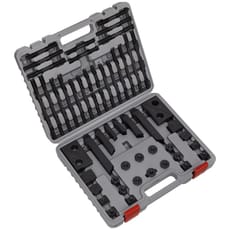
Storage and Organisation: Quality kits come in organised storage cases with compartments for different components, making it easy to find the right piece quickly and keep track of your inventory. This is particularly important when working with sets containing 40+ individual components.
Future Expansion: Some users benefit from purchasing multiple kits or additional individual components to enable more complex multi-part setups. Consider whether you'll need to clamp multiple workpieces simultaneously.
Popular Accessories
- Angle Plates: Precision-ground cast iron plates for holding workpieces vertically or at specific angles
- Parallel Bars: Matched pairs of hardened steel bars for supporting and levelling workpieces above the machine table
- Vee Blocks: V-shaped blocks for securely holding cylindrical workpieces during machining operations
- Machine Vice: Precision milling vices that bolt to the table for quick workpiece changes
- Dial Test Indicators: Measuring tools for checking workpiece alignment and tramming the machine
- Edge Finders: Tools for accurately locating the edge of workpieces relative to the cutter
- Cutting Fluids: Coolants and lubricants for improved surface finish and tool life
- Machine Table Covers: Protective covers to prevent swarf accumulation in T-slots
- Digital Readout Systems: Electronic position displays for enhanced accuracy
Safety Information
Secure Clamping: Always ensure workpieces are firmly clamped before starting any machining operation. Insufficient clamping can result in workpiece movement, causing dangerous projectiles, tool breakage, and serious injury. Check all clamp nuts are fully tightened and test the setup by attempting to move the workpiece by hand.
Clamp Positioning: Position clamps to avoid interference with the cutter path. A collision between a rotating cutter and a steel clamp can cause catastrophic tool failure, sending sharp fragments at high velocity. Always visualise the complete tool path and maintain adequate clearance.
Regular Inspection: Examine clamps, studs, and T-nuts regularly for wear, deformation, or damage. Bent clamp straps or damaged threads can compromise holding force and create unsafe conditions. Replace worn components immediately rather than risking workpiece movement during machining.
Proper Technique: Use step blocks of appropriate height to maintain the clamp strap as level as possible. Excessive angles can reduce clamping effectiveness and cause uneven pressure distribution, potentially distorting thin workpieces or creating unstable setups.
Eye Protection: Always wear safety glasses or a face shield when operating milling machines, as metal chips can be ejected at high velocity. Follow HSE guidelines for machine shop safety and ensure adequate guarding is in place on the machine itself.
Frequently Asked Questions
Q: Are milling clamps universal across different machine brands?
A: Most milling clamps use standard T-slot dimensions and are compatible with multiple machine brands. However, it's important to verify your machine's T-slot size (commonly 12mm or 14mm width) matches the T-nuts supplied in the kit. Many clamp sets available from Tooled-Up are designed to fit Sealey, Draper, and other popular mini mill brands, with specifications clearly listed.
Q: How many clamps do I need to hold a workpiece safely?
A: This depends on the workpiece size, material, and the machining forces involved. As a minimum, use two clamps positioned diagonally opposite each other for rectangular parts. Larger workpieces or heavy cuts may require three or four clamps. Always ensure the workpiece cannot rotate or lift during operation.
Q: Can I use milling clamps on a drill press?
A: Only if your drill press has a table with T-slots. Standard drill press tables typically have plain flat surfaces without T-slots, making milling clamps incompatible. Drill-mill combination machines and milling machines feature T-slotted tables specifically designed for this clamping system.
Q: Do I need to clean and maintain milling clamps?
A: Yes, regular maintenance extends the life of your clamps and ensures reliable performance. Remove metal chips and swarf after each use, clean T-slots regularly to prevent debris accumulation, and apply a light coating of oil to prevent rust on steel components. Check threads periodically and chase them with a tap or die if they become damaged.
Q: What's the difference between a 42-piece and 52-piece clamping kit?
A: The larger 52-piece kits typically include additional sizes of key components such as extra clamp strap lengths, more step block variations, and a greater selection of T-nuts and studs. This provides more flexibility for different workpiece sizes and complex setups involving multiple clamps, making them worthwhile for users who regularly tackle varied machining projects.