

Nuts
Pay in 3 interest-free payments on purchases from £30-2000 with  . Learn more.



 Loading...
End of content
Error - No more pages to load
About Nuts
Nuts are essential threaded fasteners used across virtually every sector of construction, engineering, and manufacturing. Working in partnership with bolts and threaded rods, nuts provide the clamping force necessary to secure components together reliably. From simple hexagonal full nuts to specialised designs like serrated flange nuts and pronged tee nuts, each type serves specific applications where standard fastening solutions might fail. The diversity of nut designs reflects the enormous range of materials, load requirements, and environmental conditions encountered in professional and DIY projects alike.
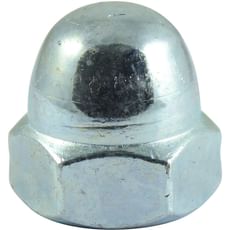
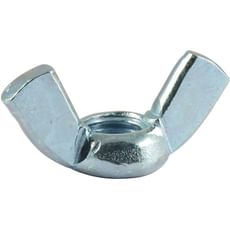
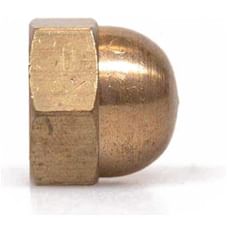
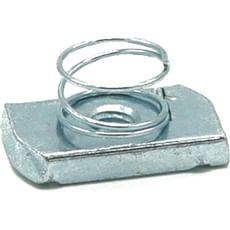
The selection available from Tooled-Up.com encompasses everything from everyday carbon steel hexagonal nuts for general assembly work to specialist nylon lock nuts that prevent loosening under vibration. Channel nuts provide adjustable fixing points in strut systems, whilst wing nuts allow tool-free adjustment and removal where frequent disassembly is required. Dome nuts offer a finished appearance and protect threads from damage and corrosion, making them ideal for exposed applications. Understanding the specific characteristics of each nut type ensures optimal performance, longevity, and safety in any fastening application.
Professional tradespeople and engineers select nuts based on factors including thread size and pitch, material composition, strength grade, corrosion resistance, and installation method. British and European standards govern nut specifications, with ISO metric threads being the predominant system in UK applications. High-tensile nuts carry grade markings indicating their maximum load capacity, which must be matched appropriately to bolt grades for safe, compliant installations. Tooled-Up stocks nuts in materials ranging from zinc-plated mild steel for general use to stainless steel and brass for corrosive environments, ensuring the right solution for every fixing challenge.
Jargon Buster
- Thread Pitch: The distance between adjacent threads, measured in millimetres for metric fasteners. Coarse pitch threads are standard for most applications, whilst fine pitch threads provide greater strength and precision in specialist applications.
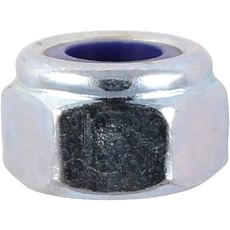
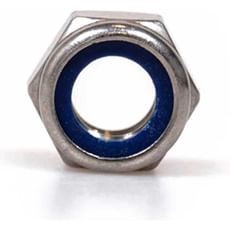
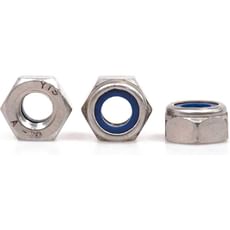
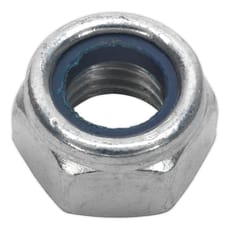
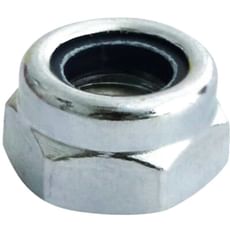
- Nyloc (Nylon Insert Lock Nut): A nut featuring a nylon collar that grips the bolt threads, creating friction that resists loosening from vibration. The nylon insert is typically visible as a coloured band within the nut's upper section.
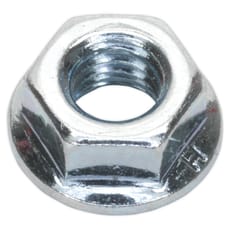
- Flange Nut: A nut with an integrated washer-like flange at the base that distributes load over a wider area and eliminates the need for a separate washer. Serrated flanges provide additional grip and prevent rotation.
- Grade Marking: Numerical or symbolic markings on nuts indicating their mechanical strength properties. Common grades include 8 (800 MPa) and 10 (1000 MPa) for high-tensile applications.
- Self-Locking Nut: Any nut design incorporating features that create resistance to loosening without additional locking devices. Examples include nylon insert nuts, prevailing torque nuts, and deformed thread designs.
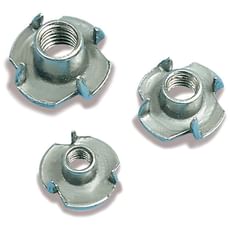
- Tee Nut (T-Nut): A fastener with a threaded barrel and pronged flange designed to be hammered into wood, creating a durable threaded fixing point in materials that would otherwise strip easily.
Who Uses Nuts?
- General Builders and Construction Workers: Structural connections, formwork assembly, temporary fixings, and general site fabrication
- Mechanical Engineers and Fitters: Machinery assembly, equipment installation, maintenance work, and precision engineering applications
- Automotive Technicians: Vehicle repairs, chassis work, exhaust systems, and component replacement
- Electricians: Securing trunking, cable tray installations, equipment mounting, and control panel assembly
- Plumbers and Heating Engineers: Pipework supports, radiator brackets, boiler installations, and sanitary ware fixing
- Carpenters and Joiners: Furniture construction, timber frame connections, and hardware installation using tee nuts
- Steel Fabricators and Welders: Structural steelwork, framework assembly, and temporary bolted connections
- Maintenance Teams: Equipment servicing, replacement of worn fasteners, and general facility repairs
- DIY Enthusiasts and Home Improvers: Flatpack assembly, garden structures, shelving, and general household repairs
How to Choose the Right Nuts
Thread Size and Type: Ensure the nut matches your bolt or threaded rod exactly. Metric threads (M6, M8, M10, etc.) are standard in the UK, though imperial sizes (UNC/UNF) appear on older equipment and imported machinery. Check both the nominal diameter and thread pitch, particularly when sourcing fine-pitch variants.
Material and Finish: Select materials appropriate to the environment. Zinc-plated mild steel suits most dry indoor applications, whilst stainless steel (A2 or A4 grade) resists corrosion in damp or exterior conditions. Brass nuts prevent galvanic corrosion when paired with brass bolts, and nylon variants provide electrical insulation and prevent damage to delicate surfaces.
Strength Requirements: Match nut grades to bolt grades in structural and high-load applications. Grade 8 and Grade 10 nuts suit corresponding high-tensile bolts, whilst standard grade nuts suffice for general assembly work. Undersized or mismatched grades risk thread stripping or fastener failure under load.
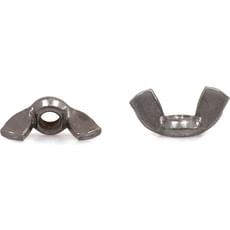
Locking Requirements: Consider whether vibration or movement might loosen the connection. Nylon insert lock nuts provide excellent resistance to vibration loosening, whilst serrated flange nuts grip the substrate surface. Wing nuts suit applications requiring frequent adjustment without tools, though they offer minimal locking capability.
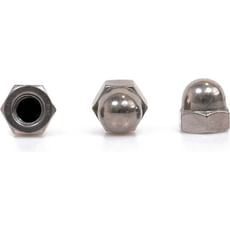
Installation Access: Assess the available space and access for installation. Standard hex nuts require spanners or sockets, whilst wing nuts allow finger-tight adjustment. Dome nuts provide a finished appearance but require greater height clearance. Channel nuts suit strut-based systems where adjustment along the channel length is beneficial.
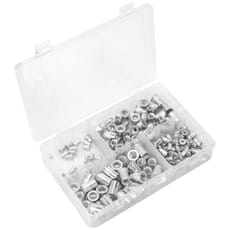
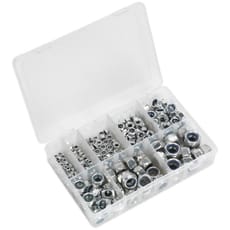
Quantity and Assortments: The range at Tooled-Up includes both single-size packs for specific projects and assorted packs containing commonly used sizes. Assortments prove economical for toolboxes and maintenance applications, whilst bulk packs of single sizes suit production or repetitive installation work.
Popular Accessories
- Bolts and Threaded Rod: Machine screws, hex head bolts, coach bolts, and studding for complete fastening assemblies
- Washers: Flat washers, spring washers, penny washers, and repair washers to distribute loads and prevent surface damage
- Socket Sets and Spanners: Combination spanners, socket sets, and ratcheting wrenches for nut installation and removal
- Thread Locking Compounds: Chemical threadlockers providing additional security against vibration loosening
- Taps and Dies: Thread cutting and repair tools for creating or restoring damaged threads
- Spring Clips and Circlips: Alternative fastening methods for shaft retention and quick-release applications
- Rivet Nuts (Rivnuts): Threaded inserts for creating fixing points in thin materials and hollow sections
- Thread Gauges: Measurement tools for accurately identifying thread sizes and pitches
Frequently Asked Questions
What's the difference between a full nut and a half nut?
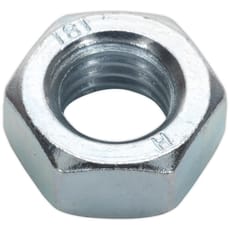
A full nut (standard hex nut) has a height approximately equal to the nominal thread diameter and provides maximum thread engagement for strength and durability. Half nuts (also called jam nuts or lock nuts) have roughly half the thickness and are typically used as secondary locking nuts tightened against a primary nut, or in space-restricted applications where full thread engagement isn't critical.
Can nylon insert lock nuts be reused?
Nylon lock nuts can typically be reused 2-3 times before the nylon insert becomes compressed and loses its locking effectiveness. The prevailing torque should be checked during removal—if the nut spins freely without resistance, the locking capability has been compromised and the nut should be replaced. Always use new nyloc nuts in safety-critical or high-vibration applications.
How do I know what grade nut I need?
Match the nut grade to your bolt grade for optimal performance. Standard mild steel nuts (unmarked or grade 5) suit general applications with non-graded or low-strength bolts. Grade 8 nuts pair with grade 8.8 bolts, and grade 10 nuts with grade 10.9 bolts in high-strength structural applications. Using a lower grade nut than bolt risks thread stripping, as the nut becomes the weak point in the assembly.
What size spanner do I need for different nut sizes?
Common metric nut sizes require the following across-flats (AF) spanner sizes: M6 = 10mm, M8 = 13mm, M10 = 17mm, M12 = 19mm, M16 = 24mm, and M20 = 30mm. These are standard dimensions, though some specialist nuts like flange nuts may have different spanner requirements. Always check the specific nut dimensions before starting work to ensure you have the correct tools available.
Are stainless steel nuts compatible with ordinary steel bolts?
Whilst physically compatible, mixing stainless steel nuts with ordinary carbon steel bolts in exterior or corrosive environments can lead to galvanic corrosion at the junction between dissimilar metals. For best results, match nut and bolt materials—use stainless fasteners together, or carbon steel together. If mixing is unavoidable, apply anti-seize compound to the threads and monitor the connection for signs of corrosion during routine maintenance.