
R Clips

Pay in 3 interest-free payments on purchases from £20-£3000 with  . Learn more.
Loading...
End of content
Error - No more pages to load
About R Clips
R clips, also known as R-pins or hairpin cotter pins, are essential fastening components used to secure clevis pins, shafts, and axles in a wide range of mechanical assemblies. Named for their distinctive 'R' shape when viewed from the side, these spring-steel fasteners feature a looped head and two parallel legs that pass through a drilled hole, with the natural spring tension holding them securely in place. Unlike split pins or linchpins, R clips can be quickly installed and removed without tools, making them ideal for applications requiring frequent disassembly or adjustment.
The design of R clips provides excellent retention force whilst allowing for easy removal when necessary, making them particularly valuable in agricultural machinery, automotive applications, industrial equipment, and workshop tools. Tooled-Up.com stocks quality R clip assortments in various sizes to suit different shaft diameters and load requirements, ensuring tradespeople and engineers have the right fastener for their specific application.
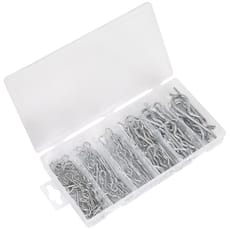
Available in partitioned storage boxes for workshop organisation, R clip assortments typically include the most commonly used sizes ranging from 2mm to 4mm wire diameter with varying leg lengths. These durable spring-steel fasteners resist vibration loosening and provide reliable retention in demanding environments, from construction sites to manufacturing facilities.
Jargon Buster
- Wire Diameter: The thickness of the spring steel used to form the R clip body, typically ranging from 2mm to 4mm for standard applications. Larger wire diameters provide greater strength and retention force.
- Leg Length: The measurement from the curved head to the end of the parallel legs, which must be sufficient to pass through the component and provide adequate grip. Common leg lengths range from 30mm to 75mm.
- Clevis Pin: A fastener consisting of a cylindrical shaft with a head at one end and a cross-hole at the other, designed to accept an R clip for retention in mechanical linkages and pivot points.
- Spring Steel: A specialized low-alloy steel with high yield strength and excellent elasticity, heat-treated to provide the spring tension necessary for R clips to maintain their grip.
- Retention Force: The clamping pressure exerted by the R clip's spring tension against the clevis pin or shaft, preventing unintentional removal during operation whilst allowing deliberate disassembly.
- Shaft Diameter: The external diameter of the pin or axle being secured, which determines the appropriate R clip size needed for proper fit and retention.
Who Uses R Clips?
- Agricultural Engineers: Maintaining tractors, harvesters, and implements with frequent linkage adjustments
- Automotive Mechanics: Securing throttle linkages, suspension components, and adjustment mechanisms
- Plant Maintenance Engineers: Servicing industrial machinery and production equipment
- HGV Technicians: Working on commercial vehicle brake systems, coupling mechanisms, and trailer connections
- Manufacturing Engineers: Assembling and maintaining production line equipment and robotic systems
- Marine Engineers: Securing rigging components, steering linkages, and deck equipment
- Construction Equipment Operators: Maintaining excavators, loaders, and site machinery
- Workshop Technicians: General mechanical repair and fabrication work
- DIY Enthusiasts: Garden machinery maintenance, trailer repairs, and general mechanical projects
How to Choose the Right R Clips
Selecting the appropriate R clip requires careful consideration of the application requirements and the components being secured. Start by measuring the shaft or clevis pin diameter accurately – the R clip must fit snugly without excessive force, as too tight a fit makes installation difficult whilst too loose a fit compromises retention.
The leg length is equally important; the clip must pass completely through the drilled hole with enough extension to provide secure retention, typically allowing 3-5mm beyond the far side of the component. Consider the operating environment when selecting R clips – applications subject to high vibration, shock loads, or corrosive conditions may require upgraded materials or additional retention methods.
For workshop and service applications, assortments available from Tooled-Up provide excellent value and convenience, offering multiple sizes in a partitioned storage box. This ensures you have the correct size immediately available without needing to stock individual packets. Professional users should consider wire diameter carefully – heavier-duty applications require thicker wire for increased strength and retention force.
Always verify that the R clip material is suitable for the application environment. Standard spring steel R clips perform well in most workshop and mechanical applications, whilst stainless steel variants offer superior corrosion resistance for marine or outdoor use.
Popular Accessories
- Clevis Pins: Cylindrical fasteners specifically designed to work with R clips in mechanical linkages
- Split Pins: Alternative retention fasteners for applications where R clips may not be suitable
- Linchpins: Quick-release fasteners for applications requiring frequent removal
- Circlip Assortments: Internal and external retaining rings for shaft and bore applications
- Spring Pin Assortments: Rolled or slotted pins for permanent or semi-permanent fastening
- Parts Storage Boxes: Organized compartment boxes for workshop fastener storage
- Engineer's Pliers: For installing and removing R clips safely
- HSS Drill Bit Sets: For creating accurate holes for clevis pins and R clips
- Grease and Lubricants: Protecting pivot points and reducing wear in mechanical assemblies
Frequently Asked Questions
What's the difference between an R clip and a split pin?
R clips feature parallel legs and rely on spring tension for retention, making them easily removable and reusable. Split pins have legs that must be bent outward after installation, providing more permanent retention but requiring replacement after removal. R clips are preferred for applications requiring frequent disassembly.
Can R clips be reused after removal?
Yes, R clips are designed for multiple installation and removal cycles. Provided the spring steel hasn't been damaged or permanently deformed, they can be reused numerous times. Inspect clips before reinstallation for any signs of wear, bending, or reduced spring tension that might compromise retention.
How do I measure for the correct R clip size?
Measure the diameter of the shaft or clevis pin being secured – this determines the R clip's internal width. Then measure the thickness of the component through which the clip will pass to determine the required leg length. The clip should extend 3-5mm beyond the component after full installation.
Why won't my R clip stay in place?
This typically indicates the clip is too large for the shaft diameter, reducing spring tension. Ensure you're using the correct size for your application. Worn or damaged clips that have lost their spring tension should be replaced. In high-vibration applications, consider using a smaller size or supplementary retention method.
Are R clips suitable for safety-critical applications?
While R clips provide reliable retention in many applications, safety-critical assemblies may require additional security measures such as lockwire, secondary retention devices, or more permanent fastening methods. Always consult relevant HSE guidance and manufacturer specifications for safety-critical equipment fastening requirements.