

Ratchet Clamps
Pay in 3 interest-free payments on purchases from £30-2000 with  . Learn more.
 Loading...
End of content
Error - No more pages to load
About Ratchet Clamps
Ratchet clamps are essential workshop tools that provide rapid, one-handed clamping action through an innovative ratcheting mechanism. Unlike traditional screw clamps or G-clamps that require multiple turns to apply pressure, ratchet clamps can be quickly tightened by simply squeezing a trigger or lever, making them ideal for situations where speed and convenience matter. The ratcheting mechanism allows for fast adjustment across the full range of the clamp's capacity, whilst still delivering substantial holding force to secure workpieces firmly in place during cutting, gluing, assembly or finishing operations.
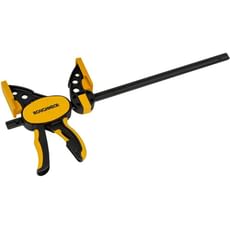
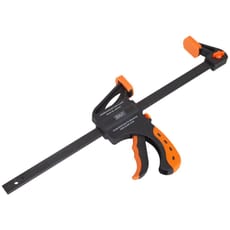
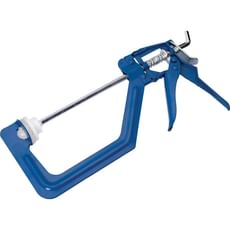
The most recognisable style is the Quick Grip F-type ratchet clamp, which features a pistol-grip handle with a trigger mechanism and a sliding jaw that moves along a steel bar. These clamps are particularly valued for their ability to be operated with just one hand, leaving your other hand free to position and hold the workpiece whilst applying clamping pressure. This single-handed operation is a significant advantage over traditional screw clamps, especially when working alone on assembly projects or when multiple clamps need to be positioned simultaneously.
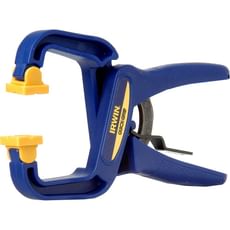
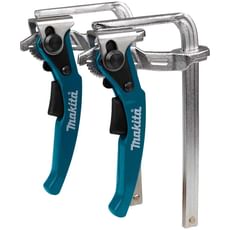
Ratchet clamps at Tooled-Up.com are available from trusted manufacturers including Sealey, Makita, Quick-Grip, Roughneck and Blue Spot, spanning various price points and build qualities. Entry-level models typically feature plastic bodies and are suitable for light-duty DIY work, whilst professional-grade ratchet clamps incorporate metal components and reinforced mechanisms designed to withstand the rigours of daily workshop use. Capacities generally range from 150mm up to 900mm or more, with different jaw depths and throat reaches to accommodate various workpiece sizes and configurations.
Jargon Buster
- Clamping Capacity: The maximum opening distance between the fixed and movable jaws, typically measured in millimetres. This determines the largest workpiece thickness the clamp can accommodate.
- Throat Depth: The distance from the clamping surface to the back of the clamp bar or frame. Greater throat depth allows you to clamp further from the edge of a workpiece.
- Clamping Force: The amount of pressure the clamp can exert on a workpiece, usually measured in kilograms or Newtons. Higher clamping force provides more secure holding power for demanding applications.
- Quick Release: A mechanism (often a lever or button) that instantly releases the ratchet mechanism, allowing the movable jaw to slide freely for rapid repositioning or removal of the clamp.
- Spreader Mode: A feature found on some ratchet clamps that allows the jaws to be reversed, converting the tool from a clamp into a spreader for pushing components apart rather than together.
- Non-Marking Pads: Protective caps or covers on the clamping jaws, typically made from plastic or rubber, that prevent damage or marking to finished surfaces and delicate materials.
Who Uses Ratchet Clamps?
Ratchet clamps are versatile tools used across numerous trades and applications:
- Carpenters and joiners - for holding timber assemblies during gluing, dowelling and general joinery work
- Cabinet makers - securing cabinet carcasses, drawer boxes and face frames during construction
- Furniture makers - clamping components during assembly and whilst adhesives cure
- Shopfitters - temporarily holding fixtures and fittings in position during installation
- DIY enthusiasts - home improvement projects, furniture assembly and general workshop tasks
- Model makers - securing small components and assemblies with precision
- Picture framers - holding mitred corners square during gluing
- Metalworkers - positioning metal components for tack welding or drilling
- Site workers - temporary fixing and positioning work on construction sites
How to Choose the Right Ratchet Clamps
Clamping Capacity: Consider the typical size of workpieces you'll be clamping. For general workshop use, a selection of clamps in the 150mm to 600mm range covers most applications. Larger furniture projects may require 900mm or longer capacities.
Build Quality: Professional tradespeople should invest in clamps with metal bars and reinforced mechanisms that can withstand daily use. The selection available from Tooled-Up includes both economy plastic models suitable for occasional DIY use and heavy-duty professional clamps built for longevity.
Clamping Force: Match the clamping force to your applications. Light assembly work requires less force than structural gluing or metalwork. Check manufacturer specifications to ensure adequate holding power for your needs.
Jaw Protection: Look for models with non-marking pads or caps if you regularly work with finished surfaces or soft materials. Some clamps feature ball-joint pads that accommodate angled or uneven surfaces.
Quick Release Function: This feature significantly speeds up workflow when repositioning clamps or removing them from completed work. Most quality ratchet clamps incorporate a quick-release lever for one-handed operation.
Spreader Capability: If you need to push components apart as well as pull them together, choose clamps with reversible jaws that convert to spreader mode.
Brand Reputation: Established brands like Irwin Quick-Grip, Sealey and Makita offer proven reliability and often provide better warranty support than unbranded alternatives.
Popular Accessories
- Replacement clamp pads - spare non-marking jaw covers for worn or damaged clamps
- Clamp storage racks - wall-mounted organisers to keep clamps tidy and accessible
- Parallel jaw clamps - complementary clamping tools for applications requiring even pressure distribution
- Corner clamps - specialised clamps for holding mitred joints at precise 90-degree angles
- Workbenches and vice systems - stable work surfaces to use alongside your clamping tools
- Wood glue and adhesives - the materials you'll be clamping whilst they cure
- Measuring and marking tools - squares, rules and marking gauges for accurate positioning before clamping
Frequently Asked Questions
Can ratchet clamps be used for metalwork as well as woodwork?
Yes, ratchet clamps are suitable for both metalwork and woodwork applications. However, when working with metal, ensure the clamp has adequate clamping force and consider using protective pads to prevent jaw damage. Professional-grade clamps with metal construction are better suited to regular metalworking tasks.
How do I maintain my ratchet clamps?
Keep the ratchet mechanism clean and free from sawdust, adhesive residue and debris. Occasionally apply a light machine oil to moving parts. Check regularly for worn or damaged jaw pads and replace them as needed. Store clamps in a dry environment to prevent rust on metal components.
What's the difference between a ratchet clamp and a traditional F-clamp?
Traditional F-clamps use a threaded screw mechanism that requires multiple rotations to apply pressure, whilst ratchet clamps use a quick-action ratcheting system operated by squeezing a trigger. Ratchet clamps are significantly faster to operate and can typically be used one-handed, making them more convenient for many applications.
Can ratchet clamps apply as much pressure as screw clamps?
Quality ratchet clamps can deliver substantial clamping force, though traditional screw clamps may achieve slightly higher maximum pressure. For most woodworking, furniture assembly and general workshop applications, the clamping force provided by ratchet clamps is more than adequate, with the advantage of much faster operation.
Are cheap plastic ratchet clamps worth buying?
Budget plastic ratchet clamps can be suitable for occasional DIY use and light-duty applications. However, the plastic mechanisms are prone to wear and breakage with regular use. Tradespeople and serious hobbyists will find better value in investing in professional-grade clamps with metal construction and reinforced mechanisms that will last for years of daily workshop use.