

Ratchets

Pay in 3 interest-free payments on purchases from £20-£3000 with  . Learn more.
 Loading...
End of content
Error - No more pages to load
About Ratchets
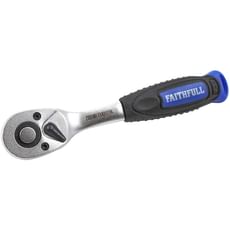
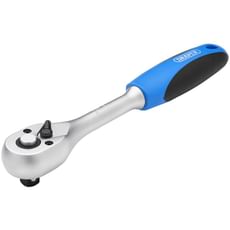
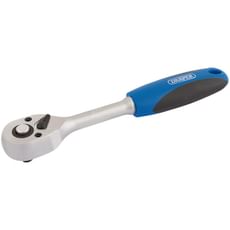
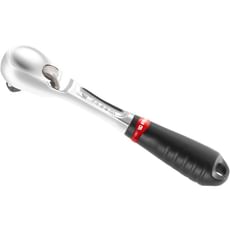
A ratchet, often referred to as a socket wrench or ratchet handle, is an essential tool for any professional tradesperson or serious DIY enthusiast. Featuring a male square drive connector, ratchets accept interchangeable sockets that fit various fastener sizes, making them incredibly versatile for mechanical work, automotive repairs, and general maintenance tasks. The ingenious ratcheting mechanism allows users to tighten or loosen nuts and bolts with continuous back-and-forth motion, eliminating the need to reposition the tool after each turn like traditional spanners require. A reversible switch on the head changes the direction of operation, enabling efficient work in confined spaces where full rotation isn't possible.
Ratchets are manufactured in several standard drive sizes, each suited to different applications and torque requirements. The compact 1/4" drive ratchets are ideal for light-duty tasks, precision work, and accessing tight spaces, whilst 3/8" drive models offer a versatile middle ground for general automotive and mechanical applications. The 1/2" drive ratchet remains the most popular choice for general-purpose work, delivering sufficient torque for most automotive, engineering, and maintenance jobs. Heavy-duty industrial applications may require 3/4" or 1" drive ratchets capable of handling extreme torque loads. Tooled-Up.com stocks an extensive selection from trusted manufacturers including Bahco, Draper, Elora, and Blue Spot, offering everything from standard fixed-head designs to advanced swivel head models and quick-release mechanisms.
Modern ratchets incorporate various features that enhance usability and durability. Fine tooth counts—such as 60 or 72 teeth—provide smaller action angles (6° or 5° respectively), allowing operation in extremely restricted spaces. Quick-release buttons enable fast socket changes, whilst sealed head designs protect the mechanism from dust and contamination. Soft-grip handles improve comfort during extended use, and many professional-grade ratchets feature chrome vanadium steel construction with corrosion-resistant finishes for long-lasting performance on site.
Jargon Buster
- Drive Size: The measurement of the square drive connector (1/4", 3/8", 1/2", 3/4", or 1") that determines which sockets fit the ratchet. Drive size generally correlates with the tool's intended torque capacity.
- Tooth Count: The number of internal teeth in the ratchet mechanism, which determines the action angle. Higher tooth counts (60 or 72 teeth) require less swing arc to engage the next tooth, making them essential for working in confined spaces.
- Action Angle: The minimum arc of swing required for the ratchet to advance to the next position. A 72-tooth ratchet has a 5° action angle, whilst a 60-tooth model requires 6°, and a 45-tooth ratchet needs 8°.
- Quick Release: A button mechanism on the ratchet head that releases the ball detent, allowing sockets to be removed quickly without pulling them off manually—essential for efficient workflow.
- Swivel Head: A pivoting ratchet head that can be positioned at various angles, providing improved access to fasteners located at awkward angles or in recessed positions.
- Sealed Head: A ratchet design where the mechanism is fully enclosed to prevent ingress of dust, dirt, and moisture, extending the tool's working life in harsh environments.
Who Uses Ratchets?
Ratchets are indispensable across numerous trades and applications:
- Motor Mechanics and Automotive Technicians: For engine work, suspension repairs, brake servicing, and general vehicle maintenance
- Plant Maintenance Engineers: Servicing industrial machinery, production equipment, and manufacturing plant
- Agricultural Engineers: Maintaining tractors, harvesters, and farm machinery in field conditions
- HVAC Engineers: Installing and servicing heating systems, air conditioning units, and ventilation equipment
- Plumbers and Heating Engineers: For radiator valve work, boiler installation, and pipework assembly
- Construction Workers: Assembling scaffolding, structural steelwork, and temporary site installations
- Bike Mechanics: Bicycle assembly, maintenance, and repair work
- Marine Engineers: Boat maintenance and marine engine servicing
- DIY Enthusiasts: Home repairs, furniture assembly, and general household maintenance tasks
How to Choose the Right Ratchets
Selecting the appropriate ratchet depends on several key factors:
Drive Size Selection: Match the drive size to your typical applications. A 1/4" drive suits electronics, small appliances, and precision work; 3/8" drive handles light automotive and general mechanical tasks; 1/2" drive is the workhorse for most automotive and industrial applications; whilst 3/4" and 1" drives are reserved for heavy industrial and commercial vehicle work. Many professionals maintain multiple drive sizes to cover all scenarios.
Tooth Count and Action Angle: For general workshop use with plenty of clearance, a 45-tooth (8°) ratchet provides robust construction and reliability. When working around engines, dashboards, or machinery where space is limited, opt for 60-tooth (6°) or 72-tooth (5°) models available at Tooled-Up. The finer tooth count enables operation where only minimal swing arc is available.
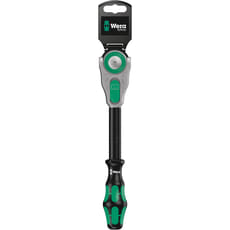
Handle Length: Longer handles provide greater leverage for stubborn fasteners but may not fit into confined areas. Compact or stubby ratchets excel in tight spaces but offer less mechanical advantage. Extending ratchets provide adjustable length, combining compactness with leverage when needed.
Quick Release Mechanism: This feature dramatically speeds up socket changes and is virtually essential for professional use where efficiency matters. The push-button release prevents fumbling with stuck sockets.
Head Design: Standard fixed-head ratchets offer maximum strength and reliability. Swivel head (flex head) ratchets provide improved access to awkward angles but may sacrifice some durability. Sealed head designs protect the mechanism in dusty or dirty environments, extending service life.
Handle Comfort: Soft-grip or two-component handles reduce fatigue during extended use and improve grip, particularly important when hands are oily or wet—common conditions in automotive and engineering work.
Build Quality and Standards: Professional-grade ratchets conforming to ISO 3315, DIN 3122, or BS standards ensure reliability and safety. Chrome vanadium steel construction with corrosion-resistant finishes indicates quality manufacturing suitable for professional environments.
Popular Accessories
Maximise the versatility of your ratchets with these complementary products:
- Socket Sets: Deep and shallow sockets in metric and imperial sizes to match your ratchet's drive size
- Extension Bars: Various lengths for reaching recessed fasteners whilst maintaining socket drive
- Universal Joints: Allow angled access to fasteners not directly in line with the ratchet
- Drive Adaptors: Convert between different drive sizes, such as using 1/4" sockets on a 3/8" ratchet
- Torque Adaptors: Add calibrated torque control to standard ratchets for precision tightening
- Ratchet Repair Kits: Replacement mechanisms, springs, and pawls to restore worn ratchets to service
- Socket Rails and Trays: Organised storage solutions keeping sockets accessible and preventing loss
- Tool Rolls and Cases: Portable storage for ratchets and socket sets on mobile or site work
- Breaker Bars: Non-ratcheting handles for applying maximum torque to seized fasteners
Safety Information
Whilst ratchets are relatively safe tools, observe these precautions for injury-free operation:
Correct Tool Selection: Never exceed the ratchet's torque rating—using undersized drive ratchets on stubborn fasteners can cause mechanism failure, potentially resulting in injury. Use appropriately rated tools, or switch to a breaker bar for initial loosening of seized fasteners.
Socket Security: Always ensure sockets are fully engaged on both the fastener and the ratchet drive before applying force. Partially engaged sockets can slip off under load, causing rounded fasteners or hand injuries.
Direction Setting: Verify the ratchet direction before applying significant force. Applying full force in the wrong direction can round fasteners or cause the tool to slip unexpectedly.
Handle Extensions: Never fit extension pipes or "cheater bars" to ratchet handles to gain extra leverage—this practice exceeds design limits and can cause catastrophic mechanism failure. Use a breaker bar or impact wrench instead.
Body Position: Position yourself to avoid injury if the ratchet slips or the fastener suddenly releases. Keep your face away from the handle path and use controlled force rather than sudden jerks.
Regular Inspection: Examine ratchets periodically for worn teeth, damaged mechanisms, or loose components. Replace worn tools—ratchet failure under load can cause serious injury.
Frequently Asked Questions
What's the difference between 60-tooth and 72-tooth ratchets?
The tooth count determines how far you need to swing the handle for the ratchet to advance. A 72-tooth ratchet requires only 5° of movement, whilst a 60-tooth needs 6°, and a 45-tooth requires 8°. Higher tooth counts work better in confined spaces but may be slightly less robust. For general workshop use, 60-tooth ratchets offer an excellent balance of fine operation and durability, whilst 72-tooth models excel when working in extremely tight quarters around engines or machinery.
Can I use any socket with my ratchet?
Sockets must match your ratchet's drive size—1/4", 3/8", 1/2", 3/4", or 1". Using mismatched sizes requires a drive adaptor. Additionally, ensure sockets meet appropriate quality standards (ISO, DIN, or BS) and are rated for your application. Impact sockets (black finish) should only be used with impact wrenches, not hand ratchets, as they're designed for different stress patterns.
How do I maintain my ratchet?
Keep the mechanism clean by periodically wiping away accumulated dirt and grease. Apply a small amount of light machine oil to the ratchet head mechanism to ensure smooth operation. Avoid pressure washing or submerging ratchets, as water can contaminate the mechanism. Store ratchets in a dry location, and if you notice roughness or slipping, consider servicing with a ratchet repair kit or replacing worn components before complete failure occurs.
Why does my ratchet sometimes skip or slip?
Ratchet skipping typically indicates worn pawls (the small parts that engage the teeth) or damaged teeth inside the mechanism. This often results from exceeding the tool's torque rating, using it as a breaker bar, or simply wear from extensive use. Whilst some professional-grade ratchets can be rebuilt using repair kits, heavily worn mechanisms may require complete replacement. Never continue using a skipping ratchet, as it can fail completely under load.
Are swivel head ratchets as strong as fixed head models?
Swivel (flex) head ratchets incorporate additional pivot points to provide angular access, which inherently introduces slight compromise in ultimate strength compared to fixed head designs. However, quality swivel head ratchets from reputable manufacturers remain entirely suitable for professional use within their rated specifications. They excel when access angles are challenging, though for maximum torque applications or when using the ratchet as a breaker bar (which isn't recommended), fixed head designs offer superior strength.