

Router Tables

Pay in 3 interest-free payments on purchases from £20-£3000 with  . Learn more.
 Loading...
End of content
Error - No more pages to load
About Router Tables
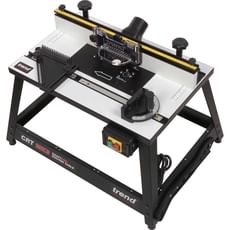
Router tables are essential workshop accessories that transform a handheld router into a stationary power tool, providing greater precision, control and safety for a wide range of woodworking operations. By mounting the router upside down beneath a flat work surface, router tables allow you to feed timber past a fixed cutter rather than moving the router across the workpiece. This configuration is particularly valuable for edge profiling, grooving, rebating, and creating joints on smaller components that would be difficult or dangerous to handle with a handheld router.
A quality router table comprises several key components: a sturdy flat table surface (typically laminated MDF or phenolic resin), an adjustable fence system for accurate guidance, a router mounting plate with interchangeable inserts to accommodate different cutter sizes, and often includes features such as dust extraction ports, featherboards for workpiece control, and quick-release mechanisms for router adjustment. Tooled-Up.com stocks router tables designed for both professional cabinetmakers and serious woodworking enthusiasts, with models offering varying levels of sophistication to match different workshop requirements and budgets.
Modern router tables have evolved to maximise the versatility of standard portable routers, with features like quick-height adjustment systems that eliminate the need to reach beneath the table, T-track slots for mounting accessories, and precision fence adjustments measured in fractions of a millimetre. Whether you're producing repetitive mouldings for architectural joinery or creating one-off furniture components, a well-designed router table significantly expands your routing capabilities whilst improving both accuracy and operator safety.
Jargon Buster
- Insert Plate: The removable aluminium or phenolic plate that sits flush with the table surface and holds the router. Quality plates are precision-machined for flatness and include interchangeable insert rings to minimise the gap around different sized cutters, reducing workpiece tear-out and improving dust collection.
- Fence: The adjustable guide that runs parallel or at angles to the cutter, providing reference for straight cuts. Router table fences typically feature independently adjustable cheeks (faces) that can be positioned close to the cutter for maximum support, plus dust extraction ports positioned behind the cutter.
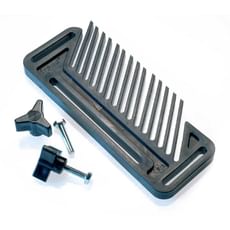
- Featherboard: A safety device with flexible fingers that applies consistent pressure to hold workpieces against the fence or table surface, preventing kickback whilst allowing forward movement only. Essential for safe routing of smaller components.
- NVR Switch: No Volt Release switch - a safety feature that prevents the router from restarting automatically after a power cut. Required under HSE guidelines for stationary machinery in professional workshops.
- Quick-Raiser: A through-the-table height adjustment mechanism that allows precise cutter height changes from above the table, eliminating the need to access the router motor beneath. Particularly valuable when making incremental depth adjustments during setup.
- Split Fence: A fence design where the two halves can be offset independently, essential when using bearing-guided cutters where the workpiece needs full support both before and after the cut.
Who Uses Router Tables?
- Cabinetmakers and Joiners: For creating rail and stile joints, decorative edge profiles, and consistent joinery on cabinet components
- Furniture Makers: Producing shaped edges, grooves for drawer bottoms, and decorative mouldings on table legs and drawer fronts
- Architectural Joinery Specialists: Manufacturing bespoke skirting boards, architraves, window boards and panelling profiles
- Shopfitters: Creating custom mouldings and edge treatments for retail display units and fitted installations
- Wood Machinists: For precision jointing operations including box joints, dovetail housings and template routing
- Restoration Specialists: Replicating period mouldings and profiles to match existing architectural features in heritage buildings
- Serious DIY Woodworkers: Home workshop enthusiasts undertaking quality furniture making, fitted furniture projects and decorative woodwork
- Model Makers and Instrument Builders: For precise miniature components requiring accurate rebating and profiling capabilities
How to Choose the Right Router Tables
Table Surface Size and Flatness: Larger table surfaces provide better support for substantial workpieces, whilst flatness is critical for accurate results. Look for laminated MDF or cast aluminium surfaces with less than 0.2mm deviation across the working area. The Tooled-Up range includes tables sized for both compact workshops and professional installations.
Router Compatibility: Verify that the mounting plate accepts your existing router or the router you intend to purchase. Most quality tables use industry-standard drilling patterns compatible with popular brands like Trend, DeWalt, and Makita, but pre-drilled plates save considerable setup time. Some tables include quick-release systems designed for specific router models.
Fence System Quality: The fence is crucial for accuracy. Look for rigid aluminium extrusions with precise adjustment mechanisms, independently adjustable faces, and clear measuring scales. High fences (150mm+) provide better support for vertical workpieces. Integrated dust extraction significantly improves visibility and workshop cleanliness.
Insert Plate System: Thick aluminium plates (6mm+) resist flexing better than thin phenolic alternatives. Multiple insert ring sizes accommodate different cutter diameters whilst minimising the gap around smaller cutters. Some systems offer tool-free insert changes for rapid cutter access.
Height Adjustment Method: Basic tables require you to adjust the router's plunge mechanism beneath the table. Mid-range options offer through-the-table winding handles, whilst premium tables feature micro-adjustable raising systems with digital readouts. Consider how frequently you'll change cutter heights when selecting your system.
Build Quality and Stability: Router tables generate significant lateral forces, particularly with large-diameter panel-raising cutters. Robust construction with rigid leg assemblies or cabinet-style bases prevents vibration. Benchtop models should include substantial clamping or fixing points.
Power Supply Considerations: Ensure your router table setup includes appropriate 240v power switching. NVR switches are essential for professional compliance, and convenient above-table power switching improves safety by eliminating the need to reach beneath the table.
Popular Accessories
- Router Cutters: TCT profile cutters, straight cutters, bearing-guided trimmers, panel raisers and chamfer bits in various shank sizes (1/4" and 1/2")
- Additional Featherboards: Supplementary pressure guards for enhanced workpiece control on complex operations
- Push Sticks and Push Blocks: Essential safety accessories for keeping hands away from cutters whilst maintaining workpiece control
- Extraction Hoses and Adaptors: Connecting router table dust ports to workshop vacuum systems (typically 63mm or 100mm diameter)
- Mitre Gauges and Sleds: For accurate cross-cutting and angled operations on the router table
- Router Table Inserts: Additional insert rings in various aperture sizes to suit different cutter diameters
- T-Track and Hold-Down Clamps: For securing jigs and auxiliary fences to table surfaces with T-track slots
- Dedicated Routers: Many woodworkers dedicate a specific router permanently to table mounting, with 1/2" collet models offering maximum versatility
- Digital Height Gauges: For precise cutter height measurement and repeatability between setups
- Router Table Books and Plans: Guides covering advanced techniques and jig-building projects
Safety Information
Guarding and Protection: Router tables must incorporate adequate guarding around the cutter, particularly for operations where the full fence cannot be used. Featherboards should be positioned to prevent workpiece kickback, and the exposed cutter should be covered wherever possible. Never remove more than 3-4mm of material in a single pass with large cutters.
Direction of Feed: Always feed workpieces against the cutter rotation (typically right to left when facing the fence). Feeding in the wrong direction can cause violent kickback. When climb-cutting is necessary for finish quality, take extremely light cuts with proper workpiece support.
Electrical Safety: Router tables should be connected to a 240v supply via an NVR switch that prevents automatic restart after power interruption. RCD protection is strongly recommended, particularly in professional workshops. Ensure the router is fully isolated before changing cutters or performing maintenance.
Cutter Speed and Selection: Large-diameter cutters (over 50mm) should be run at reduced speeds to avoid excessive rim speeds that can cause cutter failure. Consult HSE guidance on maximum router speeds for panel-raising and large-profile cutters. Always inspect cutters for damage before mounting.
Personal Protective Equipment: Hearing protection is essential as router tables generate over 100dB. Safety glasses protect against ejected chips, and dust extraction should be used to minimise inhalation of fine wood particles. Avoid loose clothing, jewellery and ensure long hair is tied back. Never wear gloves when operating router tables as they present an entanglement hazard.
Frequently Asked Questions
What size router do I need for a router table?
For general router table work, a 1/2" collet router with 1200-1800W motor provides the best balance of power and versatility. Larger motors (2000W+) handle heavy-duty operations like panel raising but generate more heat during extended use. Quarter-inch collet routers lack the rigidity for demanding table operations. Variable speed control is valuable for running large-diameter cutters at reduced speeds. Most quality router tables at Tooled-Up accept a wide range of popular router models from manufacturers including Trend, DeWalt, and Makita.
Can I build my own router table or should I buy one?
Experienced woodworkers can build functional router tables from quality sheet materials, but achieving the flatness tolerances required for precision work (under 0.2mm deviation) is challenging without machine shop facilities. Commercial router tables include engineered insert plates, precision fence systems, and proper dust extraction integration that would be difficult to replicate. For most users, manufactured tables offer better value when time and material costs are considered, plus they include safety features and compatibility with standard accessories.
Do router tables require three-phase power?
No, router tables designed for the UK market operate from standard 240v single-phase supplies using the router's existing plug. There's no need for three-phase installation or special electrical work. However, an NVR switch should be incorporated, particularly in professional settings, to comply with HSE machinery safety requirements.
How do I prevent tear-out when routing end grain?
End grain routing requires several precautions: use sharp TCT cutters rather than HSS; reduce the depth of cut to no more than 2mm per pass; always rout across the grain direction last so any breakout occurs at the edge; employ a backing board clamped behind the workpiece; and ensure the fence is positioned close to the cutter with minimal gap. Split fences work particularly well for end grain work as they support the workpiece throughout the cut.
What's the difference between a router table insert and a template guide?
A router table insert (or insert plate) is the substantial aluminium or phenolic plate that mounts in the router table surface and holds the entire router assembly. It includes interchangeable insert rings that adjust the aperture size around different cutter diameters. Template guides (also called guide bushes) are small cylindrical collars that fit to the router base for pattern following work - these are primarily used with handheld routing rather than table-mounted operations, though some specialised table jigs do incorporate them.