

Sanding Drums

Pay in 3 interest-free payments on purchases from £20-£3000 with  . Learn more.
 Loading...
End of content
Error - No more pages to load
About Sanding Drums
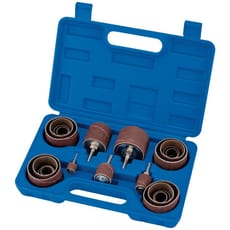
Sanding drums are cylindrical abrasive tools designed to smooth curves, contours and hard-to-reach areas that flat sanders simply cannot access. Consisting of a rubber or foam drum covered with replaceable abrasive sleeves, these versatile accessories mount onto drill presses, handheld drills or rotary multi-tools to tackle detailed sanding work. They excel at finishing inside curves, rounding edges, smoothing bore holes and refining intricate woodworking projects where precision matters.
Available in various diameters and lengths, sanding drums offer an economical alternative to dedicated spindle sanders or bobbin sanders whilst delivering professional results. The abrasive sleeves come in different grit ratings, from coarse grits for rapid material removal to fine grits for final finishing touches. Smaller diameter drums suit delicate detail work in jewellery making, model building and instrument repair, whilst larger drums handle more substantial joinery and carpentry tasks. The selection at Tooled-Up.com includes comprehensive drum sets with multiple sizes and abrasive sleeves, providing excellent value for both professional tradespeople and dedicated DIY enthusiasts.
Most sanding drums feature either a fixed mandrel or expandable design. Expandable drums incorporate an internal mechanism that expands when tightened, securing the abrasive sleeve firmly in place and allowing quick sleeve changes without tools. This design proves particularly valuable when switching between different grit ratings during multi-stage finishing work. Compatible with standard 240v variable speed drills, these accessories transform everyday power tools into precision sanding stations.
Jargon Buster
- Arbor: The shaft or spindle that mounts into the drill chuck, typically available in 3mm, 6mm or 8mm diameters to suit different drill capacities.
- Abrasive Sleeve: The replaceable sandpaper tube that slides over the rubber drum. These wear out with use and are considered consumable items available in various grit ratings.
- Grit Rating: The number indicating abrasive coarseness. Lower numbers (40-80 grit) remove material aggressively, whilst higher numbers (150-320 grit) create smoother finishes.
- Mandrel: The complete assembly including the drum body and arbor shaft. Some designs feature expandable mandrels that grip sleeves more securely.
- Drum Diameter: The measurement across the sanding drum face, typically ranging from 6mm for detail work up to 50mm for larger applications.
- Variable Speed: A drill or multi-tool feature allowing RPM adjustment. Essential for sanding drums as different materials and grit ratings require specific speeds to prevent burning or premature sleeve wear.
Who Uses Sanding Drums?
- Carpenters and Joiners: Smoothing curved components, inside radii on furniture pieces and detailed joinery work
- Cabinet Makers: Finishing curved drawer pulls, decorative mouldings and intricate cabinet details
- Luthiers and Instrument Makers: Shaping and smoothing wooden instruments, sound holes and curved components
- Model Makers: Detail sanding on miniature projects, architectural models and hobbyist creations
- Furniture Restorers: Refinishing antique pieces, removing old finishes from detailed areas and preparing curved surfaces
- Metal Workers: Deburring holes, smoothing welds and finishing metal fabrications with appropriate abrasive sleeves
- DIY Enthusiasts: Home renovation projects, craft work and general workshop tasks requiring precision sanding
- Jewellery Makers: Fine detail work on precious metals, wood and composite materials
How to Choose the Right Sanding Drums
Drum Size Selection: Consider the curves and spaces you'll be working with most frequently. Multi-piece sets offer versatility, whilst single drums suit specific repetitive tasks. Smaller diameters (6-13mm) excel at tight curves and detail work, medium sizes (18-25mm) handle general-purpose tasks, and larger diameters (38-50mm) tackle substantial curved surfaces efficiently.
Arbor Compatibility: Verify the arbor diameter matches your drill chuck capacity. Most cordless drills accept up to 10mm, whilst larger drill presses accommodate bigger arbors. Variable speed capability is essential – look for drills offering 500-2000 RPM for optimal control.
Sleeve Availability: Check that replacement abrasive sleeves are readily available from Tooled-Up or other suppliers. Sets including multiple sleeves offer better initial value, and knowing that consumables remain accessible ensures long-term usability.
Drum Construction: Rubber drums provide firmness for aggressive material removal, whilst foam or softer drums offer flexibility for contoured surfaces. Expandable mandrels simplify sleeve changes and maintain better grip during extended use, though fixed drums cost less initially.
Grit Variety: Professional work typically requires progressing through multiple grits. A comprehensive set should include coarse (60-80 grit) for shaping, medium (100-120 grit) for smoothing and fine (180-240 grit) for finishing touches.
Popular Accessories
- Replacement Abrasive Sleeves: Stock various grit ratings as these consumables wear relatively quickly with regular use
- Variable Speed Drills: Corded 240v or cordless models from Makita, DeWalt or Bosch providing essential speed control
- Drill Press: Offers superior control and consistency for repetitive sanding operations
- Rotary Multi-Tools: Compact tools perfect for detailed work with smaller sanding drums
- Dust Extraction Systems: Connect to workshop vacuums for healthier working conditions
- Safety Glasses: Essential eye protection from airborne dust and particles
- Dust Masks or Respirators: Protect respiratory health when sanding produces fine dust
- Work Clamps or Vices: Secure workpieces safely during sanding operations
Safety Information
Personal Protective Equipment: Always wear safety glasses or a full face shield to protect against flying debris. Use appropriate dust masks or respirators, particularly when sanding materials that produce fine particles or when working with treated timber. The HSE recommends adequate respiratory protection for any dust-generating activities.
Secure Workpieces: Never hold small items by hand whilst using sanding drums. Always clamp work securely to prevent it catching and spinning, which could cause serious injury. Ensure drill presses are properly adjusted with appropriate table height and speed settings.
Speed Settings: Excessive speed generates heat that can burn workpieces and cause premature abrasive sleeve failure. Start at lower speeds and increase gradually. Different materials require different speeds – hardwoods tolerate higher speeds whilst softer materials and fine grits demand slower rotation.
Inspection and Maintenance: Check sanding drums before each use for damage, wear or loose sleeves. Replace worn sleeves immediately as torn abrasives can catch on workpieces dangerously. Disconnect power tools from 240v mains supply or remove batteries before changing sleeves or making adjustments.
Frequently Asked Questions
What's the difference between a sanding drum and a spindle sander?
A sanding drum is an accessory that mounts in a standard drill or multi-tool, offering an economical solution for occasional curve sanding. A spindle sander is a dedicated benchtop machine with an oscillating spindle that moves up and down whilst rotating, providing more aggressive material removal and reduced heat build-up. For professional workshops tackling frequent curved work, spindle sanders justify the investment, but sanding drums suit most DIY and light trade applications perfectly.
How long do abrasive sleeves typically last?
Sleeve longevity depends on material hardness, pressure applied and work duration. When sanding softwoods, a sleeve might handle several projects, whilst hardwoods or aggressive material removal wears sleeves faster. Replace sleeves when abrasive particles become clogged, visibly worn or when sanding efficiency noticeably decreases. Purchasing multi-pack sleeve sets from Tooled-Up.com provides better value than individual replacements.
Can I use sanding drums on metal as well as wood?
Yes, with appropriate abrasive sleeves. Aluminium oxide sleeves suit general woodworking, whilst silicon carbide or zirconia sleeves handle metal, fibreglass and harder materials more effectively. Adjust drill speed according to material – metals generally require slower speeds than wood to prevent heat damage and premature sleeve wear.
What drill speed should I use with sanding drums?
Start around 1000-1500 RPM for general woodworking tasks and adjust based on results. Coarse grits tolerate higher speeds for rapid material removal, whilst fine grits require slower speeds to prevent burning. Harder materials like metals need slower speeds (500-800 RPM), whilst softer woods can handle slightly faster rotation. Variable speed control proves essential for optimal results across different applications.
Why do my abrasive sleeves keep slipping or tearing?
Slipping typically indicates the sleeve isn't properly secured. With expandable drums, ensure you've tightened the mechanism fully. Fixed drums may require replacement if the rubber has compressed with age. Tearing often results from excessive speed, applying too much pressure or catching workpiece edges. Let the abrasive do the work with light pressure, and always sand with the grain direction where possible to prevent catching.