

Security Lighting
Pay in 3 interest-free payments on purchases from £30-2000 with  . Learn more.
 Loading...
End of content
Error - No more pages to load
About Security Lighting
Security lighting provides essential illumination to protect properties, deter intruders, and improve safety around homes, commercial premises, and industrial sites. Modern security lighting systems typically incorporate PIR (Passive Infrared) motion sensors that automatically activate when movement is detected, providing instant illumination when needed whilst conserving energy when areas are unoccupied. LED technology has revolutionised this category, offering powerful, energy-efficient alternatives to traditional halogen floodlights with significantly lower running costs and longer lifespans.
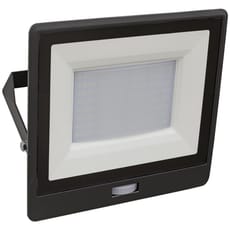
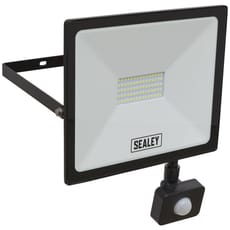
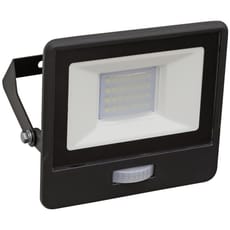
The security lighting selection at Tooled-Up.com features high-performance LED floodlights with integrated PIR sensors, available in various wattages to suit different applications. These units are housed in durable, weather-resistant enclosures designed for permanent outdoor installation, with die-cast aluminium construction and powder-coated finishes ensuring longevity in harsh British weather conditions. Whether illuminating domestic driveways, commercial car parks, warehouse loading bays, or construction site perimeters, these 240v-powered solutions deliver reliable performance with wide beam angles typically around 110°, providing comprehensive coverage across large areas.
Professional-grade security lighting offers adjustable settings for detection range, sensitivity, and illumination duration, allowing users to customise operation according to specific requirements. The transition from halogen to LED technology has delivered substantial benefits, with equivalent or superior light output at a fraction of the energy consumption, reduced maintenance requirements due to extended bulb life, and cooler operating temperatures that improve safety and comfort in enclosed or semi-enclosed spaces.
Jargon Buster
- PIR Sensor (Passive Infrared) - A motion detection device that triggers lighting when it detects changes in infrared radiation caused by moving warm bodies. Detection range and sensitivity are typically adjustable to prevent false triggers from small animals or passing vehicles.
- Lumen Output - The measurement of total visible light emitted by a source. Higher lumen ratings indicate brighter illumination, with modern LED security lights delivering 1,000-10,000+ lumens depending on wattage, far exceeding the efficiency of equivalent halogen units.
- IP Rating (Ingress Protection) - A standardised classification indicating protection levels against solid objects and liquids. Security lighting typically requires IP65 or higher, ensuring complete dust protection and resistance to water jets from any direction.
- Beam Angle - The spread of light emitted, measured in degrees. Wider angles (100-120°) provide broader coverage suitable for general security lighting, whilst narrower beams focus illumination on specific areas or entry points.
- SMD LED (Surface Mounted Device) - Advanced LED technology where multiple small diodes are mounted directly onto circuit boards, providing superior brightness, better heat dissipation, and more uniform light distribution compared to traditional LED configurations.
- Colour Temperature - Measured in Kelvin (K), this describes the light's appearance. Security lighting typically uses cool white (5000-6500K) for alertness and clear visibility, or daylight white (4000-5000K) for more natural colour rendering.
Who Uses Security Lighting?
- Homeowners and Property Owners - Installing floodlights around driveways, gardens, garages, and entry points for domestic security and convenience
- Electricians and Electrical Contractors - Specifying and installing security lighting systems for residential and commercial clients throughout the UK
- Facilities Managers - Maintaining adequate illumination and security across commercial premises, car parks, and business estates
- Property Developers and Builders - Incorporating security lighting into new builds and renovation projects as standard safety features
- Warehouse and Logistics Operators - Securing loading bays, storage yards, and perimeter areas with motion-activated illumination
- Agricultural and Rural Users - Protecting farm buildings, equipment storage areas, and access routes on rural properties
- Local Authorities and Council Maintenance Teams - Installing security lighting in public spaces, community centres, and municipal buildings
- Retailers and Shop Owners - Illuminating rear access areas, delivery zones, and car parks to enhance security and customer safety
- Construction Site Managers - Securing site compounds, tool storage, and machinery areas during non-working hours
How to Choose the Right Security Lighting
Wattage and Brightness Requirements: Consider the area size requiring illumination. Smaller domestic applications like doorways or side passages may need 20-30w LED units, whilst larger areas such as driveways or commercial yards benefit from 50-100w+ models. Remember that LED wattage doesn't directly correlate to brightness—check lumen output for true comparison.
Detection Range and Coverage: Evaluate the PIR sensor specifications, with typical detection ranges between 8-15 metres. Consider mounting height, detection angle (usually 180° or 240°), and potential obstacles that might interfere with sensor operation. Adjustable sensitivity settings allow fine-tuning to minimise false activations.
Power Supply and Installation: Most security lighting connects to 240v mains electricity, requiring competent electrical installation or certification by a qualified electrician. Consider cable routing, existing outdoor circuits, and whether units include integral junction boxes or require separate connection points. Some applications may benefit from dusk-till-dawn sensors in addition to PIR activation.
Build Quality and Weather Resistance: Tooled-Up stocks robust units constructed from die-cast aluminium with powder-coated finishes designed to withstand British weather conditions. Verify IP ratings meet requirements for the installation location—exposed coastal areas demand higher protection than sheltered urban environments. Quality construction ensures longevity and reduces maintenance requirements.
Beam Angle and Light Distribution: Wide beam angles (110-120°) suit general area coverage, whilst narrower beams provide focused illumination for specific zones. Consider whether you need even light distribution across the entire coverage area or concentrated brightness on particular features like gates, doors, or pathways.
Energy Efficiency and Running Costs: LED technology dramatically reduces electricity consumption compared to halogen alternatives. Calculate projected running costs based on expected activation frequency—PIR-triggered operation typically means lights run for minutes rather than hours, maximising energy savings whilst maintaining security coverage.
Popular Accessories
- Extension Cables and Weatherproof Connectors - Outdoor-rated electrical accessories for safe 240v power distribution to security lighting installations
- Cable Conduit and Trunking - Protective housing for external cabling runs, ensuring compliance with electrical regulations and protecting against weather damage
- Mounting Brackets and Adjustable Arms - Additional or replacement mounting hardware for optimal positioning and angle adjustment
- Timer Switches and Photocell Sensors - Supplementary control devices for scheduling or dusk-till-dawn automatic operation
- Spare PIR Sensors - Replacement motion detection units for maintenance and upgrades
- CCTV and Surveillance Cameras - Complementary security equipment often installed alongside illumination systems
- External Junction Boxes - Weatherproof enclosures for electrical connections in outdoor installations
- Security Signage - Visible warnings that properties are protected by security lighting and surveillance systems
Safety Information
Electrical Installation: All 240v security lighting installations must comply with BS 7671 wiring regulations (IET Wiring Regulations). Unless competent and qualified, engage a registered electrician (Part P certified for domestic work) to carry out installation and testing. Outdoor electrical work presents particular hazards requiring appropriate cable types, protective devices, and earthing arrangements.
Working at Height: Installation typically requires ladder work or elevated access. Follow HSE guidance for safe working at height, ensuring ladders are secured, positioned at correct angles, and used on stable ground. For installations above 2 metres or in challenging locations, consider scaffold towers or professional installation services.
Positioning Considerations: Mount units away from flammable materials and ensure adequate clearance for heat dissipation, despite LED technology generating minimal heat compared to halogen alternatives. Position sensors to avoid direct sunlight, which can affect performance, and ensure coverage doesn't create light pollution affecting neighbours or highways.
Maintenance and Inspection: Regularly inspect installations for secure mounting, cable integrity, and lens cleanliness. Dirt accumulation on PIR sensors can reduce sensitivity, whilst debris on light fittings diminishes output. Always isolate power supplies before conducting maintenance work on 240v systems.
Frequently Asked Questions
How much electricity does LED security lighting consume compared to halogen?
LED security lights use approximately 80-90% less energy than equivalent halogen units. A 50w LED floodlight provides similar illumination to a 400-500w halogen lamp, delivering substantial savings on electricity bills whilst reducing environmental impact. With PIR activation ensuring lights only operate when needed, actual consumption is minimal for typical domestic installations.
Can I install security lighting myself or do I need an electrician?
Any work involving 240v mains electricity in the UK must comply with building regulations Part P. Outdoor electrical installations are notifiable work requiring certification. Unless you hold appropriate qualifications and can self-certify, you must engage a registered electrician to ensure safe, compliant installation and obtain necessary certification for building control and insurance purposes.
How do I adjust PIR sensor sensitivity to stop false triggers?
Most security lights feature adjustable controls—typically small dials or screws—for sensitivity (how readily the sensor responds), range (detection distance), and duration (how long lights remain on after activation). Reduce sensitivity if small animals or moving vegetation trigger false activations. Adjust range to focus detection on relevant areas rather than passing traffic or neighbouring properties.
What IP rating do I need for outdoor security lighting?
For standard outdoor installation in the UK, IP65 rating provides adequate protection against dust ingress and water jets from any direction, suitable for wall-mounted positions with some weather shelter. More exposed locations—coastal areas, fully open mounting positions, or sites with pressure washing requirements—benefit from IP66 or IP67 ratings offering enhanced water protection.
How long do LED security lights last before requiring replacement?
Quality LED units typically offer 30,000-50,000 hours operational life—equivalent to 15-25 years under normal security lighting usage patterns. Unlike halogen lamps requiring frequent bulb changes, LEDs gradually diminish in brightness over time rather than failing suddenly. Die-cast aluminium housings and weather-resistant construction ensure the entire fitting remains serviceable throughout this extended lifespan.