

Split Pins

Pay in 3 interest-free payments on purchases from £20-£3000 with  . Learn more.
 Loading...
End of content
Error - No more pages to load
About Split Pins
Split pins, also known as split cotter pins or cotter keys, are fundamental fastening components used throughout mechanical and engineering applications. These ingenious devices consist of a metal wire formed into a cylindrical shaft with two legs that can be bent outwards after insertion through a hole. Their primary purpose is to secure clevis pins, castle nuts, and other components where a reliable yet removable fastening solution is required. Unlike permanent fixings such as welded joints or rivets, split pins allow for easy disassembly and reassembly, making them invaluable for maintenance work and applications requiring regular inspection or adjustment.
Split pins are manufactured from various materials including mild steel, stainless steel, brass, and copper, each offering different properties suited to specific environments and load requirements. The most common type is the standard cylindrical split pin with a half-round cross-section, though both metric and imperial sizing options are available to suit different hole diameters. Metric sizes typically range from 1mm to 13mm in nominal diameter, whilst imperial sizes use fractional inch measurements for older British and American-made equipment. Many split pins feature protective finishes such as galvanised or zinc-plated coatings to enhance corrosion resistance in demanding environments.
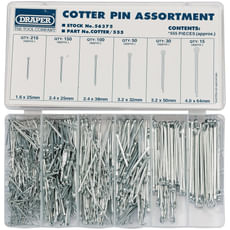
Whether you're maintaining agricultural machinery, repairing automotive components, or working on industrial equipment, having a well-organised selection of split pins in your toolbox ensures you're never caught without the right fastener. Tooled-Up.com stocks comprehensive split pin assortments from trusted brands like Draper, providing tradespeople and DIY enthusiasts with a ready supply of commonly used sizes for workshop and site work. These cost-effective components may be small, but their role in preventing catastrophic component failure makes them critical safety items in mechanical assemblies across all industries.
Jargon Buster
- Split Pin / Cotter Pin: A metal fastener formed from a single piece of wire bent in half to create two legs that can be inserted through a hole and bent outwards to secure components in place.
- Castle Nut (Castellated Nut): A nut with slots cut into its upper surface, designed to accept a split pin through a hole in a bolt, preventing the nut from loosening through vibration or torque.
- Clevis Pin: A cylindrical pin with a head at one end and a cross-hole at the other, through which a split pin is inserted to prevent the pin from sliding out of its mounting.
- Nominal Diameter: The measurement of the split pin shaft before it's inserted, typically ranging from 1mm to 13mm, which should match the hole diameter in the component being secured.
- Shear Strength: The maximum force a split pin can withstand before breaking when force is applied perpendicular to its shaft—critical for ensuring safety in load-bearing applications.
- Galvanised Finish: A protective zinc coating applied to steel split pins to prevent corrosion, particularly important for outdoor, marine, or agricultural applications exposed to harsh weather conditions.
Who Uses Split Pins?
Split pins are used across a remarkably wide range of trades and industries:
- Agricultural Engineers and Farmers: Securing linkages on tractors, ploughs, harrows, and other farm machinery where regular maintenance and part replacement is essential.
- Automotive Mechanics: Fitting brake components, steering linkages, and suspension parts where safety-critical fastening is required to prevent component failure.
- Plant Engineers and Millwrights: Maintaining industrial machinery, conveyors, and production equipment in factories and manufacturing facilities.
- Marine Engineers: Securing components on boats and ships, particularly in rigging and mechanical systems exposed to harsh saltwater environments.
- General Mechanics and Fitters: A staple fastener for all types of mechanical repair and assembly work across engineering workshops and mobile service operations.
- Aircraft Engineers: Using specialised split pins in aviation applications where component security is paramount and subject to rigorous safety standards.
- Construction Plant Operators: Maintaining excavators, dumpers, and other site machinery where removable fixings facilitate regular servicing.
- DIY Enthusiasts and Hobbyists: Repairing garden machinery, bicycles, trailers, and various household equipment requiring mechanical fasteners.
How to Choose the Right Split Pins
Size and Diameter: Measure the hole diameter in your component accurately using callipers or a gauge. The split pin should fit snugly without excessive force—too loose and it won't secure properly, too tight and you risk damaging the hole or the pin during installation. Standard metric sizes range from 1mm to 13mm diameter, whilst imperial sizes are also available for older equipment. Always verify measurements before purchasing to ensure correct fitment.
Material Selection: Choose your material based on environmental conditions and load requirements. Mild steel split pins offer good general-purpose performance at economical prices for indoor workshop applications. Stainless steel versions (typically 304 or 316 grade) provide excellent corrosion resistance for outdoor, marine, or food-processing applications. Brass and copper split pins are specified where non-magnetic or anti-spark properties are required, such as in explosive atmospheres or near sensitive electronic equipment.
Length Considerations: The pin must be long enough to pass completely through the component with sufficient leg length remaining to bend back and secure effectively. As a rule of thumb, you'll need approximately 6-10mm of leg protruding beyond the component to create a secure fixing that won't easily straighten under vibration or load. If there's excessive length, trim it with side cutters before bending to avoid sharp protrusions.
Application Requirements: Consider whether the application involves vibration, load bearing, or regular disassembly. Heavy-duty applications such as agricultural machinery or industrial equipment may require larger diameter pins or upgraded materials with higher shear strength. For safety-critical applications such as braking systems, lifting equipment, or pressure vessels, always refer to manufacturer specifications and relevant HSE or BS/EN standards.
Assortment vs Individual Sizes: For workshops and mobile mechanics, browse the selection at Tooled-Up.com for comprehensive split pin assortments that provide excellent value and ensure you have the right size to hand when needed. Site-specific or production applications may warrant purchasing individual sizes in bulk quantities to minimise costs for high-volume use.
Popular Accessories
To work effectively with split pins and complementary fastening systems, consider these related products:
- Castle Nuts and Slotted Nuts: Purpose-designed nuts with slots that align with split pins for secure, vibration-resistant fastening.
- Clevis Pins: Cylindrical pins with cross-holes specifically designed to accept split pins, ideal for linkage and pivot applications.
- R-Clips and Linch Pins: Alternative removable fastening solutions for different applications requiring quick-release mechanisms.
- Long-Nose Pliers: Essential for bending split pin legs neatly and securely after installation, particularly in confined spaces.
- Side Cutters: For trimming excess split pin length when required to prevent sharp protrusions or interference with adjacent components.
- Pin Punches: Useful for removing stubborn or corroded split pins during disassembly and maintenance work.
- Parts Organisers and Storage Boxes: Keep your split pin assortment organised and easily accessible in workshop drawers or mobile tool kits.
- Thread Lock and Anti-Seize Compounds: Complementary products for complete fastening solutions in demanding applications.
- Penetrating Oil: Essential for removing corroded split pins from outdoor or marine equipment during servicing.
Safety Information
Whilst split pins themselves are relatively simple components, their proper installation is crucial for safety, particularly in load-bearing or safety-critical applications:
Always wear appropriate PPE: Safety glasses should be worn when cutting or installing split pins, as the wire legs can spring back unexpectedly. Work gloves protect hands from sharp edges and cut ends, particularly when working with larger diameter pins or stainless steel versions.
Bend legs correctly: After insertion, bend both legs of the split pin back against the component or around the shaft to prevent accidental removal. Legs bent at acute angles or left protruding can cause injury to hands or catch on moving parts, creating additional hazards in machinery.
Never reuse split pins: Once a split pin has been bent and then straightened for removal, the metal is work-hardened and weakened, making it prone to failure. Always fit a new split pin during reassembly—they're inexpensive components not worth the risk of reusing, especially in safety-critical applications.
Check regularly: In vibration-prone environments or safety-critical applications, regularly inspect split pins for signs of wear, corrosion, or loosening. This is particularly important in accordance with HSE guidelines for workplace equipment maintenance, LOLER regulations for lifting equipment, and PUWER requirements for work equipment.
Match specifications: For regulated or safety-critical applications such as lifting equipment, pressure vessels, or transport machinery, always use split pins that meet the required material specifications and standards. When in doubt, consult the equipment manufacturer's guidelines or seek advice from a qualified engineer.
Frequently Asked Questions
What's the difference between metric and imperial split pins?
The primary difference is the sizing system—metric split pins are measured in millimetres (e.g., 2mm, 3.2mm, 5mm) whilst imperial versions use fractional inches (e.g., 1/16", 1/8", 3/16"). Metric sizing is now standard in the UK, but you may encounter imperial sizes on older British or American-made equipment. Always measure the hole diameter carefully with callipers to ensure proper fitment, as using an incorrect size can compromise the security of the fastening.
Can I reuse a split pin that I've removed?
No, split pins should never be reused. The process of bending the legs during installation and then straightening them for removal work-hardens the metal, creating stress points that significantly weaken the component. Given their low cost compared to the potential consequences of component failure, always fit fresh split pins during reassembly to ensure reliable, safe fastening in accordance with best engineering practice.
How do I remove a corroded split pin?
For corroded split pins, first apply penetrating oil and allow it to soak for several minutes or even overnight for severely corroded fixings. Use long-nose pliers or side cutters to straighten the bent legs carefully. If the pin is severely corroded, you may need to cut through one leg with side cutters or a small grinder, then drive out the remaining section with a pin punch and hammer. Always wear safety glasses during removal to protect against flying debris.
What material split pin should I use for outdoor applications?
For outdoor applications exposed to weather, stainless steel split pins (typically grade 304 or 316) provide the best corrosion resistance and longevity. Marine environments particularly benefit from 316-grade stainless steel due to its superior resistance to saltwater corrosion. Galvanised or zinc-plated mild steel offers reasonable weather protection at lower cost for less demanding outdoor applications such as garden machinery or trailers, though eventual rust should be expected over time.
How much of the split pin should protrude through the hole?
As a general rule, you need approximately 6-10mm of each leg protruding beyond the component to allow proper bending and secure fastening. The legs should be bent back against the component or wrapped around the shaft to prevent accidental removal. If there's excessive length, trim it with side cutters before bending to avoid sharp protrusions that could cause injury or interfere with other components. For safety-critical applications, consult manufacturer specifications for precise requirements.