
Thread Inserts

Pay in 3 interest-free payments on purchases from £20-£3000 with  . Learn more.
Loading...
End of content
Error - No more pages to load
About Thread Inserts
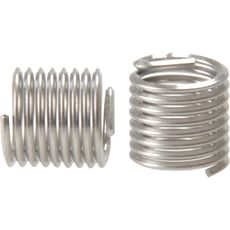
Thread inserts are precision-engineered fastening components designed to repair damaged threads or create strong, durable threads in softer materials such as aluminium, magnesium, or plastic. Also known as helicoil inserts or wire thread inserts, these helically wound coils of stainless steel or phosphor bronze provide a permanent threaded anchor point that's often stronger than the original thread. When a bolt hole becomes stripped, cross-threaded, or worn through repeated use, thread inserts offer a cost-effective repair solution that eliminates the need to replace expensive components or weld new mounting points.
The range available from Tooled-Up.com includes various types of thread inserts to suit different applications and thread standards. Metric thread inserts are the most common, covering standard sizes from M5 upwards, whilst BSF (British Standard Fine), BSW (British Standard Whitworth), UNC (Unified National Coarse), and NPT (National Pipe Thread) inserts cater to legacy equipment and specialist applications. Specialised inserts for automotive applications include spark plug thread repair inserts, glow plug thread repair inserts, and brake calliper thread repair inserts, which are essential for workshop environments dealing with high-temperature and high-stress threaded connections.
Thread inserts work by creating a precision internal thread that accepts standard bolts whilst distributing load across a greater surface area than a tapped hole alone. Installation requires drilling out the damaged thread to a specific size, tapping with a special STI (Screw Thread Insert) tap, and then threading the insert into place using a dedicated installation tool. Once installed, the insert provides a permanent repair that can be repeatedly used without degradation, making them invaluable for production machinery, automotive components, and equipment that undergoes regular maintenance cycles.
Jargon Buster
- Helicoil: A brand name that has become synonymous with wire thread inserts. Describes the helical (coiled spring-like) shape of the insert wound from diamond-shaped wire.
- STI Tap: Screw Thread Insert tap – a specialised tapping tool with a larger diameter than standard taps, designed to cut the precise thread profile required for insert installation.
- Tang: The protruding tab or tail on some thread inserts used during installation. It's typically broken off flush once the insert is fitted, leaving a smooth internal thread.
- Pitch: The distance between adjacent threads, measured in millimetres for metric threads (e.g., M8 x 1.25 means 8mm diameter with 1.25mm pitch) or threads per inch (TPI) for imperial threads.
- Free Running Insert: A thread insert that rotates freely within the parent material until a bolt is tightened into it, as opposed to self-locking or keyed inserts that lock into position.
- Parent Material: The base material (aluminium, steel, plastic, etc.) into which the thread insert is being installed.
Who Uses Thread Inserts?
Thread inserts are essential tools across numerous trades and industries:
- Automotive Technicians and Mechanics: Repairing stripped spark plug threads, glow plug ports, sump plug holes, brake calliper mounting points, and cylinder head threads
- Manufacturing Engineers: Installing permanent threads in cast aluminium housings, machinery frames, and production equipment
- Aerospace Engineers: Creating lightweight yet strong threaded connections in aluminium and composite structures where weight saving is critical
- Plant Maintenance Technicians: Repairing damaged threads on industrial machinery, pumps, gearboxes, and production line equipment
- Marine Engineers: Installing corrosion-resistant threads in boat engine blocks, marine hardware, and aluminium hull fittings
- Model Makers and Prototype Engineers: Creating durable threads in plastic and soft metal prototypes for repeated assembly and disassembly
- MOT Testers and Vehicle Inspectors: Repairing seized or damaged fasteners that might otherwise fail inspection
- General Engineers and Fabricators: Strengthening threads in custom metalwork and providing thread repair services
How to Choose the Right Thread Inserts
Selecting the correct thread insert requires careful consideration of several factors:
Thread Standard and Size: Identify whether you need metric (M5, M6, M8, M10, M12, etc.), imperial (UNC, UNF), or specialist threads (BSF, BSW, NPT). Measure the original bolt diameter and pitch carefully, as using the wrong size will result in a failed repair. Tooled-Up stocks inserts for the most common thread standards including dedicated refill packs for popular sizes.
Application Type: General-purpose inserts suit most applications, but specialised designs exist for specific jobs. Spark plug thread inserts feature longer lengths to handle combustion pressures and temperatures, whilst brake calliper inserts are designed for the specific thread profiles and stresses encountered in braking systems. For high-vibration environments, consider whether you need standard free-running inserts or locking variants.
Material Compatibility: Most thread inserts are manufactured from 304 stainless steel, offering excellent corrosion resistance and strength. This makes them suitable for aluminium, cast iron, steel, magnesium, and plastic parent materials. For extreme environments or specialist applications, phosphor bronze inserts provide superior corrosion resistance, particularly in marine applications.
Insert Length: Thread inserts are typically available in 1x, 1.5x, 2x, and 3x diameter lengths. For most applications, 1.5x to 2x the bolt diameter provides optimal strength. Shorter inserts work in thin-wall applications, whilst longer inserts are specified where maximum pull-out strength is required or where the parent material is particularly soft.
Installation Tooling: Verify whether you have the correct installation tools – STI tap, installation mandrel or tang break-off tool – or purchase a complete kit that includes taps, installation tools, and a selection of inserts. Refill packs are economical when you already have the installation equipment and need to replenish commonly used sizes.
Popular Accessories
Thread insert installation and use often requires complementary products:
- Thread Insert Installation Kits: Complete sets containing STI taps, installation mandrels, drill bits, and a selection of inserts in common sizes
- STI Taps: Dedicated tapping tools for cutting the precise thread profile required for insert installation, available individually for specific thread sizes
- Installation Mandrels: Tools that thread into the insert and allow controlled installation to the correct depth
- Tang Break-Off Tools: Punch-style tools for cleanly removing the installation tang once the insert is fitted
- Drill Bits: Precision HSS or cobalt drill bits in the specific sizes required for each thread insert diameter
- Thread Gauges: For accurately identifying existing thread sizes and pitches before ordering replacement inserts
- Tapping Fluid: Cutting lubricant that extends tap life and ensures clean thread cutting in the parent material
- Thread Locking Compound: Medium-strength threadlock for securing bolts within inserts in high-vibration applications
Frequently Asked Questions
Can thread inserts be removed and reused?
Thread inserts are designed as permanent repairs and removing them typically damages both the insert and the parent material. In most applications, they should be considered a one-time installation. However, the bolt or screw threaded into the insert can be removed and replaced indefinitely without affecting the insert.
Are thread inserts stronger than the original thread?
Yes, in most cases. Stainless steel thread inserts are significantly harder than aluminium, magnesium, or plastic parent materials, distributing load across more thread engagement and often providing greater pull-out strength than the original tapped hole. In steel components, inserts provide equivalent strength whilst offering superior wear resistance.
What size drill bit do I need for thread insert installation?
Each thread insert size requires a specific drill bit diameter, typically larger than the nominal bolt size. For example, an M8 thread insert might require a 9mm drill bit. Always consult the manufacturer's specification chart or the instructions included with your thread insert kit, as drilling the wrong size will result in installation failure.
Can I install thread inserts without a special tap?
No. Standard taps cut a 60-degree thread profile for direct bolt engagement, whereas STI (Screw Thread Insert) taps cut a slightly different profile with larger dimensions to accommodate the insert's coiled wire. Using a standard tap will result in loose, unreliable inserts that may pull out under load.
Do thread inserts work in plastic materials?
Yes, thread inserts are highly effective in thermoplastics and composites, providing metal threads in materials that would otherwise strip easily. They're commonly used in automotive interior panels, electronic enclosures, and fibreglass components. For soft plastics, consider using slightly longer inserts (2x to 3x diameter) to maximise holding power and distribute load across a larger area.