

Timers
Pay in 3 interest-free payments on purchases from £30-2000 with  . Learn more.
 Loading...
End of content
Error - No more pages to load
About Timers
Electrical timers are essential control devices that automate the switching of appliances, lighting, heating systems, and machinery according to pre-set schedules. Whether managing energy consumption on construction sites, controlling security lighting in commercial premises, or automating workshop equipment, timers provide precise control over when electrical devices operate. Available in both digital and mechanical formats, these versatile control solutions operate on standard 240v UK mains supply and offer scheduling capabilities ranging from simple daily cycles to complex weekly programmes with multiple switching events.
The timer category at Tooled-Up.com encompasses two primary types: digital timers offering advanced programming features with LCD displays and memory backup, and mechanical timers providing straightforward, reliable operation through clockwork mechanisms with manual segment selection. Digital variants typically feature random switching functions for security applications, countdown modes, and summer time adjustment, whilst mechanical options deliver robust performance in demanding environments where simplicity and durability are paramount. Both categories accommodate various load capacities, typically from 13A for standard appliances up to 16A for more demanding applications.
Modern electrical timers have evolved significantly from basic plug-in devices to sophisticated control systems suitable for professional trade applications. Tradespeople rely on these devices for temporary site lighting control, managing dust extraction systems, controlling underfloor heating installations, and automating power tool charging stations. The selection available from Tooled-Up includes compact plug-through models for individual appliances, DIN-rail mounted units for consumer unit installation, and weatherproof outdoor variants for external lighting and pump control applications.
Jargon Buster
- Switching Capacity: The maximum electrical load measured in amperes (A) that a timer can safely control. Standard models handle 13A (approximately 3120W at 240v), whilst heavy-duty versions manage 16A loads for more demanding applications.
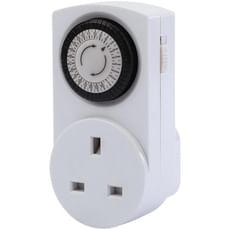
- Segment Programming: Found on mechanical timers, these are the removable pins or tabs around the dial face that determine when the timer switches on and off. Each segment typically represents 15 or 30-minute intervals throughout a 24-hour cycle.
- Random Function: A security feature on digital timers that varies switching times by several minutes each day, simulating occupancy in unoccupied properties by preventing predictable lighting patterns that could indicate an empty building.
- Countdown Mode: A timing function that switches an appliance on for a specific duration before automatically switching off, particularly useful for controlling temporary equipment like battery chargers or drying equipment.
- IP Rating: Ingress Protection classification indicating the device's resistance to dust and moisture. IP44-rated timers suit protected outdoor locations, whilst IP20 units are designed for dry indoor environments only.
- Residual Charge: The backup power stored in digital timers that maintains programming during power cuts or when unplugged, typically lasting 48-100 hours depending on the model and battery condition.
Who Uses Timers?
Electrical timers serve a diverse range of professional trades and applications:
- Electricians: Installing permanent timer solutions for domestic and commercial lighting control, immersion heaters, and ventilation systems
- Builders and Site Managers: Controlling temporary site lighting, security lighting, and managing energy costs on construction projects
- Plumbers and Heating Engineers: Programming central heating systems, underfloor heating circuits, and hot water cylinders for optimised energy efficiency
- Landscapers and Groundskeepers: Automating irrigation systems, water features, and garden lighting installations
- Workshop Owners: Managing dust extraction systems, air filtration units, and controlling battery charging schedules for cordless tool fleets
- Property Maintenance Professionals: Installing security lighting systems and managing communal area lighting in residential and commercial buildings
- Agricultural Workers: Controlling livestock heating lamps, ventilation systems, and automated feeding equipment
- DIY Enthusiasts: Reducing household energy consumption through automated control of appliances, aquarium equipment, and greenhouse heating
How to Choose the Right Timers
Selecting the appropriate timer requires consideration of several critical factors. First, determine the load capacity needed by calculating the total wattage of connected appliances and dividing by 240v to establish the amperage requirement. Always select a timer rated above your calculated load, with 13A models suitable for most single appliances and 16A variants for heavier equipment like workshop heaters or multiple connected devices.
Consider whether digital or mechanical operation better suits your application. Digital timers at Tooled-Up offer superior programming flexibility with multiple daily switching events, weekly scheduling variations, and random functions ideal for security applications. They're perfect when complex schedules or frequent programme changes are required. Mechanical timers provide unbeatable simplicity and reliability, particularly suited to repetitive daily schedules that rarely change, and they continue operating during power cuts without losing their physical segment settings.
Environmental conditions significantly influence timer selection. Indoor applications in dry locations accommodate standard IP20-rated plug-in models, whilst outdoor installations or damp environments like greenhouses require weatherproof IP44 or higher-rated units with sealed casings. Installation method matters too – plug-through models offer portable convenience for temporary applications, whilst DIN-rail mounted timers provide permanent solutions integrated within distribution boards for controlling fixed wiring circuits.
Programme complexity should match your actual requirements. Simple applications like daily lighting control need basic 24-hour mechanical timers, whilst scenarios requiring different weekend schedules, seasonal variations, or holiday modes demand digital models with 7-day programming and memory backup. Consider future flexibility too – digital timers accommodate changing requirements without physical modification, whilst mechanical models offer limited adjustment within their fixed segment arrangement.
Popular Accessories
- Extension Leads: Quality 13A extension cables for positioning timers conveniently when socket locations are awkward or distant from controlled appliances
- Weatherproof Enclosures: IP-rated boxes for housing standard timers in outdoor or damp locations where exposed installation isn't suitable
- RCD Adaptors: Residual current device protection for adding earth leakage safety to timer-controlled equipment, particularly important for outdoor applications
- Multi-Gang Adaptors: Allowing multiple appliances to be controlled simultaneously from a single timer, useful for workshop equipment or display lighting
- DIN Rail Clips: Mounting hardware for installing timers within consumer units or electrical enclosures alongside circuit protection devices
- Cable Management: Trunking, clips and ties for neatly routing cables from timer locations to controlled equipment
- Replacement Batteries: Backup batteries for maintaining digital timer programmes during power interruptions in critical applications
Safety Information
Electrical timers must be used within their rated capacity – never exceed the specified amperage or wattage limits printed on the device, as overloading creates serious fire risks. When calculating loads, remember that motor-driven equipment like compressors and power tools draw significantly higher starting currents than their running load, potentially exceeding timer ratings during start-up. For such applications, select timers with appropriate surge tolerance or consult a qualified electrician.
Installation of timers controlling fixed wiring circuits must comply with BS 7671 wiring regulations and should only be undertaken by competent persons or qualified electricians registered with appropriate schemes. Plug-in timers for portable appliances should only be used indoors unless specifically rated for outdoor use with adequate IP protection. Never modify weatherproof seals or casings, as this compromises safety certification and creates moisture ingress risks.
Particular attention is required when using timers with heating appliances. Never control portable heaters using timers unless constantly supervised, as HSE guidance warns against unattended operation of portable heating equipment. Fixed heating installations like immersion heaters and underfloor heating systems are suitable for timer control when correctly installed according to manufacturer specifications. Always ensure adequate ventilation around timers, as the control electronics generate modest heat that requires dissipation to prevent premature failure.
Frequently Asked Questions
Can I use a timer to control electric heaters on construction sites?
Fixed heating installations designed for timer control can be safely automated, but portable heaters should not be left unattended on timer control due to fire safety concerns. For temporary site heating, consider using timers with fixed, properly installed heaters rather than portable units, and ensure the timer's switching capacity exceeds the heater's rated load by a comfortable margin to accommodate starting currents.
Will my digital timer lose its programme during a power cut?
Most digital timers feature battery backup maintaining programme memory for 48-100 hours during power interruptions. However, the timer won't actively switch loads whilst mains power is absent – it simply retains the programmed schedule ready to resume normal operation when power returns. Mechanical timers continue rotating during power cuts if they have a mechanical reserve, though obviously cannot switch anything without mains supply.
How many watts can a 13A timer control?
At 240v UK mains voltage, a 13A timer safely controls approximately 3120 watts (13A × 240v = 3120W). However, it's prudent to operate at around 80% of maximum capacity for longevity, suggesting a practical limit of approximately 2500W for continuous loads. Remember that resistive loads like heaters draw consistent current, whilst inductive loads like motors require higher-rated timers due to starting surge currents.
Can I install a timer outdoors for garden lighting?
Yes, provided you use a timer with appropriate IP44 or higher weatherproof rating specifically designed for outdoor use. Standard indoor timers lack adequate moisture protection and present serious safety hazards if used externally. Even with weatherproof models, installation in a sheltered location protected from direct rainfall extends service life. For permanent outdoor installations, consider having a qualified electrician install a DIN-rail timer within a weatherproof enclosure.
What's the difference between 24-hour and 7-day timers?
A 24-hour timer repeats the same switching pattern every day – suitable when your schedule doesn't vary between weekdays and weekends. A 7-day timer allows different programmes for each day of the week, ideal when requirements differ between working days and weekends, or when varied scheduling throughout the week provides better energy management or security simulation for unoccupied premises.