

Draper Protractors

 Loading...
End of content
Error - No more pages to load
Draper Protractors at Tooled-Up.com
Draper Tools has built a formidable reputation for manufacturing precision measuring instruments that combine professional-grade accuracy with exceptional value for money. The Draper protractor range exemplifies this commitment, offering tradespeople and engineers reliable angle measurement tools that deliver consistent results across demanding workshop and site environments. From simple bevel protractors for basic angle verification to sophisticated digital models with advanced features, Draper has developed a comprehensive selection to meet the diverse needs of modern fabricators, machinists, and construction professionals.
Each Draper protractor is engineered with clearly marked graduations and robust construction materials designed to withstand the rigours of daily professional use. Whether you're setting up machinery, checking welding angles, or verifying architectural elements, these instruments provide the accuracy essential for quality workmanship. The brand's focus on ergonomic design ensures that even during extended measurement sessions, users can maintain comfortable grip and precise positioning for accurate readings.
Tooled-Up.com stocks the complete range of Draper protractors, ensuring that professionals can source the exact specification required for their particular trade or application. From educational settings to heavy industrial fabrication shops, Draper measurement tools continue to be specified by those who understand the critical relationship between accurate angle measurement and finished work quality.
Why Choose Draper Protractors?
Draper's reputation for manufacturing dependable measuring instruments spans decades, with protractors representing a core component of their precision tool offering. The brand's commitment to quality control means every protractor undergoes rigorous testing to ensure scale accuracy and durability before reaching the trade counter. This attention to detail has established Draper as a trusted name among professional fabricators, engineers, and tradespeople who cannot afford measurement errors that compromise workpiece quality or safety.
The value proposition offered by Draper protractors is particularly compelling—these tools deliver professional-grade accuracy at price points that make them accessible to apprentices, small workshops, and educational institutions without sacrificing the performance standards demanded by experienced tradespeople. The brand's extensive UK distribution network also ensures replacement parts and warranty support remain readily available, providing long-term peace of mind for professional users investing in measurement equipment.
Draper's continuous product development responds directly to feedback from the trade, incorporating practical improvements that enhance usability in real-world conditions. Features such as anti-reflective scale markings, secure locking mechanisms, and corrosion-resistant finishes demonstrate the brand's understanding of the challenging environments where these tools must perform reliably day after day.
Who Uses Draper Protractors?
- Fabricators and Welders: Professionals requiring precise angle verification for structural steelwork, custom metalwork, and welding preparation
- Machinists and Toolmakers: Workshop engineers setting up milling machines, lathes, and inspection of machined components
- Carpenters and Joiners: Tradespeople checking mitre angles, roof pitches, and complex joinery angles
- Mechanical Engineers: Service technicians and fitters verifying angular relationships in mechanical assemblies
- Educational Institutions: Technical colleges and apprenticeship programmes teaching measurement fundamentals
- Automotive Technicians: Mechanics checking steering geometry, suspension angles, and custom fabrication work
- Architectural Metalworkers: Specialists creating balustrades, staircases, and decorative metalwork requiring precise angles
- Maintenance Engineers: Site maintenance staff conducting equipment inspection and alignment verification
Key Features of Draper Protractors
Draper protractors incorporate several design features that enhance measurement accuracy and tool longevity. The clearly etched or engraved scales resist wear from repeated use and cleaning, ensuring graduations remain legible throughout the tool's working life. Many models feature dual-scale markings displaying both degrees and alternative angular measurements, providing flexibility for different calculation methods and trade conventions.
Construction materials vary across the Draper protractor range to suit different applications and budgets. Hardened stainless steel models offer exceptional corrosion resistance for marine environments and outdoor site work, whilst chrome-plated versions provide excellent durability at accessible price points. The precision-ground edges and faces ensure accurate registration against workpieces, eliminating measurement errors caused by burrs or manufacturing imperfections.
Locking mechanisms on adjustable Draper protractors provide secure angle retention, preventing inadvertent movement during transfer from setup gauge to workpiece verification. Digital models in the range feature easy-to-read LCD displays with backlight functionality for low-light workshop conditions, plus zeroing functions that simplify relative angle measurements. Battery life on electronic versions is optimised for extended professional use, with auto-shutoff features conserving power between measurement tasks.
Popular Draper Protractors
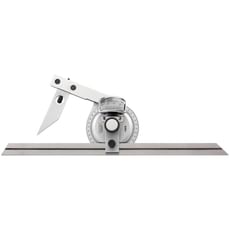
The Draper bevel protractor range remains consistently popular among metalworkers and machinists, offering traditional dial-type angle measurement with vernier scales for enhanced precision. These instruments typically provide accuracy within minutes of arc, making them suitable for quality control applications and precision engineering tasks where tolerances are critical.
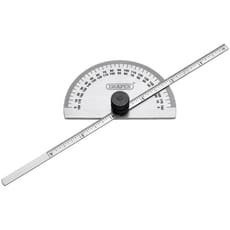
For fabrication and general workshop use, the selection at Tooled-Up includes Draper's simple protractors with blade and stock configurations, ideal for quickly establishing and transferring angles during marking out and setup operations. The straightforward mechanical design ensures reliability and makes these tools particularly well-suited to harsh environments where electronic instruments might be vulnerable.
Digital angle finders from Draper have gained popularity for their instant readability and ability to display measurements in multiple formats, including degrees, percentages, and ratios. These battery-powered instruments appeal to tradespeople working across multiple disciplines who benefit from versatile measurement display options and the convenience of digital zeroing for comparative angle checks.
Safety and Compliance
Whilst protractors are inherently low-risk measuring instruments, Draper manufactures these tools in accordance with relevant quality standards to ensure dimensional accuracy and material safety. The brand's commitment to supplying measurement equipment suitable for professional environments means materials are selected for durability and freedom from sharp edges or burrs that could cause injury during handling.
Users should ensure protractors are maintained in clean condition, as accumulated metal swarf, dust, or corrosion can affect measurement accuracy and potentially cause injury during handling. Regular inspection of locking mechanisms and pivot points ensures continued reliable operation and prevents measurement errors that could compromise workpiece safety or quality. When measuring angles on machinery, always ensure equipment is properly isolated and stationary before taking measurements, following appropriate HSE guidance for workshop safety.
Digital protractors should be stored in protective cases when not in use to prevent impact damage to displays and electronic components. Battery replacement should follow manufacturer guidance, and exhausted batteries should be disposed of responsibly according to UK environmental regulations for electronic waste.
Frequently Asked Questions
What accuracy can I expect from Draper protractors?
Draper protractors typically offer accuracy ranging from ±0.5 degrees on basic models to within minutes of arc on precision vernier protractors. Digital models generally provide accuracy of ±0.1 to ±0.3 degrees depending on specification. The product documentation for each model specifies exact tolerances, allowing users to select appropriate instruments for their accuracy requirements.
Are Draper digital protractors suitable for site work?
Many Draper digital angle measurement tools feature robust construction with protective rubberised casings and water-resistant designs suitable for site conditions. However, users should consult individual product specifications regarding environmental protection ratings. For particularly harsh or wet environments, traditional mechanical protractors may offer greater durability and reliability.
How should I calibrate my Draper protractor?
Digital Draper protractors typically include zeroing functions allowing users to establish reference points for relative measurements. For absolute angle verification, check your instrument against certified angle standards or known accurate references such as machinist squares (90 degrees) and straight edges (180 degrees). Mechanical protractors should be inspected for wear, damage, or looseness in pivot mechanisms that might affect accuracy.
What's the difference between a bevel protractor and a simple protractor?
Simple protractors consist of a graduated semicircular or circular scale with a movable blade, ideal for basic angle measurement and transfer. Bevel protractors incorporate vernier scales providing much finer resolution (typically reading to 5 minutes of arc), making them suitable for precision engineering applications where tighter tolerances must be maintained. Draper offers both types to suit different accuracy requirements and budgets.
Can Draper protractors measure internal angles?
Most Draper protractors can measure both internal and external angles depending on their design. Simple blade-type protractors are particularly versatile for accessing restricted spaces, whilst dial-type bevel protractors may have limitations in confined areas. When selecting a protractor, consider the typical measuring situations you'll encounter to ensure the tool's physical configuration suits your application requirements.