

Faithfull Grinding Wheels
 Loading...
End of content
Error - No more pages to load
Faithfull Grinding Wheels at Tooled-Up.com
Faithfull has established itself as a trusted name in abrasives and workshop consumables, delivering professional-grade grinding wheels that meet the exacting demands of tradespeople and serious DIY enthusiasts across the UK. With decades of experience in manufacturing quality abrasive products, Faithfull grinding wheels are engineered to deliver consistent performance, precision grinding, and exceptional value for money. Whether you're sharpening tools, preparing metal surfaces, or tackling heavy-duty grinding applications, Faithfull offers a comprehensive selection designed to handle everything from delicate finishing work to aggressive material removal.
The Faithfull grinding wheel range available from Tooled-Up encompasses various specifications including bench grinding wheels, flap discs, cutting discs, and specialised abrasive wheels for different materials and applications. Each wheel is manufactured to exacting standards, incorporating carefully selected abrasive grains bonded with precision to ensure optimal cutting action, minimal heat generation, and extended working life. Faithfull's commitment to quality control means every grinding wheel undergoes rigorous testing to ensure it meets both British and European safety standards before reaching your workshop.
From general-purpose aluminium oxide wheels suitable for everyday workshop tasks to specialised silicon carbide variants for grinding harder materials, Faithfull provides grinding solutions that deliver professional results without the premium price tag associated with some competitor brands. This combination of quality manufacturing, practical design, and competitive pricing has made Faithfull grinding wheels a staple in workshops, garages, and on construction sites throughout the United Kingdom.
Why Choose Faithfull Grinding Wheels?
Faithfull has built its reputation on delivering reliable, competitively priced tools and accessories that don't compromise on performance. Their grinding wheels are manufactured using carefully graded abrasive materials and advanced bonding techniques that ensure consistent cutting action throughout the wheel's lifespan. Unlike cheaper alternatives that may wear unevenly or become glazed quickly, Faithfull wheels maintain their cutting efficiency, reducing the need for frequent dressing and replacement.
The brand's extensive experience in abrasives technology means each grinding wheel is formulated with the correct balance of hardness, grain size, and bond strength for its intended application. This attention to detail translates into cooler grinding with less risk of workpiece discolouration or distortion—particularly important when working with hardened tool steels or precision components. Faithfull grinding wheels also demonstrate excellent resistance to side loading and impact, making them suitable for demanding workshop environments where accidents and mishaps can occur.
Value for money remains a cornerstone of the Faithfull philosophy. Tradespeople choosing Faithfull grinding wheels benefit from professional-grade performance at prices that won't strain project budgets or workshop overheads. This makes them an ideal choice for both established businesses looking to control consumable costs and newcomers to the trades who need reliable equipment without excessive initial investment.
Who Uses Faithfull Grinding Wheels?
Faithfull grinding wheels serve a diverse user base across multiple trades and applications:
- General Engineers and Fabricators – for grinding welds, preparing metal surfaces, and sharpening cutting tools
- Blacksmiths and Metalworkers – for shaping, finishing, and maintaining edge tools and metal sculpture work
- Agricultural and Plant Engineers – for maintaining farm machinery, sharpening ploughshares, and repair work
- Automotive Technicians and Body Shops – for paint preparation, rust removal, and component modification
- Tool and Die Makers – for precision grinding and tool sharpening applications
- Maintenance Engineers – for general workshop grinding, repair work, and equipment maintenance
- Construction Trades – for site-based grinding tasks including steel fixers and groundworkers
- Woodworkers and Carpenters – for maintaining chisels, plane irons, and other edge tools
- DIY Enthusiasts and Home Workshop Users – for general grinding, sharpening, and metalworking projects
Key Features of Faithfull Grinding Wheels
Faithfull grinding wheels incorporate several design features that enhance their performance and longevity. The abrasive grains used in Faithfull wheels are carefully selected and graded to ensure consistent particle size, which directly impacts cutting efficiency and surface finish quality. The bonding matrix is formulated to release dulled grains at the optimal rate, exposing fresh cutting edges and maintaining grinding efficiency throughout the wheel's usable life.
Manufactured to comply with BS EN 12413 and other relevant British and European safety standards, Faithfull grinding wheels feature reinforced construction where appropriate, with fiberglass webbing incorporated into cutting and grinding discs to provide additional strength and safety. The wheels are clearly marked with essential information including maximum operating speed (expressed in RPM and surface metres per second), grain type, grain size, and recommended applications.
Faithfull offers grinding wheels in standard bore sizes compatible with most bench grinders and angle grinders commonly used in UK workshops, with reducing bushes available where needed. The wheels maintain excellent balance even during extended use, minimising vibration that can lead to poor surface finish and operator fatigue. Heat dissipation characteristics are optimised to reduce the risk of workpiece burning or hardness loss, particularly important when grinding high-carbon tool steels.
Popular Faithfull Grinding Wheels
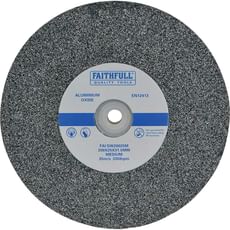
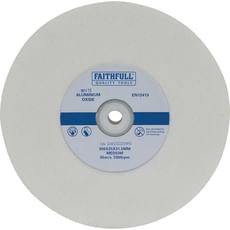
The Faithfull grinding wheel range at Tooled-Up includes several popular categories suited to different applications. Bench grinding wheels in aluminium oxide formulation remain the workhorse of most workshops, available in various diameters from compact 150mm wheels for smaller bench grinders through to 200mm and 250mm variants for heavier machines. These are offered in different grit grades from coarse 36-grit wheels for rapid stock removal through to finer 80-grit and 100-grit wheels for finishing work and tool sharpening.
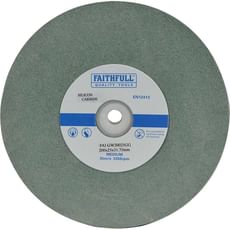
For grinding non-ferrous metals, ceramics, stone, and very hard materials, Faithfull's silicon carbide grinding wheels provide superior cutting action compared to standard aluminium oxide variants. Flap discs and depressed-centre grinding wheels designed for angle grinder use are popular for fabrication work, offering aggressive material removal with reasonable control. Thin cutting discs enable rapid cutting of steel bar, tube, and sheet material with minimal kerf loss.
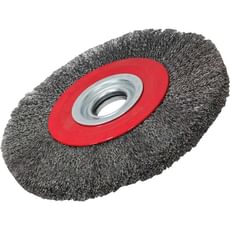
Specialised wheels including diamond and CBN (Cubic Boron Nitride) variants may be available for ultra-hard materials and precision grinding applications, whilst wire wheel brushes and mounted points complement the range for deburring, cleaning, and detailed grinding work.
Safety and Compliance
Safety remains paramount when using any grinding wheel, and Faithfull products are manufactured to meet stringent British and European safety standards including BS EN 12413 for reinforced grinding wheels and cutting discs. Every wheel is tested to ensure it can safely withstand its maximum rated speed, with a safety factor built in to provide additional protection.
Users must always verify that the grinding wheel's maximum RPM rating exceeds the no-load speed of the grinding machine being used. Operating a grinding wheel above its rated speed can result in catastrophic wheel failure with serious injury potential. Wheels should be visually inspected before mounting to check for cracks, chips, or damage, and a "ring test" performed on vitrified wheels by suspending the wheel and tapping gently—a clear ring indicates integrity whilst a dull thud suggests damage.
Grinding wheels must be mounted using appropriate flanges that support at least one-third of the wheel diameter, with blotting paper washers fitted between metal flanges and the wheel faces. The wheel guard must always be in place during operation, positioned to contain debris and wheel fragments in the event of failure. Personal protective equipment including safety glasses or a face shield, hearing protection, and respiratory protection should be worn, particularly during extended grinding sessions. The Health and Safety Executive (HSE) provides comprehensive guidance on abrasive wheel safety, and only competent persons who have received appropriate training should mount grinding wheels.
Frequently Asked Questions
What's the difference between aluminium oxide and silicon carbide Faithfull grinding wheels?
Aluminium oxide grinding wheels are best suited for grinding ferrous metals including steel, iron, and high-carbon tool steels. They're the most versatile and commonly used type for general workshop applications. Silicon carbide wheels are harder and sharper but more friable, making them ideal for grinding non-ferrous metals (aluminium, brass, copper), cast iron, stone, ceramics, and very hard materials. For most metalworking tasks involving steel, aluminium oxide Faithfull wheels provide the best combination of performance and value.
How do I choose the correct grit size for my Faithfull grinding wheel?
Grit size determines the balance between material removal rate and surface finish quality. Coarse grits (24-36) remove material quickly and are ideal for heavy grinding, weld removal, and rapid stock removal, but leave a rough finish. Medium grits (46-60) provide a balance suitable for general-purpose grinding. Fine grits (80-120) are best for tool sharpening, achieving smooth finishes, and precision grinding where material removal rate is less critical than surface quality. Consider having multiple wheels available if you regularly perform different types of grinding work.
Can I use Faithfull grinding wheels designed for bench grinders on angle grinders?
No, absolutely not. Bench grinding wheels (Type 1) are designed for radial grinding with specific mounting flanges and guards suited to bench grinder configuration. Angle grinder wheels (typically Type 27 or Type 42 depressed-centre designs) are engineered for the different forces, mounting systems, and operating angles encountered with angle grinders. Using the wrong wheel type on incompatible equipment is extremely dangerous and can result in wheel failure and serious injury. Always select Faithfull wheels specifically designed and rated for your grinding equipment type.
How should I store unused Faithfull grinding wheels to maintain their integrity?
Store grinding wheels in a dry environment away from extreme temperatures and direct sunlight. Wheels should be kept in their original packaging where possible, laid flat or hung on suitable racks—never stack heavy items on top of grinding wheels as this can cause stress damage. Vitrified wheels are particularly susceptible to moisture absorption which can weaken the bond structure, so avoid damp workshop areas. Rotate stock to use older wheels first, and always inspect stored wheels before use, performing a ring test on vitrified types to confirm integrity before mounting.
What does the hardness grade marking on Faithfull grinding wheels indicate?
The hardness grade (typically a letter from the alphabet) indicates how firmly the abrasive grains are held in the bonding matrix, not the hardness of the abrasive material itself. Softer grade wheels (letters toward the start of the alphabet) release grains more readily, making them suitable for grinding harder materials—the wheel wears faster, constantly exposing fresh sharp grains. Harder grade wheels (letters toward the end of the alphabet) retain grains longer and are better for softer materials. For most general-purpose steel grinding, medium hardness grades provide the best balance of wheel life and cutting efficiency.