

Faithfull Spring Callipers

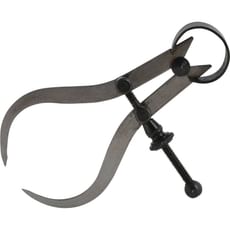
 Loading...
End of content
Error - No more pages to load
Faithfull Spring Callipers at Tooled-Up.com
Faithfull has established itself as a trusted name in precision measurement tools, and their spring callipers exemplify the brand's commitment to accuracy and durability. These traditional measuring instruments combine time-tested design principles with quality British engineering standards, making them essential tools for engineers, metalworkers, and precision craftspeople. The Faithfull range represents excellent value without compromising on the accuracy and reliability that professionals demand from their measuring equipment.
Spring callipers remain indispensable in workshops where direct measurement isn't possible or practical. Unlike digital alternatives, Faithfull's mechanical spring callipers offer independence from batteries, immunity to electronic interference, and the tactile feedback that experienced craftspeople prefer. Available in both inside and outside configurations, these callipers are manufactured from hardened and tempered steel to withstand the rigours of daily workshop use whilst maintaining dimensional stability over years of service.
The comprehensive selection of Faithfull spring callipers available from Tooled-Up.com caters to various measurement requirements, with sizes typically ranging from compact 75mm models suited to delicate work through to substantial 300mm versions for larger-scale engineering projects. Each calliper features precision-ground points or jaws, adjustable tension springs, and knurled adjustment nuts for fine control during measurement transfer operations.
Why Choose Faithfull Spring Callipers?
Faithfull has built its reputation on delivering professional-grade tools at accessible price points, and their spring callipers maintain this tradition. Each instrument undergoes rigorous quality control to ensure measurement accuracy and consistent spring tension. The hardened steel construction resists wear at critical contact points, whilst the corrosion-resistant finish protects against workshop environments where cutting fluids and moisture are present.
The brand's commitment to traditional craftsmanship means these callipers are manufactured to patterns proven over centuries of engineering practice. Faithfull understands that spring callipers aren't merely measuring devices but transfer tools that allow craftspeople to replicate dimensions from templates, compare machined parts against standards, and verify internal and external diameters where direct measurement proves awkward. This functional understanding informs every aspect of their design and construction.
Professionals appreciate Faithfull's attention to practical details: springs calibrated for positive location without excessive stiffness, adjustment mechanisms that remain precise after repeated use, and leg geometries that provide stable contact across various surface profiles. These seemingly minor considerations significantly impact daily usability and measurement confidence on the workshop floor.
Who Uses Faithfull Spring Callipers?
- Engineering machinists transferring measurements from technical drawings to workpieces and verifying turned or milled dimensions
- Pattern makers creating templates and moulds where precise dimensional replication is critical
- Automotive restoration specialists matching replacement parts to original specifications
- Metalworking fabricators marking out cutting lines and checking component dimensions during assembly
- Toolmakers setting precise distances for drilling operations and verifying gauge dimensions
- Apprentices and students learning traditional measurement techniques in technical colleges and training workshops
- Woodturners checking bowl wall thickness and spindle diameters during turning operations
- Model engineers working on miniature projects where precision matters despite small scale
- Maintenance engineers assessing wear on shafts, bearings, and cylindrical components
Key Features of Faithfull Spring Callipers
Faithfull spring callipers incorporate several design features that distinguish quality instruments from basic alternatives. The hardened and tempered steel construction provides the rigidity essential for accurate measurement transfer whilst resisting the deformation that compromises cheaper callipers. Precision-ground contact points or jaws ensure consistent measurement geometry, whether checking external diameters with outside callipers or internal dimensions with inside patterns.
The spring mechanism itself represents critical engineering: too weak and the calliper won't maintain setting during transfer; too strong and fine adjustment becomes difficult. Faithfull calibrates spring tension to balance these requirements, with adjustment nuts featuring positive threads that resist vibration whilst allowing precise dimensional changes. Knurled surfaces on adjustment components facilitate control even when hands are oily or wearing gloves.
Leg geometry receives particular attention in Faithfull's designs. Outside callipers feature curved legs that naturally conform to cylindrical surfaces, whilst inside callipers incorporate outward-turning points that reach into recesses and grooves. The pivot design allows smooth leg movement throughout the measurement range whilst maintaining consistent spring characteristics from fully closed to maximum extension.
Popular Faithfull Spring Callipers
The 150mm outside spring calliper represents the most versatile size for general engineering and metalworking applications, offering sufficient capacity for common workshop tasks whilst remaining compact enough for detailed work. This mid-range size suits everything from checking shaft diameters to transferring template dimensions, making it a staple in toolboxes across multiple trades.
Inside spring callipers in 100mm and 150mm sizes prove invaluable for measuring bore diameters, groove widths, and internal recesses where conventional measuring tools cannot reach. These specialized instruments allow craftspeople to verify hole dimensions after drilling or boring operations and check internal clearances during assembly work.
Larger 200mm and 300mm models cater to heavy engineering applications where component dimensions exceed the capacity of smaller instruments. These substantial callipers maintain measurement accuracy across extended ranges, with robust construction suited to industrial environments. Conversely, compact 75mm versions serve precision work on small components, instrument making, and jewellery fabrication where delicacy matters as much as accuracy.
Safety and Compliance
Whilst spring callipers don't present the hazards associated with powered equipment, safe handling practices remain important. The hardened steel points on both inside and outside patterns are sharp enough to cause injury if mishandled, particularly when callipers are set to small dimensions with points close together. Store instruments in protective cases or designated tool drawers to prevent accidental contact and protect measurement accuracy from impact damage.
Workshop housekeeping extends instrument lifespan significantly. Clean callipers after use to remove swarf, cutting fluid, and general workshop contamination that could affect spring operation or corrode critical surfaces. A light application of machine oil to pivot points and springs prevents corrosion during storage whilst maintaining smooth adjustment throughout the instrument's range.
Periodically verify calliper accuracy against known standards, particularly if instruments have been dropped or subjected to unusual loads. Bent legs or sprung pivots compromise measurement reliability, and whilst some damage can be professionally corrected, severe deformation typically requires replacement. HSE guidelines for hand tool maintenance apply equally to measuring instruments, with regular inspection forming part of comprehensive workshop tool management.
Frequently Asked Questions
What's the difference between inside and outside spring callipers?
Outside spring callipers measure external dimensions like shaft diameters and material thickness, with inward-curving legs that wrap around the workpiece. Inside spring callipers measure internal dimensions such as hole diameters and groove widths, featuring outward-turning points that expand into the space being measured. Both types transfer measurements to rules or other measuring devices rather than providing direct readings.
How do I adjust Faithfull spring callipers for accurate measurement?
Place the calliper against the dimension being measured and adjust the knurled nut until the legs just contact the workpiece with light spring pressure. The calliper should drag slightly when moved across the surface without forcing. Once set, carefully transfer to a steel rule or other measuring device to read the dimension. Practice develops the feel for correct spring tension that ensures consistent accuracy.
Can spring callipers measure as accurately as digital instruments?
Spring callipers serve different purposes from direct-reading instruments. Whilst they don't provide the immediate numerical display of digital callipers, they excel at transferring and comparing dimensions, marking out work, and verifying consistency across multiple parts. In skilled hands, spring callipers achieve repeatability within 0.1-0.2mm, adequate for many engineering and fabrication tasks. Their independence from batteries and electronics makes them reliable in all workshop conditions.
How should I maintain my Faithfull spring callipers?
Keep callipers clean and lightly oiled, particularly at pivot points and spring areas. Store in a dry location, preferably in protective cases to prevent damage to precision-ground contact surfaces. Avoid dropping instruments or using them as scribing tools, which can bend legs or damage points. Periodically check that springs maintain appropriate tension and that adjustment mechanisms operate smoothly without excessive play.
What size spring callipers do I need for general workshop use?
For most engineering and metalworking applications, 150mm outside callipers and 100-150mm inside callipers cover the majority of common measurement tasks. These mid-range sizes offer versatility without the bulk of larger instruments. Specialized work may require additional sizes: compact 75mm models for precision tasks, or 200-300mm versions for heavy engineering. Building a collection across multiple sizes provides comprehensive measurement capability as requirements develop.