

Milwaukee Guide Rails
 Loading...
End of content
Error - No more pages to load
Milwaukee Guide Rails at Tooled-Up.com
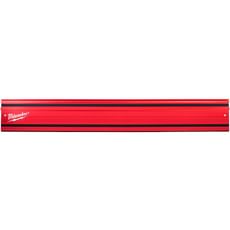
Milwaukee has established itself as a leader in precision cutting accessories, and their guide rail systems represent the pinnacle of accuracy and build quality for professional tradespeople. Designed to work seamlessly with Milwaukee's range of track saws and circular saws, these guide rails transform portable power tools into precision cutting stations capable of delivering cabinet-grade results on site. The robust aluminium construction and anti-slip base ensure stability during demanding cuts, whilst the integrated measuring scale allows for quick and accurate setup without the need for additional marking tools.
Available in multiple lengths to suit different applications, Milwaukee guide rails feature a low-friction surface that reduces drag whilst maintaining positive control throughout the cut. The precision-machined edges provide a reference point for splinter-free cutting, and the modular design allows rails to be connected for extended cutting capacity. Whether you're breaking down sheet materials, cutting worktops, or creating precise angles for joinery work, Milwaukee's guide rail system delivers the accuracy and repeatability that professional work demands.
Tooled-Up.com stocks Milwaukee guide rails alongside compatible accessories including rail connectors, clamps, and anti-slip pads to create a complete cutting solution. The system's compatibility with Milwaukee's M18 FUEL track saw and other guided circular saws makes it an essential addition to any professional toolkit where precision and portability are equally important.
Why Choose Milwaukee Guide Rails?
Milwaukee's reputation for durability and professional-grade performance extends throughout their guide rail range. Each rail undergoes rigorous quality control to ensure the straightness and precision that professional tradespeople depend upon. The heavy-duty aluminium extrusion resists warping and damage from site conditions, whilst the protective edge guards prevent damage to the critical cutting reference surfaces. Unlike budget alternatives that can flex or deflect during cutting, Milwaukee guide rails maintain their geometry even under the pressure of heavy-duty applications.
The anti-slip backing strips provide exceptional grip without the need for excessive clamping force, reducing setup time and preventing workpiece damage. Milwaukee's attention to detail extends to the measurement scale, which is clearly marked and positioned for easy reading from multiple angles. The investment in Milwaukee guide rails pays dividends through improved cutting accuracy, reduced material waste, and the confidence that comes from using equipment trusted by professionals across the construction and joinery industries.
Milwaukee backs their guide rails with comprehensive warranty coverage, demonstrating their confidence in the product's longevity. The brand's commitment to the trade professional means that replacement parts and accessories remain available, protecting your investment and ensuring that your cutting system can grow with your needs.
Who Uses Milwaukee Guide Rails?
- Carpenters and Joiners: Creating precise cuts for fitted furniture, door hanging, and architectural joinery where accuracy is paramount
- Kitchen Fitters: Breaking down worktops and sheet materials with splinter-free edges for professional installations
- Shop Fitters: Cutting display panels, shelving, and retail fixtures to exact dimensions on site
- Shopfitting and Contractors: Achieving workshop-quality cuts without the need to transport materials back to a fixed workshop
- Flooring Specialists: Precision cutting of engineered boards and transition pieces for perfect fit-up
- Boat Builders: Working with marine ply and composite materials where clean, accurate cuts are essential
- Furniture Makers: Breaking down sheet goods and creating repeatable cuts for batch production work
- Renovation Specialists: Making surgical cuts in existing structures and fitting new materials with precision
Key Features of Milwaukee Guide Rails
Milwaukee guide rails incorporate several distinctive features that enhance both accuracy and usability. The precision-machined aluminium extrusion provides a dead-straight reference edge that won't deflect under cutting pressure, whilst the anodised surface resists corrosion and wear from repeated use. The integrated anti-splinter strip creates a zero-clearance cutting edge that virtually eliminates tear-out on both sides of the cut, particularly important when working with veneered materials or melamine-faced boards.
The measurement scale is laser-etched directly into the rail surface, providing permanent reference marks that won't wear away or become illegible over time. Clear graduation marks allow for quick setup, whilst the metric measurements align with UK building standards and material dimensions. The rail's profile includes multiple reference points for different saw models, ensuring compatibility across Milwaukee's range of guided cutting tools.
Milwaukee's connector system allows multiple rails to be joined for extended cutting capacity, with positive location ensuring alignment remains true across the join. The connectors feature cam-lock mechanisms for quick assembly and disassembly, making it practical to transport rails separately and assemble them on site. Anti-slip pads strategically positioned along the rail's length provide exceptional grip without marking or damaging work surfaces, reducing the need for additional clamps on many applications.
Popular Milwaukee Guide Rails
Milwaukee guide rails are available in several standard lengths to accommodate different workshop and site requirements. The 1400mm rail represents the ideal balance between portability and cutting capacity, perfectly sized for breaking down standard 8x4 sheet materials with a single setup. For smaller applications and increased manoeuvrability, the shorter format rails excel at cutting doors, narrow panels, and working in confined spaces where full-length rails would be impractical.
Extended length rails provide the capacity for cutting larger panels or creating long rip cuts without repositioning. When paired with Milwaukee's rail connectors available at Tooled-Up, even these longer rails can be broken down for transport whilst maintaining the capability to tackle any cutting task on site. The modular nature of the system means that investing in multiple rail lengths creates maximum flexibility across different job types.
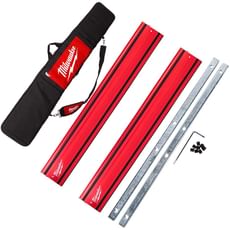
Milwaukee also offers specialist accessories including replacement anti-splinter strips, which can be rotated or replaced to maintain zero-clearance performance as they wear, and storage bags designed to protect rails during transport and prevent damage to vehicles and other tools.
Safety and Compliance
When using Milwaukee guide rails with power saws, adherence to HSE guidelines for portable power tool use is essential. Always ensure that the rail is securely positioned before starting any cut, and verify that anti-slip pads are in good condition and free from debris. The work surface must provide adequate support along the entire length of the cut to prevent binding or kickback.
Appropriate personal protective equipment including safety glasses, hearing protection, and dust masks should be worn when making guided cuts, as the close proximity of the saw to the material can generate significant dust and noise. Ensure that the workspace is adequately ventilated, particularly when cutting treated materials or manufactured boards that may release harmful particles.
Regular inspection of the guide rail for straightness and damage to the reference edge is important for maintaining both accuracy and safety. Any rail showing signs of significant wear, damage, or deflection should be replaced rather than repaired. Store rails in protective bags or cases to prevent accidental damage and maintain their precision over time.
Frequently Asked Questions
Are Milwaukee guide rails compatible with other brands of track saws?
Milwaukee guide rails are designed specifically for Milwaukee track saws and circular saws with guide rail adaptors. Whilst the physical dimensions may appear similar to other systems, the shoe profile and anti-splinter strip design are optimised for Milwaukee tools. Using non-Milwaukee saws may result in reduced accuracy, poor anti-splinter performance, or incompatibility with the rail profile.
Can Milwaukee guide rails be connected together for longer cuts?
Yes, Milwaukee guide rails feature a connector system that allows multiple rails to be joined for extended cutting capacity. The connectors maintain alignment across the join and feature quick-release mechanisms for easy assembly. This modular approach provides maximum flexibility whilst keeping individual rails manageable for transport and storage.
How do I maintain the anti-splinter strip on my Milwaukee guide rail?
The anti-splinter strip can be rotated or repositioned to present a fresh edge as the initial cutting line becomes worn. Milwaukee supplies replacement strips that can be easily installed, restoring zero-clearance performance. Regular rotation of the strip extends its service life and maintains splinter-free cutting quality.
What length guide rail do I need for cutting standard sheet materials?
For cutting standard 2440mm x 1220mm (8x4) sheet materials, a 1400mm guide rail provides sufficient length for cross-cutting and most rip-cutting operations. For full-length rip cuts on sheet goods, either a longer single rail or connected rails totalling approximately 2500mm will be required. Many professionals find that owning both a 1400mm rail for general work and a shorter rail for confined spaces provides maximum versatility.
Do Milwaukee guide rails work with 240v and cordless track saws?
Yes, Milwaukee guide rails are compatible with both their M18 cordless track saw and any future 240v corded models. The rail design is tool-agnostic within the Milwaukee range, meaning that the same guide rail system works across different power sources. This compatibility protects your investment and allows you to use whichever saw best suits the specific job requirements without needing separate rail systems.