

Sealey Dial Indicators

 Loading...
End of content
Error - No more pages to load
Sealey Dial Indicators at Tooled-Up.com
Sealey has established itself as a trusted name in precision measurement tools, and their dial indicators exemplify the brand's commitment to accuracy and reliability. Designed for engineering, manufacturing, and quality control applications, Sealey dial indicators deliver professional-grade measurement capabilities that skilled tradespeople and precision engineers depend on daily. These instruments are essential for measuring small linear distances, checking component alignment, verifying surface flatness, and monitoring run-out on rotating parts.
The Sealey dial indicator range available from Tooled-Up.com encompasses various measurement ranges and mounting options to suit different workshop requirements. Whether you're setting up machinery, inspecting manufactured components, or performing quality assurance checks, Sealey provides dial indicators with clear, easy-to-read faces and robust construction that withstands the rigours of professional workshop environments. Each instrument is manufactured to deliver consistent, repeatable measurements that meet the exacting standards required in modern engineering operations.
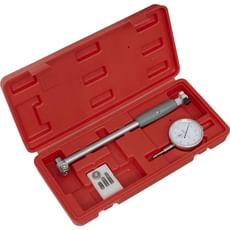
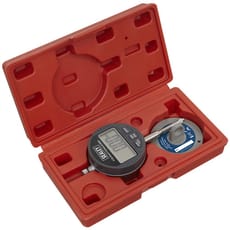
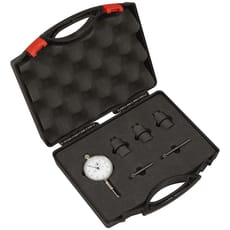
Tooled-Up stocks Sealey dial indicators complete with appropriate mounting accessories, protective cases, and calibration documentation. These precision instruments represent excellent value for workshops that demand accuracy without compromising on build quality, making them equally suitable for established engineering facilities and growing businesses investing in quality measurement equipment.
Why Choose Sealey Dial Indicators?
Sealey has built a reputation for manufacturing measurement tools that balance precision with practicality. Their dial indicators feature hardened and ground measurement spindles that resist wear, ensuring long-term accuracy even with frequent use. The large, clearly marked dial faces make readings straightforward, reducing measurement errors and improving productivity in busy workshop environments.
The engineering behind Sealey dial indicators incorporates quality jewelled bearings and precision rack-and-pinion mechanisms that deliver smooth, accurate movement throughout the measurement range. This attention to mechanical detail translates into instruments that maintain their calibration over extended periods, minimising downtime and recalibration costs. Sealey backs their dial indicators with comprehensive support and replacement parts availability, ensuring these tools remain serviceable assets rather than disposable items.
Value proposition is another compelling reason professionals choose Sealey dial indicators. The brand offers performance comparable to premium measurement tool manufacturers whilst maintaining price points accessible to small workshops and independent tradespeople. This democratisation of precision measurement technology enables businesses of all sizes to implement proper quality control procedures without excessive capital investment.
Who Uses Sealey Dial Indicators?
- Precision Engineers - for measuring tolerances on machined components and verifying dimensional accuracy
- Tool and Die Makers - checking alignment and parallelism during mould and die manufacture
- Quality Control Inspectors - performing incoming goods inspection and production verification
- Machine Tool Setters - aligning machine components and checking spindle run-out
- Automotive Engineers - measuring shaft end-float, disc run-out, and engine component alignment
- Maintenance Technicians - diagnosing wear in rotating machinery and checking bearing clearances
- Manufacturing Supervisors - establishing quality benchmarks and training staff in measurement techniques
- Technical Colleges and Apprentice Training Centres - teaching fundamental measurement skills
Key Features of Sealey Dial Indicators
Sealey dial indicators incorporate several features that enhance their utility and longevity in professional environments. The robust metal housings protect the delicate internal mechanisms from workshop knocks whilst providing rigid mounting that prevents flex during measurement. Hardened steel plungers with polished contact points ensure consistent readings across various surface finishes, from rough castings to precision-ground components.
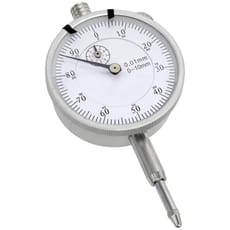
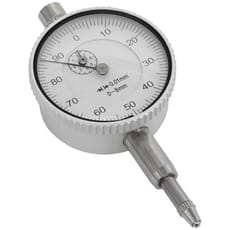
The dial mechanisms feature balanced hands with clear graduation markings, typically offering resolution down to 0.01mm for standard models. Revolution counters on longer-travel indicators track total displacement across multiple dial rotations, essential when measuring larger deviations or component movements. Many Sealey dial indicators include adjustable tolerance markers that allow users to set acceptable measurement ranges, speeding up pass/fail inspection processes.
Mounting versatility is built into the Sealey design philosophy, with indicators supplied with standard 8mm stems that fit commonly available magnetic bases, clamp stands, and dedicated mounting fixtures. Protective cases preserve accuracy during storage and transportation, whilst protective lugs prevent the plunger from being pushed beyond its travel limits, which could damage the internal mechanism.
Popular Sealey Dial Indicators
Sealey's dial indicator portfolio addresses different measurement scenarios found across engineering disciplines. Standard travel indicators with 10mm measurement range suit general inspection work, offering sufficient displacement measurement for most component checking applications. These versatile instruments handle routine dimensional verification, surface flatness checks, and basic alignment tasks.
Long-range dial indicators providing 30mm or greater travel prove invaluable when measuring larger movements, such as machine table parallelism or significant component run-out. These instruments maintain the same measurement resolution across their extended range, ensuring consistency regardless of the displacement being measured.
Lever-type dial indicators (often called finger gauges) represent a specialised category ideal for confined spaces where traditional plunger-style indicators cannot reach. These compact instruments convert lever movement into dial readings, perfect for internal measurements, groove depth checking, and applications where access limitations prevent straight-line measurement approaches.
Safety and Compliance
Whilst dial indicators themselves present minimal safety hazards, proper usage practices ensure both personal safety and measurement accuracy. Always ensure workpieces are securely clamped before taking measurements, preventing unexpected movement that could trap fingers or damage the indicator plunger. When measuring rotating components, position the indicator carefully and maintain appropriate clearances to prevent contact with moving parts that could cause injury or instrument damage.
Sealey dial indicators should be calibrated regularly according to ISO 463 standards to maintain measurement accuracy. Many quality-conscious businesses implement calibration schedules aligned with ISO 9001 requirements, typically recalibrating measurement instruments annually or after any suspected damage. Keep calibration certificates accessible for audit purposes and mark instruments with their next calibration due date.
Handle dial indicators with care appropriate to precision instruments. Avoid dropping them, exposing them to excessive vibration during transport, or storing them in environments with extreme temperatures or humidity. Clean contact points with appropriate solvents after use, particularly when measuring oily or dirty components, to prevent contamination affecting subsequent measurements.
Frequently Asked Questions
What measurement resolution do Sealey dial indicators offer?
Most Sealey dial indicators provide 0.01mm resolution, which suits the majority of engineering and manufacturing applications. This level of precision enables accurate dimensional verification whilst maintaining robust construction that withstands workshop conditions. The clear dial markings make these fine increments easy to read, even in less-than-ideal lighting conditions.
Can Sealey dial indicators measure both imperial and metric dimensions?
Sealey produces dial indicators calibrated in metric measurements (millimetres), which aligns with UK and European engineering standards. For applications requiring imperial measurements, conversion charts can be used, though most modern UK engineering work operates exclusively in metric units. Dual-scale indicators are less common but may be available for specialised applications.
How often should Sealey dial indicators be calibrated?
Industry best practice recommends annual calibration for dial indicators used in quality-critical applications. Workshops operating under ISO 9001 quality management systems typically maintain documented calibration schedules. Additionally, recalibration should occur after any suspected damage, such as dropping the instrument, or if measurements appear inconsistent with known reference standards.
What's the difference between continuous dial indicators and balanced reading indicators?
Continuous dial indicators feature numbering that runs in one direction around the entire dial face, ideal for measuring total displacement in one direction. Balanced reading indicators have zero positioned centrally with positive and negative scales either side, making them perfect for checking centreline alignment or measuring deviation from a nominal position. Sealey offers both types to suit different measurement scenarios.
Do Sealey dial indicators come with mounting accessories?
Sealey dial indicators typically come with protective storage cases and standard 8mm mounting stems. However, magnetic bases, clamp stands, and other mounting fixtures are usually sold separately, allowing users to select mounting solutions appropriate to their specific applications. This approach provides flexibility whilst keeping initial costs accessible for those who already own suitable mounting equipment.