

Stanley Grade Rods
 Loading...
End of content
Error - No more pages to load
Stanley Grade Rods at Tooled-Up.com
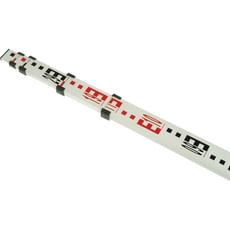
Stanley has established itself as a trusted name in precision measuring equipment, and their grade rods exemplify the brand's commitment to accuracy and durability. Grade rods, also known as levelling staffs, are essential tools for surveying, construction, and civil engineering projects where precise height measurements are critical. The Stanley range available from Tooled-Up combines traditional craftsmanship with modern materials and clear, easy-to-read graduations that stand up to demanding site conditions.
Whether you're working on groundworks, drainage projects, site preparation, or detailed surveying tasks, Stanley grade rods deliver the reliability professionals demand. These measuring tools are designed to work seamlessly with optical levels, laser levels, and digital levelling instruments, providing accurate readings across a variety of applications. Stanley's reputation for producing robust, weather-resistant equipment ensures these grade rods maintain their accuracy even after extended use in challenging outdoor environments.
Tooled-Up stocks Stanley grade rods that cater to both professional surveyors and construction professionals who need dependable measuring solutions. With features like reinforced construction, high-visibility markings, and lightweight yet sturdy materials, Stanley grade rods represent an investment in measurement accuracy that will serve tradespeople for years to come.
Why Choose Stanley Grade Rods?
Stanley's heritage in manufacturing precision tools spans over a century, and this experience translates directly into the quality of their grade rods. The brand's commitment to accuracy means each rod undergoes rigorous quality control to ensure graduations are printed with absolute precision, eliminating measurement errors that could compromise project outcomes. Stanley understands that even minor inaccuracies in levelling work can lead to costly mistakes, which is why their grade rods are manufactured to exacting standards.
Durability is another hallmark of Stanley grade rods. Construction sites and surveying environments present numerous challenges – from accidental impacts to exposure to moisture, UV radiation, and temperature extremes. Stanley addresses these concerns by using materials that resist warping, fading, and degradation. The protective coatings and robust construction ensure that measurement markings remain clearly visible throughout the tool's lifespan, whilst the structural integrity of the rod prevents the bowing or bending that can affect accuracy.
Value for money sets Stanley apart in the grade rod market. Whilst maintaining professional-grade quality, Stanley manages to offer competitive pricing that makes their equipment accessible to both established surveying firms and independent tradespeople. This combination of reliability, longevity, and reasonable pricing has made Stanley a go-to choice for professionals who need dependable measuring equipment without breaking the budget.
Who Uses Stanley Grade Rods?
Stanley grade rods serve a diverse range of professionals across the construction and civil engineering sectors:
- Land Surveyors: Professional surveyors rely on Stanley grade rods for topographical surveys, boundary determinations, and site analysis work
- Civil Engineers: Used extensively for groundwork preparation, drainage schemes, and infrastructure projects requiring precise level measurements
- Groundworkers: Essential for setting out foundations, drainage falls, and ensuring proper site levels before construction begins
- Construction Site Engineers: For daily levelling tasks, monitoring settlement, and verifying ground levels throughout building projects
- Highways and Drainage Contractors: Critical for establishing correct gradients for road surfaces and drainage systems
- Agricultural Contractors: Used in land drainage projects and field levelling work
- Building Contractors: For establishing datum points and checking levels during construction phases
- Local Authority Works Departments: For maintenance, inspection, and new infrastructure projects
Key Features of Stanley Grade Rods
Stanley grade rods incorporate several design features that enhance their practicality and accuracy in the field. High-contrast graduation markings ensure readings can be taken quickly and accurately, even in challenging lighting conditions or at considerable distances. The clear numbering systems, typically featuring bold figures at regular intervals, reduce the risk of misreading measurements during fast-paced site work.
Many Stanley grade rods feature telescopic or folding designs that make transportation and storage considerably more convenient. These collapsible configurations don't compromise on rigidity when extended – positive locking mechanisms ensure the rod remains perfectly straight during measurements. The lightweight construction, often utilising fibreglass or aluminium materials, reduces fatigue during extended surveying sessions whilst maintaining the structural integrity necessary for accurate readings.
Weather resistance is built into Stanley grade rods through protective finishes that prevent moisture ingress and UV-resistant coatings that stop graduation markings from fading in sunlight. The oval or rectangular cross-sections common in Stanley designs provide excellent stability against wind, whilst graduated faces are positioned to facilitate easy reading from levelling instruments. Reinforced end caps protect the rod from impact damage when placing on hard surfaces, extending the tool's working life significantly.
Popular Stanley Grade Rods
The Stanley grade rod range at Tooled-Up encompasses various lengths and graduation types to suit different applications. Standard metric grade rods, typically available in 3-metre, 4-metre, and 5-metre lengths, cover the majority of construction and surveying requirements. These rods feature clear metric graduations, usually in 10mm increments with bolder markings at 100mm intervals, allowing for precise measurements that comply with UK construction standards.
Telescopic models offer exceptional versatility, extending to full height when needed but collapsing to a compact size for easy vehicle transport and site mobility. These are particularly popular among professionals who work across multiple sites daily, as they eliminate the need for roof racks or long-bed vehicles. The robust locking mechanisms ensure that once extended, these rods maintain the rigidity essential for accurate levelling work.
Stanley also produces grade rods with dual graduation systems, featuring both metric and imperial measurements. Whilst metric is standard in the UK, these dual-scale rods prove valuable when working on projects involving imported plans or when liaising with international engineering specifications. Heavy-duty models with reinforced construction cater to demanding environments where equipment takes considerable punishment, such as infrastructure projects or quarry work.
Safety and Compliance
When using Stanley grade rods on construction sites, adherence to UK Health and Safety Executive (HSE) guidelines is essential. Operators should wear appropriate high-visibility clothing, especially when working near plant machinery or traffic. Grade rods should be held vertically and kept away from overhead power lines – maintaining safe distances from electrical hazards is critical, particularly with conductive materials.
Regular inspection of grade rods ensures continued accuracy and safety. Check for warping, damage to graduation markings, or degradation of locking mechanisms on telescopic models. Any grade rod showing signs of bending or structural compromise should be withdrawn from service, as this will affect measurement accuracy. Store Stanley grade rods in protective cases or horizontally supported to prevent warping, and avoid leaving them in direct sunlight for extended periods when not in use.
Stanley grade rods should be handled with care during transport to prevent damage. When working on uneven terrain or near excavations, ensure stable footing before taking measurements. The HSE recommends that site workers are properly trained in levelling equipment use and understand the importance of accurate measurements in preventing structural issues and ensuring site safety.
Frequently Asked Questions
What length Stanley grade rod should I choose?
For general construction work, a 4-metre or 5-metre grade rod covers most applications. Longer rods are necessary for extensive earthworks or large-scale surveying projects, whilst 3-metre models offer easier handling in confined spaces. Consider the typical distances and height differences you'll measure when selecting the appropriate length.
Can Stanley grade rods be used with laser levels?
Yes, Stanley grade rods are compatible with optical levels, digital levels, and laser levels. Ensure your grade rod has clear, high-contrast markings that are easily visible through your levelling instrument. Some laser level applications may benefit from grade rods with special reflective sections or detector brackets.
How do I maintain the accuracy of my Stanley grade rod?
Store your grade rod horizontally or in a vertical protective case to prevent warping. Avoid dropping or striking the rod against hard surfaces, as impacts can cause bending. Regularly inspect graduations for wear or fading, and clean the rod with a damp cloth to maintain marking visibility. Never use the grade rod as a pry bar or support.
Are Stanley grade rods suitable for professional surveying work?
Stanley produces grade rods that meet the accuracy requirements for professional surveying and construction applications. Their precision graduations and robust construction make them suitable for site engineering, setting out work, and level monitoring. For highly specialised geodetic surveying, consult specific project requirements to ensure the rod meets necessary standards.
What's the difference between fibreglass and aluminium Stanley grade rods?
Fibreglass grade rods offer excellent durability and are non-conductive, making them safer near electrical installations. They're typically more resistant to impacts and environmental conditions. Aluminium rods are often lighter and may feature clearer graduation printing, but require more care around electrical hazards. Both materials provide the rigidity necessary for accurate measurements when manufactured to Stanley's quality standards.