

Wiha VDE Sockets & Ratchets
 Loading...
End of content
Error - No more pages to load
Wiha VDE Sockets & Ratchets at Tooled-Up.com
Wiha stands as one of Germany's most respected tooling manufacturers, and their VDE insulated sockets and ratchets represent the pinnacle of electrically safe hand tools for professional tradespeople. When working with live electrical systems up to 1000V AC or 1500V DC, standard chrome vanadium sockets simply aren't adequate – you need tools that have been rigorously tested to VDE standards. Tooled-Up.com stocks a comprehensive selection of Wiha VDE insulated socket sets, individual sockets, and ratchet handles engineered specifically for electrical installation and maintenance work where safety cannot be compromised.
Every Wiha VDE socket and ratchet undergoes individual testing at 10,000V before leaving the factory, ensuring complete electrical isolation and providing absolute peace of mind when working near live conductors. The distinctive red and yellow colour coding – mandated by VDE standards – makes these tools instantly identifiable on site, reducing the risk of accidentally using non-insulated alternatives. Whether you're working on industrial control panels, renewable energy installations, or domestic 240v consumer units, the Wiha VDE socket range available from Tooled-Up provides the protection and precision that electrical work demands.
Wiha's commitment to quality extends beyond safety certification. Their VDE sockets feature hardened chrome vanadium cores for durability, precision-machined profiles that grip fasteners securely without rounding, and ergonomically designed ratchet handles that reduce hand fatigue during extended use. The insulation itself is moulded rather than dipped, creating a seamless barrier that won't peel or crack with age, whilst maintaining the slim profile needed for access in tight electrical enclosures.
Why Choose Wiha VDE Sockets & Ratchets?
Wiha has built an unrivalled reputation amongst electricians and electrical engineers for producing VDE tools that balance uncompromising safety with practical usability. Whilst several manufacturers produce VDE-certified tools, Wiha distinguishes itself through superior build quality, longevity, and attention to the specific needs of electrical professionals. Each tool carries individual certification markings and batch numbers, providing full traceability should any workplace safety audit require it.
The German engineering heritage behind Wiha tools ensures dimensional accuracy that mechanics and electricians can depend upon. Unlike budget alternatives where insulation can add bulk and reduce socket access, Wiha's precision moulding process maintains compact external dimensions whilst achieving full VDE protection. This attention to detail means you can reach recessed terminals and work within confined spaces without sacrificing safety. The ratchet mechanisms employ fine-tooth designs – typically 72 teeth or more – allowing minimal swing arc in restricted areas where electrical work frequently takes place.
Wiha also provides comprehensive product support and certification documentation, essential for contractors maintaining tool registers and demonstrating compliance with BS 7671 wiring regulations and HSE guidance on electrical safety. The lifetime guarantee against manufacturing defects reflects Wiha's confidence in their production standards, though it's worth noting this doesn't cover electrical damage from misuse – a clear indicator these tools are precision instruments requiring proper care.
Who Uses Wiha VDE Sockets & Ratchets?
Wiha VDE sockets and ratchets are essential equipment for a wide range of electrical professionals and industrial maintenance specialists:
- Electricians and Electrical Contractors: Particularly those working on commercial and industrial installations where live working may be unavoidable
- Renewable Energy Installers: Solar PV and wind turbine technicians working with high DC voltages
- Industrial Maintenance Engineers: Factory and plant electricians maintaining machinery and control systems
- Instrumentation Technicians: Professionals working on process control and automation systems
- Railway and Transport Engineers: Those working with traction power systems and signalling equipment
- Electrical Testing Specialists: Engineers conducting inspection, testing, and fault-finding on electrical installations
- Utility Company Workers: Distribution network operators and meter installation technicians
- MOD and Defence Contractors: Working on military electrical and electronic systems
Key Features of Wiha VDE Sockets & Ratchets
Wiha VDE sockets and ratchets incorporate numerous technical features that set them apart from conventional socket tools and even competitor VDE offerings:
Individual Testing and Certification: Every single tool is tested at 10,000V and carries individual certification markings, not just batch certification, ensuring complete reliability.
Seamless Moulded Insulation: The insulation is precision-moulded around the metal core rather than dipped, eliminating potential weak points and maintaining dimensional accuracy for proper fastener engagement.
Colour-Coded Safety Design: The distinctive red insulation with yellow identification bands provides instant visual confirmation you're using VDE-rated tools, crucial for site safety protocols.
Fine-Tooth Ratchet Mechanisms: High tooth count (typically 72-tooth) allows operation with as little as 5 degrees of swing arc, essential when working in electrical enclosures and tight spaces around cable management systems.
Hardened Chrome Vanadium Cores: Despite the insulation, the working components use premium tool steel for strength and wear resistance, with precisely machined socket profiles that won't round fastener heads.
Slim Profile Design: Compact external dimensions maintained despite full insulation coverage, allowing access to recessed terminals and confined areas typical in electrical work.
Ergonomic Handle Design: Ratchet handles feature comfortable grips that reduce hand fatigue whilst maintaining the tactile feedback needed for controlled fastening in sensitive electrical applications.
Popular Wiha VDE Sockets & Ratchets
The Tooled-Up Wiha VDE range encompasses several popular configurations tailored to different electrical working requirements:
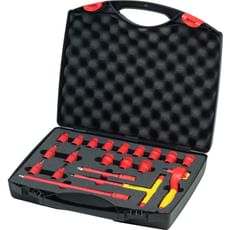
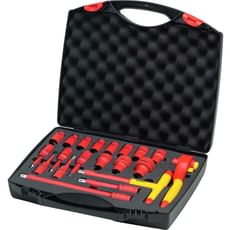
VDE Socket Sets: Comprehensive sets combining 1/4" and 3/8" drive sockets with ratchet handles and extension bars, providing complete coverage for standard electrical fastener sizes from M4 through M14. These typically come in high-quality storage cases with foam inserts for organised transport and instant identification of missing tools.
Individual VDE Sockets: Available in both metric and imperial sizes across 1/4", 3/8", and 1/2" drive options, allowing you to replace worn sockets or expand existing sets with specific sizes your work demands most frequently.
VDE Ratchet Handles: Offered in various drive sizes and handle lengths, featuring fine-tooth mechanisms and quick-release buttons for efficient socket changes whilst wearing electrical safety gloves.
VDE Extension Bars: Insulated extensions in various lengths providing reach whilst maintaining electrical isolation, essential for accessing recessed terminals without compromising safety.
Compact Socket Sets: Smaller sets focused on 1/4" drive sockets ideal for control panel work, instrumentation, and applications where space constraints dominate.
Safety and Compliance
Wiha VDE sockets and ratchets are manufactured and tested to comply with VDE 0682-201, IEC 60900, and EN 60900 standards – the internationally recognised specifications for insulated tools for live working. These tools are rated for use on systems up to 1000V AC (alternating current) or 1500V DC (direct current), covering the vast majority of industrial and commercial electrical installations including UK 240v domestic supplies, 400v three-phase systems, and higher voltage DC systems found in renewable energy and transport applications.
It's crucial to understand that VDE certification doesn't provide a licence for unnecessary live working. The HSE's Electricity at Work Regulations 1989 stipulate that electrical work should be conducted with systems isolated wherever possible. VDE tools are intended for situations where live working is unavoidable or where proving dead requires tool contact, such as voltage testing and phasing checks. They provide crucial protection against accidental contact but should always be used as part of a comprehensive risk assessment and safe working procedure.
Regular inspection of VDE tools is essential for maintaining safety. Before each use, check the insulation for cracks, cuts, or damage, and ensure certification markings remain legible. Contamination with conductive materials should be removed before use. Wiha recommends periodic re-testing of VDE tools, particularly in demanding industrial environments, though specific intervals depend on frequency of use and working conditions. Tools showing any insulation damage should be withdrawn from service immediately – the cost of replacement is negligible compared to the consequences of insulation failure.
When working with VDE tools, additional personal protective equipment remains necessary, including insulated gloves rated for the working voltage, safety footwear, and arc-rated clothing where appropriate. VDE tools form one layer of protection within a comprehensive electrical safety strategy, not a standalone solution.
Frequently Asked Questions
What does VDE certification mean on Wiha sockets and ratchets?
VDE certification indicates that Wiha sockets and ratchets have been individually tested to 10,000V and meet the stringent requirements of VDE 0682-201 and IEC 60900 standards for insulated tools. This certification ensures they provide reliable electrical isolation when working on systems up to 1000V AC or 1500V DC. Each tool carries individual certification markings and is safe for use near live electrical conductors when used correctly. The certification is issued by independent German testing institutes and represents the gold standard for electrically insulated hand tools.
Can I use Wiha VDE sockets on standard mechanical fasteners, or are they only for electrical work?
Wiha VDE sockets are fully capable of handling standard mechanical fastening tasks and feature hardened chrome vanadium cores identical in quality to professional non-insulated sockets. However, the insulation adds cost, so using them exclusively for electrical work and maintaining separate standard tools for general mechanical tasks is more economical. The insulation may also add slight bulk compared to standard sockets, though Wiha's precision moulding minimises this. Many electricians maintain both VDE and standard socket sets, using VDE tools specifically when electrical safety requires it.
How do Wiha VDE sockets compare to standard sockets with insulated sleeves?
Wiha VDE sockets feature precision-moulded insulation that's integral to the tool construction, whilst aftermarket insulated sleeves are separate components that slide over standard sockets. Moulded insulation provides superior protection with no risk of the sleeve slipping during use, maintains tighter dimensional tolerances for better fastener access, and undergoes individual testing and certification. Insulated sleeves don't carry VDE certification, aren't individually tested, and can slip or be accidentally removed. For professional electrical work where safety is paramount, properly certified VDE tools like Wiha's are the only acceptable choice and are required for compliance with electrical safety regulations.
Do Wiha VDE ratchets work with standard non-insulated sockets?
Whilst Wiha VDE ratchet handles use standard drive sizes (1/4", 3/8", 1/2") and will physically accept non-insulated sockets, doing so completely defeats the purpose of VDE protection and creates a serious electrical safety hazard. The entire drive train must be insulated to provide protection, so mixing insulated and non-insulated components compromises the tool's safety rating. If you need to use Wiha VDE ratchets with additional socket sizes, purchase individual VDE-certified sockets in those sizes. Using non-insulated sockets on a VDE ratchet would violate HSE guidance and potentially invalidate your electrical safety procedures and insurance.
How should I store and maintain Wiha VDE sockets and ratchets?
Store Wiha VDE tools in their original cases or dedicated tool storage away from conductive materials, sharp objects, and extreme temperatures that might damage the insulation. Before each use, visually inspect the insulation for any cracks, cuts, punctures, or degradation, and ensure certification markings remain legible. Clean with mild soap and water if contaminated, avoiding solvents that might damage the insulation material. Never use damaged VDE tools – even minor insulation breaches compromise electrical safety. Keep VDE tools separate from standard tools to prevent accidental misuse, and consider implementing a tool inspection register for workplace compliance. Wiha recommends periodic re-testing in demanding environments, with frequency determined by usage intensity and working conditions.