

Lockout Equipment
Pay in 3 interest-free payments on purchases from £30-2000 with  . Learn more.








 Loading...
End of content
Error - No more pages to load
About Lockout Equipment
Lockout equipment is essential safety apparatus designed to prevent the accidental start-up or release of energy from machinery and electrical systems during maintenance, servicing, or repair work. These critical safety devices physically isolate energy sources – whether electrical, mechanical, hydraulic, or pneumatic – ensuring that equipment cannot be operated whilst personnel are working on it. Lockout tagout (LOTO) procedures are fundamental to workplace safety and are mandated by HSE regulations across numerous industries to protect workers from potentially fatal injuries.
The lockout equipment range at Tooled-Up.com encompasses a comprehensive selection of devices designed to control hazardous energy, including electrical lockout devices for circuit breakers, switches and plugs operating at 240v mains voltage, valve lockout systems for pneumatic and hydraulic lines, and universal lockout hasps that allow multiple workers to secure a single energy source. These devices work in conjunction with safety padlocks and warning tags to create a robust safety system that prevents unauthorised operation of isolated equipment.
Proper lockout equipment is not merely a recommendation but a legal requirement under the Health and Safety at Work Act and associated regulations. Whether working on industrial machinery, electrical installations, or complex production lines, implementing effective lockout tagout procedures protects maintenance personnel, contractors, and other workers from crush injuries, electrical shock, burns, and other serious hazards associated with unexpected equipment energisation or movement.
Jargon Buster
- LOTO (Lockout Tagout): A safety procedure ensuring that dangerous machines and energy sources are properly shut off and cannot be restarted before maintenance or repair work is completed. The 'lockout' physically prevents operation whilst the 'tagout' provides visible warning information.
- Authorised Person: An employee who has been trained and designated by their employer to perform lockout procedures and apply lockout devices to energy-isolating equipment. Only authorised persons should attach or remove lockout equipment.
- Energy-Isolating Device: A mechanical device that physically prevents the transmission or release of energy, including circuit breakers, disconnect switches, line valves, and blocks. These devices must be capable of being locked out.
- Lockout Hasp: A device that accepts multiple padlocks, allowing several workers to simultaneously lock out the same energy source. The equipment cannot be re-energised until all workers have removed their individual locks.
- Group Lockout: A procedure used when multiple workers are servicing equipment, requiring a lockout system that accommodates all personnel with individual locks to ensure no single person can restore energy independently.
- Stored Energy: Energy that remains in machinery even after primary power sources are isolated, including compressed air, hydraulic pressure, springs, flywheels, and capacitors in electrical systems. This residual energy must be safely dissipated before work begins.
Who Uses Lockout Equipment?
Lockout equipment is essential for numerous trades and professions working with powered machinery and energy systems:
- Electrical Contractors and Sparkies: For isolating 240v circuits, distribution boards, and electrical panels during installation, testing, and maintenance work
- Maintenance Engineers: Industrial and facilities maintenance personnel servicing production machinery, conveyor systems, and automated equipment
- Facilities Managers: Responsible for implementing and overseeing LOTO programmes across commercial and industrial premises
- Production Line Technicians: Factory workers performing routine maintenance, adjustments, and troubleshooting on manufacturing equipment
- HVAC Engineers: When working on heating, ventilation, and air conditioning systems with electrical, pneumatic, and mechanical energy sources
- Machine Operators: Personnel authorised to perform basic maintenance and cleaning tasks requiring equipment isolation
- Health and Safety Officers: Professionals responsible for developing, implementing, and auditing lockout tagout procedures
- Plant Engineers: Working in utilities, water treatment, and process industries with complex energy control requirements
- Contractors: External service providers working on client machinery who must comply with site LOTO protocols
How to Choose the Right Lockout Equipment
Selecting appropriate lockout equipment requires careful assessment of your specific workplace hazards and energy control requirements:
Identify Energy Sources: Begin by conducting a thorough survey of all energy sources requiring isolation – electrical systems including 240v mains supplies, pneumatic lines, hydraulic systems, mechanical energy from moving parts, and thermal energy. Different energy types require specific lockout devices designed for purpose.
Electrical Lockout Devices: For electrical isolation, choose devices compatible with your specific equipment. Circuit breaker lockouts must match the breaker size and style, whilst plug lockouts prevent reconnection of disconnected equipment. Consider whether you need miniature circuit breaker (MCB) lockouts, moulded case circuit breaker (MCCB) devices, or isolator switch lockouts based on your electrical infrastructure.
Universal vs Specific Devices: Tooled-Up stocks both universal lockout devices that accommodate various equipment types and application-specific solutions. Universal lockouts offer versatility and cost-effectiveness for facilities with diverse equipment, whilst dedicated devices provide optimal security for particular applications.
Group Lockout Capability: When multiple workers service the same equipment, lockout hasps are essential. Select hasps with sufficient capacity for the maximum number of workers who might simultaneously require access, typically ranging from 3 to 12 padlock positions.
Durability and Environmental Resistance: Consider the working environment when selecting materials. Industrial settings may require heavy-duty steel devices, whilst corrosive environments benefit from coated or non-metallic options. Outdoor applications need weather-resistant materials.
Standardisation and Colour Coding: Implementing standardised lockout equipment across your facility simplifies training and ensures consistency. Many organisations use colour-coded systems to identify different departments, contractors, or energy types for enhanced visual management.
Compliance Requirements: Ensure selected equipment meets relevant British Standards and HSE guidance for lockout tagout procedures. Documentation and traceability become important considerations for regulated industries.
Popular Accessories
- Safety Padlocks: Dedicated LOTO padlocks with unique keying, often in distinctive colours with 'Danger - Do Not Remove' labelling
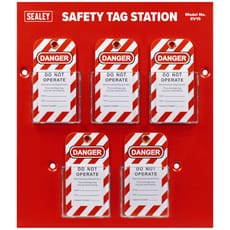
- Lockout Tags: Durable warning tags providing information about who applied the lockout, when, and why equipment is isolated
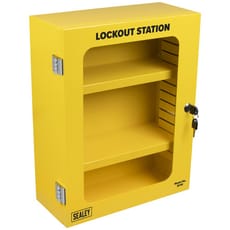
- Lockout Stations: Wall-mounted storage systems keeping lockout devices, padlocks, and tags organised and accessible
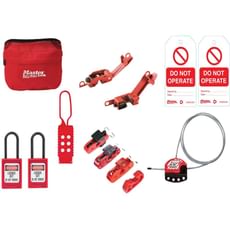
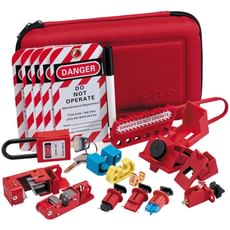
- Lockout Kits: Pre-assembled collections of commonly needed lockout devices for specific trades or industries
- Cable Lockouts: Adjustable cable devices for securing larger valves, steering wheels, and irregular-shaped isolators
- Valve Lockouts: Specialised devices for gate valves, ball valves, and butterfly valves in pneumatic and hydraulic systems
- Permit-to-Work Documentation: Forms and record-keeping systems for maintaining LOTO compliance records
- Lockout Training Materials: Visual aids, posters, and guidance documents supporting employee training programmes
Safety Information
Lockout equipment itself is a critical safety device, but its effectiveness depends entirely on proper implementation and adherence to procedures:
Training is Mandatory: Only authorised and trained personnel should apply or remove lockout devices. HSE regulations require employers to provide comprehensive training covering energy sources, isolation procedures, and lockout equipment operation. Regular refresher training ensures competency is maintained.
Written Procedures Required: Every piece of equipment requiring lockout must have documented, equipment-specific procedures detailing the isolation sequence, lockout points, energy dissipation steps, and verification methods. These procedures should be readily accessible to authorised workers.
Personal Locks Only: Each worker must apply their own individually keyed padlock and retain the only key during work. Never share locks or keys, and never remove another worker's lockout device under any circumstances. This personal accountability is fundamental to LOTO effectiveness.
Verify Zero Energy: After applying lockout devices, always verify that equipment is truly de-energised before beginning work. Test for residual 240v electrical power, check that moving parts cannot operate, and confirm pressure gauges read zero. Stored energy in capacitors, springs, and elevated components must be safely dissipated.
Regular Inspections: Lockout equipment should be inspected periodically for damage, wear, or deterioration. Damaged devices must be replaced immediately as compromised lockout equipment cannot provide reliable protection.
Emergency Removal Procedures: Establish and document procedures for the rare situations when a lockout device must be removed in the absence of the person who applied it, ensuring worker safety remains paramount throughout the process.
Frequently Asked Questions
Q: Is lockout equipment legally required in the UK?
A: Whilst specific "lockout tagout" regulations don't exist in UK law as they do in the USA, the legal requirements under the Health and Safety at Work Act, Electricity at Work Regulations 1989, and Provision and Use of Work Equipment Regulations 1998 effectively mandate energy isolation and prevention of inadvertent equipment operation. HSE guidance strongly recommends lockout tagout procedures as best practice for controlling hazardous energy.
Q: Can I use a standard padlock for lockout purposes?
A: Standard padlocks are not suitable for safety lockout applications. Dedicated safety padlocks should be used, featuring non-conductive bodies, unique keying to prevent master key access, durable construction, and distinctive colouring with safety labelling. These features ensure the padlock cannot be easily defeated and clearly identifies it as a safety device rather than security hardware.
Q: What's the difference between electrical lockout equipment and other types?
A: Electrical lockout equipment available from Tooled-Up is specifically designed for isolating electrical energy sources such as circuit breakers, fuse switches, and plug connections operating at voltages including 240v mains supplies. These devices often feature non-conductive materials to prevent electrical shock. Other lockout equipment addresses mechanical, hydraulic, pneumatic, and thermal energy sources using different isolation mechanisms appropriate to each energy type.
Q: How many workers can lock out the same piece of equipment?
A: Using a lockout hasp, multiple workers can simultaneously secure the same energy-isolating device with their individual padlocks. Hasps are available in various sizes accommodating from 3 to 12 or more padlocks. The equipment cannot be re-energised until every worker has completed their task and removed their personal lock, ensuring no individual is at risk from another worker's actions.
Q: Do I need different lockout devices for 240v domestic circuits versus industrial three-phase systems?
A: Yes, different electrical systems require appropriately sized and rated lockout devices. Single-phase 240v domestic-style MCBs use compact lockout devices designed for standard consumer units, whilst industrial installations with larger MCCBs, isolators, and three-phase equipment require correspondingly robust lockout solutions. The physical size, configuration, and accessibility of the isolation point determines which lockout device is appropriate, ensuring secure application and preventing inadvertent removal.