

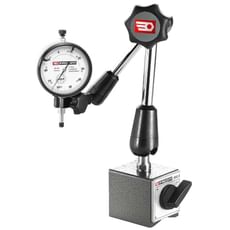
Facom Dial Indicators
 Loading...
End of content
Error - No more pages to load
Facom Dial Indicators at Tooled-Up.com
Facom has established itself as one of the most trusted names in precision measurement tools, and their dial indicators exemplify the brand's commitment to accuracy and reliability. These mechanical measuring instruments are essential for professionals who demand exacting standards in their work, from engineering workshops to quality control laboratories. The Facom dial indicators available at Tooled-Up.com represent decades of French engineering excellence, combining robust construction with the precision necessary for critical measurement tasks.
Dial indicators, also known as dial gauges or dial test indicators, are fundamental tools for measuring small linear distances and checking the alignment, flatness, and concentricity of machined parts. Facom's approach to dial indicator design focuses on creating instruments that deliver consistent, repeatable readings whilst withstanding the demanding conditions of professional workshops. Each gauge is engineered to provide smooth plunger movement and clear dial readouts, ensuring that measurements can be taken quickly and accurately without user fatigue.
Whether you're performing routine quality checks, setting up machine tools, or inspecting finished components, Facom dial indicators provide the measurement certainty that professionals require. The range encompasses various measurement spans and resolutions to suit different applications, all manufactured to exacting standards that have made Facom a byword for quality in the professional tool market.
Why Choose Facom Dial Indicators?
Facom's reputation in precision measurement tools stems from their unwavering commitment to manufacturing excellence and metrological accuracy. Every Facom dial indicator undergoes rigorous calibration and testing before leaving the factory, ensuring that it meets strict international standards for measurement instruments. The brand's dial indicators feature hardened and ground components in critical areas, reducing wear and maintaining accuracy over extended periods of professional use.
The jewelled bearings found in Facom dial indicators represent a significant quality advantage, providing smooth, friction-free movement that enhances measurement sensitivity and extends instrument life. This attention to detail extends to every aspect of construction, from the precision-ground measuring spindles to the anti-reflective crystal faces that ensure dial readings remain clear under varied lighting conditions. Facom also designs their dial indicators with practical workshop use in mind, incorporating features such as rotating bezels for zeroing, lockable measuring faces, and robust shock-resistant mechanisms that protect the delicate internal components.
Tradespeople and engineers choose Facom dial indicators because they understand that measurement accuracy directly impacts work quality and efficiency. A reliable dial indicator eliminates guesswork, reduces rework, and provides documentary evidence of dimensional compliance – factors that make Facom instruments a sound investment for quality-conscious professionals.
Who Uses Facom Dial Indicators?
Facom dial indicators serve a diverse range of professionals who depend on precise measurements:
- Precision Engineers and Machinists – for machine setup, alignment verification, and component inspection
- Quality Control Inspectors – conducting dimensional verification and production monitoring
- Tool and Die Makers – ensuring accuracy in tooling manufacture and maintenance
- Automotive Technicians – checking bearing play, shaft runout, and surface flatness
- Maintenance Engineers – diagnosing machinery wear and alignment issues
- Fabricators and Welders – verifying flatness and alignment in structural work
- Aerospace and Defence Technicians – where measurement traceability is critical
- Apprentices and Training Facilities – learning fundamental metrology skills with professional-grade instruments
Key Features of Facom Dial Indicators
Facom dial indicators incorporate numerous features that distinguish them from economy alternatives. The precision-ground measuring spindles are manufactured from hardened stainless steel, providing excellent wear resistance and corrosion protection whilst maintaining dimensional stability. The internal mechanism utilises a rack-and-pinion arrangement with jewelled bearings, ensuring smooth movement with minimal friction and hysteresis.
The dial faces on Facom indicators feature high-contrast markings with clear numerical graduations, allowing rapid reading without eye strain. Many models include a smaller revolution counter dial that tracks the number of complete rotations, enabling measurements beyond the primary dial's range. The rotating bezel with locking mechanism allows users to zero the indicator at any point in its travel, simplifying comparative measurements and tolerance checking.
Shock protection systems are integrated into Facom dial indicators to safeguard the delicate internal components from impact damage during handling or accidental overtravel. The measuring tip is retractable against spring pressure, preventing damage when excessive force is applied. Facom also supplies their dial indicators with a range of accessories, including magnetic bases, clamp attachments, and protective cases, creating complete measurement solutions for various applications.
Popular Facom Dial Indicators
The Facom dial indicator range at Tooled-Up encompasses various configurations to suit different measurement requirements. Standard dial indicators with continuous dial faces are the most versatile choice, offering measurement ranges typically from 0-10mm with resolutions of 0.01mm. These are ideal for general engineering and workshop applications where relative measurements and comparative checks are needed.
Lever-type dial test indicators, also available in the Facom range, feature a pivoting contact point rather than a direct plunger action. This design excels in applications where access is restricted or where the measuring direction needs to be perpendicular to the indicator body, such as checking concentricity on rotating parts or verifying surface profiles.
Facom's precision dial indicators with finer resolutions (0.001mm or 0.002mm) cater to applications demanding exceptional accuracy, such as gauge calibration, precision grinding operations, or scientific instrument manufacture. These instruments feature enhanced internal mechanisms and superior finish quality to deliver the repeatable performance that critical applications demand.
Safety and Compliance
Whilst dial indicators themselves don't present significant safety hazards, their proper use is essential for maintaining workplace safety and product quality. Facom dial indicators are manufactured to comply with relevant international standards for measuring instruments, including ISO 463 for dial indicators and ISO 1103 for swivel-head dial test indicators. These standards define tolerances, design requirements, and verification methods, ensuring measurement reliability.
Users should ensure that Facom dial indicators are periodically verified against certified reference standards to maintain measurement traceability, particularly in quality-critical or regulated industries. Proper storage in protective cases prevents damage and contamination that could affect accuracy. When using dial indicators with magnetic bases or clamp systems, ensure that the mounting arrangement is stable and secure before taking measurements, as movement during measurement will compromise results.
Facom recommends that dial indicators be handled carefully, avoiding drops or impacts that could damage internal components even if external damage isn't visible. Regular cleaning with appropriate solvents removes workshop contaminants, whilst light lubrication of the measuring spindle maintains smooth operation and prevents corrosion.
Frequently Asked Questions
What's the difference between a dial indicator and a dial test indicator?
Standard dial indicators (also called plunger-type indicators) measure in a straight line along the axis of the plunger, making them ideal for checking flatness, parallelism, and direct linear measurements. Dial test indicators (lever-type) feature a pivoting contact point that magnifies small movements perpendicular to the indicator body, making them better suited for checking concentricity, runout, and surface profiles on curved or rotating parts. Facom manufactures both types to cover the full spectrum of measurement applications.
How often should Facom dial indicators be calibrated?
Calibration frequency depends on usage intensity and the criticality of measurements. For quality-critical applications or regulated industries, annual calibration against traceable standards is typical. Workshop instruments used for general setup and checking may be verified less frequently, though any dial indicator showing signs of damage, sticky movement, or inconsistent readings should be recalibrated immediately. Tooled-Up stocks Facom dial indicators that can be supplied with calibration certificates when required for quality management systems.
Can Facom dial indicators measure in both metric and imperial units?
Facom dial indicators are available in both metric (millimetre) and imperial (inch) versions, each calibrated and graduated in their respective measurement system. The metric versions typically offer 0.01mm resolution, whilst imperial models provide 0.001" or 0.0005" graduations. It's important to select the measurement system that matches your drawing specifications and quality documentation requirements, as conversion between systems can introduce rounding errors.
What maintenance do Facom dial indicators require?
Facom dial indicators require minimal maintenance but benefit from proper care. Keep the measuring spindle clean and lightly lubricated with a thin film of instrument oil to ensure smooth movement. Wipe away swarf, coolant, and workshop contaminants after use. Store indicators in their protective cases when not in use to prevent dust ingress and accidental damage. Avoid exposing the instruments to extreme temperatures or corrosive atmospheres. If the movement becomes sticky or readings become inconsistent, the indicator should be professionally serviced or replaced.
Are Facom dial indicators suitable for use with coordinate measuring machines?
Whilst Facom dial indicators are precision instruments, they're primarily designed for manual measurement applications in workshop environments. Coordinate measuring machines (CMMs) typically use electronic probes specifically designed for automated measurement routines. However, Facom dial indicators excel in machine tool setup, manual inspection, and applications where tactile feedback and immediate visual readout are advantageous. For CMM applications, electronic measurement systems are more appropriate, though Facom dial indicators remain invaluable for verification and manual inspection tasks that complement automated measurement processes.