

Facom Micrometers
 Loading...
End of content
Error - No more pages to load
Facom Micrometers at Tooled-Up.com
Facom micrometers represent the pinnacle of precision measurement technology, combining French engineering excellence with over a century of tool-making expertise. As one of the most trusted names in professional metrology equipment, Facom has developed a comprehensive range of micrometers that deliver the accuracy, durability, and reliability demanded by engineers, machinists, and quality control professionals across the UK. Each Facom micrometer is manufactured to exacting standards, incorporating advanced materials and precision-ground components that ensure consistent, repeatable measurements in even the most demanding workshop environments.
The Facom micrometer collection available from Tooled-Up includes external micrometers, internal micrometers, depth micrometers, and specialist measuring instruments designed for specific applications. Whether you're working with traditional analogue models featuring vernier scales or prefer digital micrometers with LCD displays for instant readouts, Facom's portfolio caters to every measurement requirement. Each instrument is supplied with calibration certificates and protective cases, ensuring your investment remains protected and measurement-ready for years of professional use.
Tooled-Up.com stocks the complete range of Facom precision measuring instruments, offering tradespeople and engineering professionals access to workshop-grade metrology tools that meet stringent ISO standards. From compact 0-25mm external micrometers perfect for general workshop use to extended-range models measuring up to 300mm, Facom provides measurement solutions for every precision engineering application.
Why Choose Facom Micrometers?
Facom has earned its reputation as a premium tool manufacturer through unwavering commitment to quality and precision. Each Facom micrometer undergoes rigorous testing and quality control procedures before leaving the factory, ensuring measurement accuracy within ±0.002mm tolerances. The brand's micrometers feature precision-ground spindles and anvils manufactured from hardened, stabilised steel that resists wear and maintains accuracy even after thousands of measurement cycles. This exceptional build quality means Facom micrometers often outlast cheaper alternatives by many years, making them a sound investment for professional workshops.
The ergonomic design of Facom micrometers sets them apart from competitors, with features such as insulated frames that prevent heat transfer from hands affecting measurements, ratchet stops that ensure consistent measuring pressure, and clearly engraved scales that remain legible even in poor lighting conditions. Facom's attention to detail extends to every component, from the smooth operation of the thimble to the positive locking mechanism that prevents accidental adjustment. Many models also feature carbide-tipped measuring faces that provide superior wear resistance when measuring abrasive materials, extending the instrument's working life considerably.
Who Uses Facom Micrometers?
Facom micrometers are the instrument of choice for a wide range of precision-focused professionals, including:
- Precision Engineers and Machinists - for accurate measurement of turned and milled components
- Quality Control Inspectors - ensuring manufactured parts meet specified tolerances
- Tool and Die Makers - measuring critical dimensions during tooling fabrication
- Automotive Engineers - checking engine components and bearing clearances
- Aerospace Technicians - where precision measurements are safety-critical
- Manufacturing Facilities - for incoming inspection and process control
- Educational Institutions - training the next generation of skilled engineers
- Maintenance Engineers - assessing wear on critical components
- Toolmakers and Model Engineers - achieving precision in specialist projects
Key Features of Facom Micrometers
Facom micrometers incorporate numerous advanced features that enhance measurement accuracy and user experience. The precision-ground measuring faces are lapped to optical flatness, ensuring full contact across the entire measuring surface for accurate readings. Many models feature a satin chrome finish that reduces glare and provides corrosion resistance, whilst the hardened and stabilised steel frame maintains dimensional stability across temperature variations commonly encountered in workshop environments.
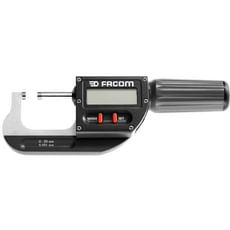
Digital Facom micrometers offer additional functionality including inch/metric conversion at the touch of a button, zero-setting at any position, and data output capabilities for statistical process control applications. The LCD displays feature large, easy-to-read digits with excellent contrast, and many models include automatic shut-off functions to preserve battery life. Analogue models benefit from precision-engraved vernier scales with clearly defined graduations, allowing accurate interpolation between main scale divisions.
The ratchet stop mechanism fitted to Facom micrometers ensures consistent measuring force, eliminating operator variation and improving measurement repeatability. Insulated frames prevent heat transfer from hands causing thermal expansion errors, whilst the spindle lock allows secure fixing once the correct measurement is achieved. Each micrometer is supplied in a protective case with calibration documentation, ready for immediate use in professional applications.
Popular Facom Micrometers
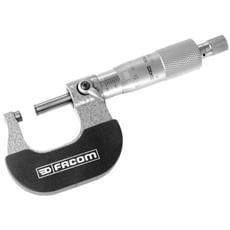
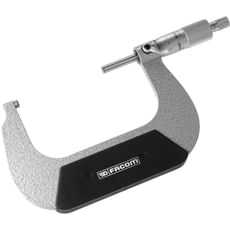
The Facom external micrometer range remains the most widely used type, with 0-25mm models serving as essential equipment in virtually every precision engineering workshop. These instruments measure external dimensions with exceptional accuracy, featuring carbide-tipped faces for extended wear resistance. Available in both analogue and digital formats, external micrometers span ranges from 0-25mm through to 275-300mm for large-diameter measurements.
Facom depth micrometers allow precise measurement of hole depths, slot dimensions, and step heights, using interchangeable measuring rods to accommodate different depth ranges. Internal micrometers measure bore diameters and internal distances with the same precision expected from external models, whilst specialist micrometers for threads, tubes, and discs cater to specific measurement requirements. Digital models across all ranges provide modern convenience whilst maintaining the legendary Facom accuracy.
Safety and Compliance
Whilst micrometers themselves present minimal safety hazards, proper usage and calibration procedures are essential for maintaining measurement accuracy and workplace quality standards. Facom micrometers comply with BS EN ISO 3611 for external micrometers and relevant British Standards for other micrometer types, ensuring traceability to national measurement standards. Regular calibration against certified reference standards is recommended, typically annually or according to your quality management system requirements.
Users should handle micrometers with clean, dry hands to prevent corrosion and contamination of measuring faces. Components being measured should be clean and free from burrs or debris that could affect accuracy. The HSE recommends proper training in precision measurement techniques to ensure accurate results and prevent damage to delicate measuring instruments. Always store micrometers in their protective cases when not in use, and avoid exposing them to temperature extremes, moisture, or magnetic fields that could affect calibration.
Frequently Asked Questions
What accuracy can I expect from Facom micrometers?
Facom micrometers typically offer accuracy within ±0.002mm (±2 microns) for models up to 100mm range, with slightly wider tolerances for larger capacity instruments. Digital models provide the same mechanical accuracy with resolution to 0.001mm. All instruments are supplied with calibration certificates traceable to national standards.
How often should Facom micrometers be calibrated?
Calibration frequency depends on usage intensity and your quality management requirements, but annual calibration is standard practice for most professional environments. High-use applications or critical measurement tasks may require more frequent calibration checks, typically every six months. The Tooled-Up range includes calibration accessories to verify micrometer accuracy between formal calibration intervals.
What's the difference between analogue and digital Facom micrometers?
Analogue micrometers use traditional vernier scales requiring manual reading and interpolation, whilst digital models display measurements on LCD screens for instant, error-free reading. Digital versions often include data output capabilities, inch/metric conversion, and zero-setting features. Both types offer identical mechanical accuracy, with the choice largely depending on user preference and application requirements.
Can Facom micrometers measure in both metric and imperial units?
Facom digital micrometers typically feature mm/inch conversion functions accessible via a button press. Analogue models are manufactured with either metric or imperial scales, so you'll need to select the appropriate version for your requirements. Most UK workshops standardise on metric measurements, with 0-25mm, 25-50mm, and 50-75mm being the most common ranges.
How do I maintain my Facom micrometer?
Clean measuring faces after each use with a lint-free cloth, and apply a thin film of light oil to prevent corrosion. Store in the protective case away from moisture and temperature extremes. Never force the spindle or over-tighten beyond the ratchet stop. Periodically check zero adjustment and verify accuracy using gauge blocks. Avoid dropping or subjecting micrometers to impact, as this can affect calibration and damage precision components.