

Stanley Block Planes
 Loading...
End of content
Error - No more pages to load
Stanley Block Planes at Tooled-Up.com
Stanley has been synonymous with quality hand tools since 1843, and their block planes represent some of the finest examples of precision woodworking tools available to UK tradespeople and enthusiasts. The compact design and exceptional build quality of Stanley block planes make them indispensable for fine finishing work, end grain planing, and detail carpentry where larger bench planes would be impractical. Whether you're a professional joiner working on bespoke furniture or a dedicated DIY enthusiast restoring period features, Stanley's heritage of craftsmanship ensures reliable performance on every project.
Stanley block planes are engineered to deliver superior control and accuracy in confined spaces. Their low-angle cutting geometry makes them particularly effective for trimming end grain, chamfering edges, and fine-tuning joints. The range at Tooled-Up includes both adjustable mouth versions for ultimate versatility and fixed models optimised for specific tasks. Each plane features Stanley's signature quality castings, precision-ground bases, and carefully heat-treated cutting irons that hold an edge exceptionally well even when working with demanding hardwoods.
The Stanley block plane collection combines traditional hand tool design with modern manufacturing precision. From compact palm-sized models perfect for one-handed operation to larger low-angle versions capable of tackling the most challenging grain patterns, Tooled-Up stocks a comprehensive selection to suit every woodworking requirement and skill level.
Why Choose Stanley Block Planes?
Stanley's reputation in the hand tool market is built on over 180 years of continuous innovation and quality. Their block planes are favoured by professionals because they maintain accuracy over years of heavy use, with cast iron bodies that resist warping and provide the mass needed to dampen vibration during cutting. The precision-machined soles on Stanley block planes are ground flat to exacting tolerances, ensuring consistent contact with the workpiece and eliminating the frustrating chatter that plagues inferior tools.
Stanley's commitment to user comfort is evident in their ergonomic designs. The knurled adjustment knobs provide positive control even when wearing gloves, whilst the lateral adjustment levers allow for quick blade alignment without tools. The depth adjustment mechanisms are both sensitive enough for micro-adjustments and robust enough to withstand workshop conditions. Many professional joiners and shopfitters specifically request Stanley block planes because replacement parts remain available even for vintage models, protecting their tool investment for decades.
The cutting irons supplied with Stanley block planes are manufactured from high-carbon tool steel, hardened and tempered to maintain sharpness through extended use. This attention to metallurgy means less time spent at the sharpening station and more productive work time. Stanley's quality control processes ensure each plane leaves the factory properly fettled and ready for immediate use, unlike budget alternatives that require extensive tuning before they'll produce acceptable results.
Who Uses Stanley Block Planes?
- Joiners and Carpenters: For fine-tuning joints, trimming door edges, and finishing work where precision matters
- Cabinet Makers: Essential for end grain work, chamfering, and achieving seamless joins in furniture construction
- Shopfitters: Perfect for on-site adjustments and fitting work in retail and commercial installations
- Boat Builders: Valued for their ability to work curved surfaces and challenging grain patterns in marine timbers
- Restoration Specialists: Ideal for sympathetic repairs to period joinery and architectural features
- Musical Instrument Makers: Precision control essential for delicate work on guitars, violins, and other wooden instruments
- DIY Enthusiasts: Serious home woodworkers who appreciate quality tools that improve with age
- Model Makers: Compact size and precise control perfect for detailed scale work
Key Features of Stanley Block Planes
Stanley block planes incorporate several distinctive features that contribute to their legendary performance. The adjustable mouth opening allows users to optimise the tool for different materials and grain patterns – a narrow opening provides maximum support for difficult grain, whilst a wider setting increases cutting speed in clearer timber. The low-angle configuration, typically around 20 degrees, positions the cutting edge to slice through end grain fibres cleanly rather than crushing them.
The cast iron construction provides thermal stability and vibration damping that lighter materials cannot match. Stanley's precision machining ensures the frog seats perfectly against the body, eliminating blade chatter and providing solid support right up to the cutting edge. The lateral adjustment lever enables quick correction of blade alignment, essential when working with varying grain directions or following the natural contours of timber.
Ergonomic palm grips and finger recesses are carefully positioned to provide comfortable control during extended use. The depth adjustment wheel offers fine control with clear tactile feedback, allowing experienced users to make adjustments by feel without breaking their workflow. Many Stanley block planes feature bronze or brass components at wear points, combining corrosion resistance with self-lubricating properties that keep adjustments smooth throughout the tool's working life.
Popular Stanley Block Planes
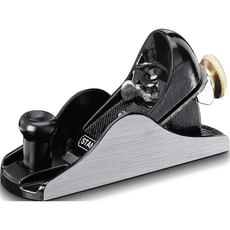
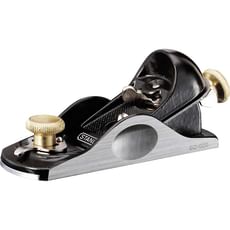
The Stanley No. 60½ low-angle block plane remains the benchmark against which all others are measured. Its 37mm cutter width and 152mm length provide the perfect balance of manoeuvrability and stability for general workshop use. The fully adjustable mouth and precision-ground sole make it equally capable of fine finishing cuts and heavier stock removal.
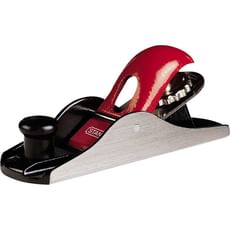
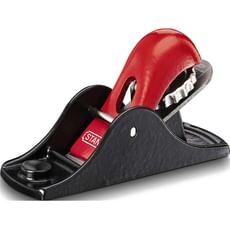
For more compact work, Stanley's smaller block planes offer excellent one-handed control in tight spaces. These palm-sized versions are particularly popular with shopfitters and site carpenters who need to carry their tools between locations. The reduced weight doesn't compromise performance – the same quality castings and cutting irons deliver professional results in a more portable package.
Stanley's premium block plane range features additional refinements such as ductile iron castings for enhanced durability, fully adjustable frogs for precise mouth control, and ergonomically sculpted bodies that reduce hand fatigue during extended sessions. These professional-grade tools are investment pieces that appreciate in both capability and value over time, making them favourites among serious craftspeople who demand the very best.
Safety and Compliance
Whilst block planes are relatively safe hand tools, proper technique and maintenance are essential to prevent accidents. Always plane away from your body and keep hands clear of the cutting path. The razor-sharp cutting iron should be retracted fully when the plane is not in use, and tools should be stored in protective cases or racks to prevent blade damage and accidental contact.
Regular maintenance includes keeping the sole flat and rust-free, ensuring all adjustment mechanisms move freely, and maintaining a properly sharpened cutting iron. A dull blade requires excessive force and is more likely to slip, creating a safety hazard. When sharpening, use appropriate eye protection and secure the blade properly in a honing guide to maintain the correct bevel angle.
Stanley block planes comply with relevant UK and EU safety standards for hand tools. Users should familiarise themselves with HSE guidance on safe working practices for hand tools, particularly when working with exotic hardwoods that may produce irritant dust. Always work in well-ventilated areas and consider respiratory protection when generating fine wood particles, in accordance with COSHH regulations.
Frequently Asked Questions
What's the difference between a block plane and a bench plane?
Block planes are smaller, designed for one-handed use, and feature a lower blade angle (typically 12-20 degrees) with the bevel facing upward. This configuration makes them ideal for end grain work and fine detail tasks. Bench planes are larger, used two-handed, and better suited to flattening boards and long-grain planing.
How do I sharpen my Stanley block plane iron?
Stanley block plane irons should be sharpened at a 25-degree primary bevel with an optional 30-degree micro-bevel for edge retention. Use progressively finer grits from 1000 to 6000 on water stones or diamond plates, maintaining consistent angle throughout. A properly sharpened iron should easily shave end grain and leave a glossy surface finish.
Why won't my Stanley block plane cut smoothly?
Common issues include a dull blade, improper depth adjustment, lateral misalignment, or a clogged mouth. Check that the cutting iron is sharp and properly seated, the mouth opening is appropriate for your material, and the sole is clean and flat. Sometimes a light fettling of the sole with fine abrasive paper on a flat surface improves performance significantly.
Can Stanley block planes work with hardwoods?
Absolutely. Stanley block planes excel with hardwoods when properly sharpened and adjusted. For dense species like oak, maple, or exotic hardwoods, use a narrow mouth opening, take lighter cuts, and ensure your iron is honed to a keen edge. The low-angle design is particularly effective for difficult grain patterns common in premium hardwoods.
Are vintage Stanley block planes better than new ones?
Vintage Stanley planes from the mid-20th century are highly regarded for their exceptional castings and quality control. However, modern Stanley block planes available from Tooled-Up maintain the company's heritage of quality with the advantage of current manufacturing precision and warranty support. Both vintage and contemporary models can deliver outstanding performance when properly maintained and tuned to the user's requirements.