

Planer Thicknessers

Pay in 3 interest-free payments on purchases from £20-£3000 with  . Learn more.
 Loading...
End of content
Error - No more pages to load
About Planer Thicknessers
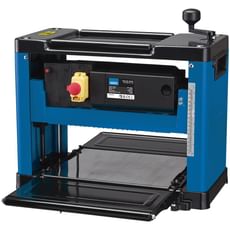
Planer thicknessers are versatile woodworking machines that combine two essential functions in one powerful unit. The planing function smooths rough-sawn timber to create a perfectly flat reference surface, whilst the thicknessing function allows you to dimension boards to a precise, uniform thickness. This dual functionality makes them indispensable tools for anyone working with solid timber, whether you're preparing stock for fine furniture making, creating custom timber components, or reclaiming salvaged wood.
Modern planer thicknessers range from compact benchtop models suitable for small workshops to substantial floor-standing machines designed for heavy-duty professional use. Most feature powerful induction motors ranging from 1,500W to over 2,000W, with cutting widths typically between 200mm and 318mm. Leading manufacturers such as DeWalt, Makita, Draper, and Einhell offer machines with precision-engineered cast tables, multiple cutter heads, and adjustable depth controls that deliver exceptional results on hardwoods and softwoods alike.
These machines eliminate the need for separate planing and thicknessing operations, saving valuable workshop space whilst providing professional-quality surface finishing. Whether you're dimensioning timber for joinery work, preparing stock for bespoke cabinetry, or creating your own mouldings and profiles, a quality planer thicknesser delivers the accuracy and consistency that hand tools simply cannot match.
Jargon Buster
- Cutting Width: The maximum width of timber the machine can process in a single pass, typically ranging from 200mm to 318mm on standard models. This determines the size of boards you can work with without edge-joining.
- Depth of Cut: The maximum amount of material the machine can remove in a single pass, usually between 2mm and 3mm. Multiple passes are required for heavily dimensioned stock.
- Cutter Block: The rotating cylinder containing the cutting blades or knives. Modern machines may feature two-blade or three-blade configurations, with some premium models offering helical cutter heads for quieter operation and superior finish.
- Infeed and Outfeed Tables: The cast iron or aluminium tables on either side of the cutter block that support the timber during planing. These must be perfectly co-planar for accurate results.
- Thicknessing Capacity: The maximum height of timber that can pass through the thicknessing function, typically between 150mm and 180mm on standard models.
- No-Load Speed: The rotational speed of the cutter block measured in RPM (revolutions per minute), usually between 8,000 and 10,000 RPM. Higher speeds generally produce smoother finishes.
Who Uses Planer Thicknessers?
Planer thicknessers are essential equipment for a wide range of woodworking professionals and enthusiasts:
- Joiners and Carpenters: For preparing timber for bespoke joinery, window frames, doors, and architectural woodwork
- Cabinet Makers: Dimensioning solid timber components for fitted and freestanding furniture
- Shopfitters: Creating custom timber fixtures and fittings for retail and commercial interiors
- Furniture Makers: Preparing stock for tables, chairs, and other fine furniture pieces
- Boat Builders: Dimensioning timber for marine joinery and structural components
- Wood Turners: Preparing blanks and square stock for turning projects
- Restoration Specialists: Matching existing profiles and dimensions when repairing historic woodwork
- Serious DIY Enthusiasts: Home workshop users tackling ambitious woodworking projects
- Timber Merchants: Offering machining services to prepare timber to customer specifications
How to Choose the Right Planer Thicknesser
Selecting the appropriate planer thicknesser depends on several key factors that should match your specific requirements:
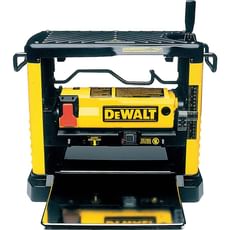
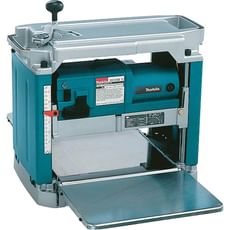
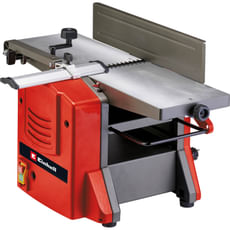
Cutting Capacity: Consider the maximum width and thickness of timber you'll typically work with. Compact models like the 204mm units from Einhell suit smaller projects, whilst 260mm to 318mm machines from DeWalt and Makita accommodate wider boards for furniture making and larger joinery work.
Motor Power: Look for machines with adequate power for your material types. Hardwoods and deep cuts require more robust motors, typically 1,800W or above. The DeWalt D27300 and Makita 2012NB both offer powerful motors suitable for professional workshop environments.
Build Quality: Cast iron tables provide superior flatness and stability compared to pressed steel or aluminium, ensuring accurate results over years of use. Check that infeed and outfeed tables are substantial and that adjustment mechanisms are precise and maintain their settings.
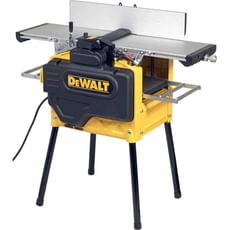
Portability vs Stability: Benchtop models offer flexibility for smaller workshops or mobile operations, whilst floor-standing machines with integrated stands provide better stability for heavy-duty use. Consider whether you need to move the machine regularly or if it will remain in a fixed position.
Dust Extraction: Efficient dust collection is crucial for maintaining a clean workshop and protecting your health. Ensure the machine has adequate extraction ports (typically 100mm diameter) compatible with workshop vacuum systems. Most models require connection to an external extractor rated for fine wood dust.
Safety Features: Look for machines with proper blade guards, emergency stop buttons, and kickback prevention mechanisms. UK-compliant machines available from Tooled-Up.com should meet BS EN 60204 electrical safety standards.
Popular Accessories
- Replacement Planer Blades: TCT (tungsten carbide tipped) or HSS (high-speed steel) blades that require periodic replacement or sharpening to maintain cutting performance
- Dust Extraction Hose and Adaptors: Flexible ducting to connect the machine to workshop vacuum systems, essential for managing the large volumes of chips and dust produced
- Mobile Bases and Stands: Wheeled platforms that allow heavier floor-standing models to be repositioned when needed whilst maintaining stability during operation
- Extension Tables: Add-on supports that extend the infeed and outfeed capacity for working with longer boards
- Push Blocks and Push Sticks: Essential safety accessories that keep hands away from the cutter block whilst maintaining control of the workpiece
- Blade Setting Jigs: Precision tools for accurately positioning replacement blades in the cutter block to ensure consistent cutting height
Safety Information
Planer thicknessers are powerful machines that demand respect and proper safety procedures:
Personal Protective Equipment: Always wear safety glasses or a full face shield to protect against flying chips. Hearing protection is essential as these machines operate at high noise levels. Avoid loose clothing, jewellery, and tie back long hair. Never wear gloves when feeding timber, as they can catch and pull hands towards the cutter.
Workshop Environment: Ensure adequate lighting around the machine and maintain clear floor space free from trip hazards. Connect to proper dust extraction to manage airborne particles – prolonged exposure to fine wood dust presents serious respiratory hazards covered under COSHH regulations.
Electrical Safety: These machines typically draw 10-13A from standard UK 240v supplies. Ensure the circuit can handle the load and that the machine is properly earthed. Consider installing an RCD (residual current device) for additional protection.
Safe Operation: Never attempt to plane timber shorter than 300mm or thinner than manufacturer minimums. Always use push blocks when surface planing and never reach over the cutter block. Ensure blades are sharp and correctly fitted – dull or incorrectly set blades increase kickback risk and produce poor results. Disconnect from the mains supply before changing blades or performing maintenance.
Frequently Asked Questions
What's the difference between a planer thicknesser and a table saw?
A table saw cuts timber to width and length but doesn't smooth surfaces or dimension thickness. A planer thicknesser creates flat, smooth surfaces and reduces timber to precise, uniform thickness. Both are complementary tools in a well-equipped workshop, serving entirely different functions in the timber preparation process.
Can I use a planer thicknesser on reclaimed timber?
Yes, but exercise caution. Always inspect reclaimed wood carefully for embedded nails, screws, or other metal objects that will damage blades. Use a metal detector for thorough checking. Reclaimed timber may also contain dirt, stones, or paint that will dull blades quickly. TCT blades cope better with demanding materials than HSS alternatives.
How often do planer blades need replacing or sharpening?
This depends on usage intensity and material types. Professional workshops processing hardwoods daily may need blade attention every few weeks, whilst occasional DIY users might go months between services. Signs that blades need attention include burn marks on timber, rough finish quality, increased feed resistance, or visible nicks in the blade edge. Many users keep spare sets to minimise downtime.
Do I need three-phase power for a planer thicknesser?
Most compact and mid-range models up to 318mm width run perfectly well on standard UK single-phase 240v domestic supplies. Only industrial machines designed for continuous heavy-duty operation typically require three-phase power. Check the specification before purchasing to ensure compatibility with your workshop electrical installation.
What size dust extractor do I need?
Planer thicknessers produce substantial volumes of chips and fine dust, requiring extractors with minimum airflow of 1,000m³/h (cubic metres per hour). Look for machines specifically designed for fine wood dust rather than basic workshop vacuums. The extractor should match the machine's extraction port diameter, typically 100mm, and feature appropriate filtration to capture harmful fine particles.