

Moore and Wright Micrometers
 Loading...
End of content
Error - No more pages to load
Moore and Wright Micrometers at Tooled-Up.com
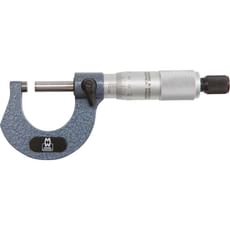
Moore and Wright has earned its position as one of Britain's most trusted names in precision measuring instruments, with a heritage spanning over a century. The Moore and Wright micrometers collection represents the pinnacle of British engineering excellence, combining traditional craftsmanship with modern manufacturing techniques to deliver measurement tools that engineers, machinists, and quality control professionals rely upon daily. Each micrometer in the range is manufactured to exacting standards, ensuring accuracy, durability, and long-term reliability in workshop environments.
Tooled-Up.com stocks a comprehensive selection of Moore and Wright micrometers designed to meet the demanding requirements of precision engineering. From external micrometers for measuring outside dimensions to internal micrometers for bore measurement, depth micrometers for recess measurements, and specialised thread micrometers, the range covers every measurement application. Whether you're working in a metrology laboratory, on the shop floor, or in field service, Moore and Wright provides the precision tools essential for maintaining tight tolerances and quality standards.
The Moore and Wright micrometer range includes both mechanical and digital models, offering measurement capabilities from 0-25mm up to 500mm and beyond. Every instrument is supplied with calibration certification traceable to national standards, providing the documented accuracy required for ISO-compliant quality systems. The robust construction and protective storage cases ensure these precision instruments remain accurate and protected throughout their working life.
Why Choose Moore and Wright Micrometers?
Moore and Wright's reputation for precision measurement instruments is built on over 100 years of British manufacturing excellence. The brand's commitment to accuracy is reflected in every micrometer produced, with instruments manufactured to Grade 0 or Grade 1 accuracy standards depending on the model. This level of precision ensures measurements are reliable and repeatable, critical for maintaining component quality in engineering and manufacturing environments.
The build quality of Moore and Wright micrometers sets them apart from budget alternatives. Frames are typically manufactured from heat-treated steel or cast iron, providing the rigidity essential for accurate measurement whilst resisting warping and distortion. Measuring faces are precision ground and lapped, often carbide-tipped on frequently used sizes to resist wear. The spindle threads are precision manufactured to minimise backlash and ensure smooth, consistent movement throughout the measurement range.
Moore and Wright micrometers feature ratchet stops or friction thimbles that ensure consistent measuring pressure, eliminating operator variation and improving measurement repeatability. The clear, easy-to-read graduations are engraved rather than printed, ensuring they remain legible throughout the instrument's life. Digital models incorporate advanced electronics with large LCD displays, data output capabilities, and automatic shut-off features to preserve battery life.
Who Uses Moore and Wright Micrometers?
Moore and Wright micrometers are the preferred choice for professionals across numerous precision engineering disciplines:
- Precision Engineers - for dimensional verification of machined components
- CNC Machinists - checking workpiece dimensions during machining operations
- Tool and Die Makers - measuring tooling components to sub-micron tolerances
- Quality Control Inspectors - verifying component conformance to specifications
- Metrology Technicians - calibration laboratories requiring traceable standards
- Automotive Engineers - measuring engine components and transmission parts
- Aerospace Inspectors - critical dimension verification on aircraft components
- Tool Room Supervisors - maintaining precision tooling standards
- Apprentices and Students - learning fundamental measurement techniques
- Maintenance Engineers - measuring wear on critical machinery components
Key Features of Moore and Wright Micrometers
Moore and Wright micrometers incorporate numerous features that enhance accuracy, durability, and ease of use. The spindle lock allows measurements to be locked in place for transfer or reading in difficult positions. Insulated frames on many models prevent heat transfer from hands affecting measurement accuracy, crucial when working to tolerances of a few microns. The ratchet stop mechanism ensures consistent measuring pressure, eliminating the risk of over-tightening and workpiece distortion.
Digital micrometers feature absolute or incremental measurement modes, inch/metric conversion at the touch of a button, and data output ports compatible with statistical process control systems. Many models include IP54 or IP65 protection ratings, making them suitable for use in workshop environments where coolant and swarf are present. The hardened and ground measuring faces, often with tungsten carbide tips, provide exceptional wear resistance even with frequent use on abrasive materials.
Each micrometer is supplied with calibration certification and protective storage case, ensuring accuracy is maintained between uses. The clear, contrasting graduations on mechanical models are designed for easy reading in workshop lighting conditions, whilst digital displays are backlit for visibility in poor light. Zero adjustment is straightforward, allowing quick recalibration when required.
Popular Moore and Wright Micrometers
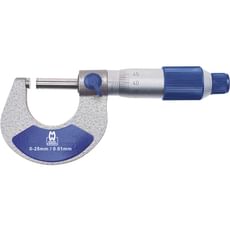
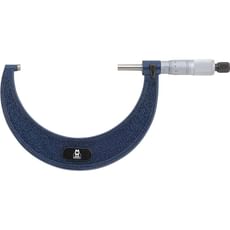
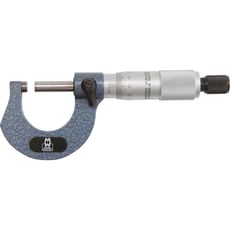
The Moore and Wright external micrometer range represents the most commonly used precision measuring instrument in engineering. Available in sizes from 0-25mm through to 500-525mm, these instruments cover virtually all outside dimension measurement requirements. The 0-25mm model is the workshop staple, whilst larger sizes are available individually or in sets for comprehensive measurement capability.
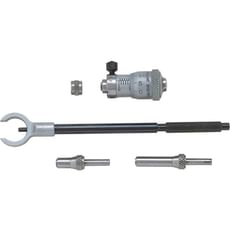
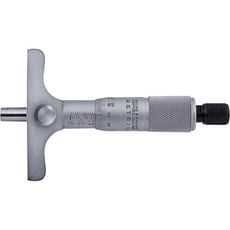
Internal micrometers from Moore and Wright provide accurate bore measurement where callipers lack precision. These instruments use interchangeable extension rods to cover measurement ranges from 50mm to 1000mm, making them ideal for measuring cylinder bores, bearing housings, and machined holes. Depth micrometers measure recess depths, step heights, and groove depths with exceptional accuracy, featuring interchangeable measuring rods for different depth ranges.
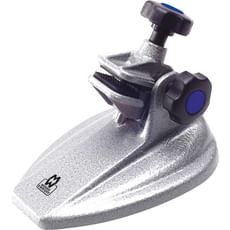
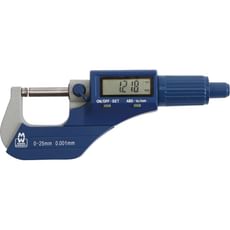
Digital micrometers have become increasingly popular for their ease of reading and data recording capabilities. Available from Tooled-Up in the same size ranges as mechanical models, digital versions eliminate reading errors and provide instant inch/metric conversion. Bench micrometers offer the ultimate in measurement precision for component inspection, whilst specialist thread micrometers verify thread dimensions with dedicated anvil and spindle profiles.
Safety and Compliance
Whilst micrometers are not inherently hazardous tools, proper handling and storage are essential to maintain accuracy and prevent injury. Always ensure measuring faces are clean and free from swarf or debris before use, as foreign matter can cause measurement errors or scratch precision surfaces. Store micrometers in their protective cases when not in use to prevent damage to measuring faces and maintain calibration.
Moore and Wright micrometers supplied through Tooled-Up include calibration certification traceable to UKAS or equivalent national standards, satisfying ISO 9001 quality system requirements. Regular calibration verification is recommended, typically annually or more frequently for instruments used in critical applications. Handle micrometers carefully - they are precision instruments and can be damaged by dropping or knocking against hard surfaces.
When measuring, avoid over-tightening the spindle as this can distort the workpiece or damage the micrometer. Use the ratchet stop or friction thimble to ensure consistent measuring pressure. Allow instruments and workpieces to stabilise to ambient temperature before measurement, as thermal expansion can significantly affect readings at tolerances below 0.01mm. Follow HSE guidance on manual handling when working with larger micrometers, particularly models above 300mm which can be substantial instruments.
Frequently Asked Questions
What accuracy can I expect from Moore and Wright micrometers?
Moore and Wright micrometers typically conform to Grade 0 or Grade 1 accuracy standards as defined by BS EN ISO 3611. For a 0-25mm external micrometer, this typically means accuracy within ±2 microns (0.002mm). Digital models offer resolution to 0.001mm (1 micron). Each instrument is supplied with calibration certification documenting its actual measured accuracy, providing traceability to national standards.
How often should Moore and Wright micrometers be calibrated?
Calibration frequency depends on usage intensity and accuracy requirements. For quality-critical applications, annual calibration is standard practice. Instruments used frequently or in production environments may require calibration every six months or quarterly. Many workshops also perform daily verification checks using gauge blocks or setting standards to ensure continued accuracy between formal calibrations.
What's the difference between mechanical and digital Moore and Wright micrometers?
Mechanical micrometers use vernier scales that require reading and interpolation, whilst digital models display measurements directly on an LCD screen, eliminating reading errors. Digital versions offer instant metric/imperial conversion, data output for statistical process control, and preset capabilities. Mechanical micrometers require no batteries and are often preferred for their simplicity and reliability, whilst digital models excel in production environments requiring data recording.
Can Moore and Wright micrometers measure in both metric and imperial?
Digital Moore and Wright micrometers feature instant conversion between metric and imperial units at the press of a button. Mechanical micrometers are manufactured with either metric or imperial graduations - you need to specify which system when purchasing. The majority of engineering in the UK uses metric measurement, so metric micrometers are most commonly stocked at Tooled-Up.
How do I maintain my Moore and Wright micrometer?
Clean measuring faces after each use with a lint-free cloth, removing any swarf, coolant, or debris. Apply a thin film of corrosion-preventive oil to exposed metal surfaces if storing for extended periods. Store in the protective case provided, ensuring the spindle is backed off slightly to avoid spring compression. Never force the spindle or over-tighten on workpieces. Check zero setting regularly and adjust if necessary following the manufacturer's instructions. Avoid exposing micrometers to temperature extremes or leaving them on machinery where vibration may affect calibration.