
Expert By Facom Precision Measuring


Loading...
End of content
Error - No more pages to load
Expert By Facom Precision Measuring at Tooled-Up.com
Expert By Facom Precision Measuring covers the hand instruments used when a tape measure is not accurate enough. The selection centres on two product types: Vernier Callipers for precise dimensional checks and Feeler Gauges & Strips for measuring small gaps and clearances. Both suit workshop, garage and maintenance work where fractions of a millimetre matter.
Tooled-Up.com stocks Expert By Facom Precision Measuring for tradespeople and serious DIYers who need dependable tools for setting up, checking and diagnosing. Each type does a distinct job. Callipers tell you how big something is, while feeler gauges tell you how much space sits between two surfaces.
Together they cover most of the everyday checking in a mechanical toolkit, from confirming a shaft diameter to setting an engine tolerance.
Key Features of Expert By Facom Precision Measuring
Vernier Callipers
- Multiple measurement types: A single calliper can take external, internal and depth readings, so one tool replaces several. Check the product listing for the exact measuring range.
- Fine graduated scale: The vernier scale lets you read well below a millimetre, which suits fitting, machining and component-matching jobs.
- Locking screw: Locking the jaws holds a reading in place, so you can lift the tool away from a tight spot and read it in good light.
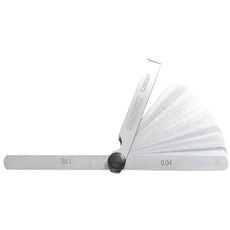
Feeler Gauges & Strips
- Graduated thicknesses: Individual blades or strips are marked by thickness, so you can build up to the exact gap you need to check.
- Slim, flexible blades: Thin leaves slide into narrow gaps, and they can be combined for larger clearances.
- Compact and portable: Gauges fold or store neatly, so they fit in a toolbox drawer or overall pocket.
Who Uses Expert By Facom Precision Measuring?
- Vehicle technicians and mechanics: Feeler gauges for valve clearances, spark plug gaps and ignition checks.
- Engineers and machinists: Vernier callipers for checking turned, milled or fabricated parts against drawings.
- Maintenance fitters: Measuring wear, checking clearances and confirming replacement parts match.
- Motorcycle and small-engine specialists: Setting tappet and component gaps accurately.
- Fabricators and metalworkers: Verifying material thickness, hole sizes and step depths.
- Home mechanics and model makers: Detailed work where accuracy decides whether parts fit.
Popular Expert By Facom Precision Measuring
Vernier Callipers
Vernier callipers are the all-rounder in this category. Use the jaws for outside diameters, the smaller upper jaws for internal bores and slots, and the depth rod for recesses and steps. They need no battery, so they are ready whenever you pick them up. Browse the Expert By Facom selection at Tooled-Up.com for the measuring range that suits your work.
Feeler Gauges & Strips
Feeler gauges and strips are the standard way to check a small clearance. Slide a blade between two surfaces, and when it passes with light resistance, that blade's thickness is the gap. They are widely used on engines, but they also help with checking machine alignment, bearing clearances and fit-up gaps in assemblies.
Frequently Asked Questions
How do I choose the right feeler gauge?
Check that the blade thicknesses cover the clearances you work with, such as the valve gap in your engine's specification. A set with fine graduations gives you more flexibility than a handful of fixed sizes.
What can I measure with Expert By Facom vernier callipers?
They measure external dimensions, internal dimensions and depths. This makes them useful for shaft and bar diameters, bore sizes, slot widths and the depth of steps or blind holes.
How do I get an accurate reading from a vernier calliper?
Close the jaws and check they read zero, then clean both measuring faces. Apply light, even pressure, lock the jaws if needed, and read the main scale followed by the vernier line that aligns exactly.
How should I look after precision measuring tools?
Wipe them clean after use, keep them dry and store them where heavier tools cannot knock or bend them. Treat feeler blades gently, as bent or rusty leaves will give false readings.