
DeWalt Engineering Tools

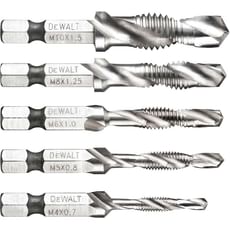
Loading...
End of content
Error - No more pages to load
DeWalt Engineering Tools at Tooled-Up.com
DeWalt Engineering Tools at Tooled-Up.com centre on taps and dies, the threading tools used to cut and restore screw threads in metal. Taps cut internal threads in drilled holes. Dies cut external threads on rod, bolt blanks and studs. Together they let you make fasteners fit, repair damaged threads and produce bespoke threaded components in the workshop or on site.
The DeWalt selection suits anyone who needs clean, accurate threads without sending work out. Typical jobs include re-cutting a damaged bolt thread on a piece of plant, tapping a bracket or plate for a machine screw, and threading a length of bar stock for a custom fixing.
Browse the full range of DeWalt taps and dies below to compare thread sizes and pitches, and choose the tools that match the fasteners you work with.
Key Features of DeWalt Engineering Tools
Threading tools are only as good as their accuracy and cutting edge. When comparing DeWalt taps and dies, these are the points that matter on the job:
- Thread size and pitch: Taps and dies must match the fastener exactly. Check the metric or imperial designation and pitch on each listing so threads mate cleanly and hold securely.
- Cutting material and hardness: Hardened cutting edges keep their sharpness through repeated use. Check the product specification to see which metals each tool is suited to, such as mild steel, aluminium or brass.
- Tap and die type: Taps and dies come in different forms for starting a thread, cutting it and finishing it. Choosing the right form gives a cleaner thread with less effort.
- Holders and wrenches: Taps need a tap wrench and dies need a die stock. Check whether the one you are buying includes these or needs them as accessories.
- Storage and organisation: Sets supplied in a case keep sizes together and protect the cutting edges between jobs.
Who Uses DeWalt Engineering Tools?
DeWalt taps and dies suit a wide range of trades and applications:
- Maintenance engineers: Repairing damaged threads on machinery and equipment to avoid replacing whole components.
- Fabricators and welders: Tapping plates, brackets and frames, and threading bar for bespoke fixings.
- Motor mechanics: Cleaning up or re-cutting threads on vehicle components, mounting points and fixings.
- Machinists and toolmakers: Producing threaded holes and studs in jigs, fixtures and prototype parts.
- Serious DIYers and home workshop users: Restoring stripped threads on projects, restorations and repairs.
Popular DeWalt Engineering Tools
The Tooled-Up DeWalt engineering selection is organised around the Taps & Dies category. Within it you will find:
- Taps: For cutting internal threads in drilled holes, from fresh tapping work to chasing out existing threads.
- Dies: For cutting or cleaning external threads on bolts, studs and round bar.
- Tap and die sets: Grouped sizes that cover a spread of common thread requirements, useful for general workshop and maintenance kits.
Choose individual taps and dies when you work with one or two specific thread sizes regularly, or a set when your work varies from job to job.
Frequently Asked Questions
What is the difference between a tap and a die?
A tap cuts a thread inside a hole, for example so a bolt can screw into a plate. A die cuts a thread on the outside of a rod or bolt. Many jobs need both, so a combined set is often the most practical choice.
How do I choose the right size tap or die?
Match the thread designation and pitch to the fastener you are using, such as an M8 bolt with its standard pitch. For tapping, drill the correct pilot hole size first. Check the product specification and a tapping drill chart before starting.
Do I need cutting fluid when threading?
Yes, in most cases. Cutting or tapping fluid reduces friction and heat, helps clear swarf and gives a cleaner thread. It also protects the cutting edges, especially in tougher metals like steel.
Can I use taps and dies on different metals?
That depends on the tool's material and specification. Always check the listing for the metals it is intended for, and use plenty of lubricant and a slow, steady action. Back the tool off regularly to break the swarf and avoid snapping the tap.